TL;DR
Security teams waste time chasing low-value alerts while real threats slip by. Automated security investigations powered by AI can handle up to 70% of repetitive triage, enrichment, and correlation tasks—cutting false positives, reducing response time, and freeing analysts to focus on real risks. With smarter triage, risk-based prioritization, and seamless cross-tool integration, automation turns chaos into clarity. It’s not about replacing analysts; it’s about giving them speed, accuracy, and space to make better decisions where it matters most.
Introduction
Security teams today are drowning in alerts. The average Security Operations Center (SOC) receives 1,000+ alerts per day, according to recent reports from Cisco and IBM. But here’s the catch: over 70% of these alerts are repetitive, low-risk, or false positives and still consume valuable analyst time. The result? Slower response times, analyst burnout, and a growing pile of unresolved cases.
This isn’t just inefficient. It’s dangerous.
The traditional approach of manually investigating every incoming alert no longer works in today’s high-speed threat at environment. That’s where automated security investigations come in. By using AI and automation to handle the bulk of routine triage, enrichment, and correlation tasks, security teams can shift from reactive firefighting to strategic threat response, without hiring dozens of new analysts.
In this blog, we’ll break down what automated security investigations actually mean, why 70% of your investigation workload can and should be automated, and how modern platforms like Secure.com are making that a reality for lean security teams.
Is it Really Possible to Automate 70% of Security Investigations?
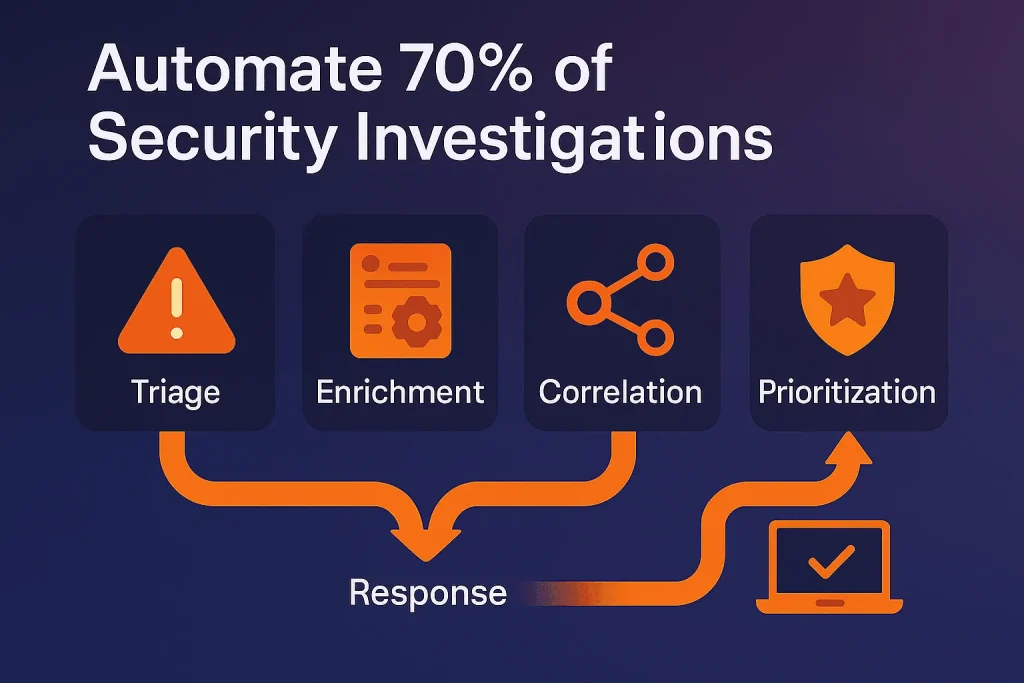
Automated security investigations are defined as AI-powered workflows that can detect, triage, enrich, and respond to security alerts, without a human having to manually do each step of the process. These systems follow an automation framework that handles repetitive triage, context gathering, and correlation across tools in seconds.
Here’s what that typically includes:
- Triage: Use threat intelligence, behavior patterns, and past data to quickly tell if an alert is real or a false alarm.
- Enrichment: Pull details from tools like EDRs, firewalls, cloud platforms, and identity systems to build a complete view of the incident.
- Correlation: Combine related alerts so your SOAR doesn’t flood your dashboard with duplicates.
- Prioritization: Rank threats by risk, impact, and asset value.
- Prioritization: Rank incidents by risk, business impact, and asset sensitivity so the most critical issues get attention first.
- Response: Take action automatically, whether that’s isolating a device, disabling an account, or escalating to an analyst when human-in-loop judgment is required.
Automated security investigations don’t eliminate human oversight; they amplify it. Consider them an intelligent co-pilot, hastening the low-level tasks so that security teams can devote time to the value-remediating high-risk threats.
Modern solutions certainly leverage automation and decision-making with artificial intelligence; combined, they will ensure alerts are not only disabled faster, but they are remediated smarter.
How Much Time Can My SOC Team Save by Automating Alert Triage?
In theory, every alert deserves attention. In practice, most teams simply don’t have the time, people, or budget to investigate everything thoroughly. And as attack surfaces grow—with cloud, SaaS, and remote endpoints, this challenge only gets worse.
Manual investigations are slow, repetitive, and prone to errors. Each time an alert comes in, an analyst has to:
- Log in to multiple systems
- Pull context from EDR, firewall, identity, and cloud logs
- Check threat intelligence feeds
- Manually correlate signals
- Write a report or escalate the incident
Now multiply that by hundreds or thousands of alerts per day. Even with a dedicated SOC, it’s impossible to keep up, especially for mid-sized organizations with lean teams.
The consequences are serious:
- Increased MTTR (mean time to respond)
- Burned-out analysts
- Missed or delayed response to real threats
- Over-reliance on gut feeling instead of data
Worse, teams often develop workarounds, such as auto-closing alerts or only investigating “high severity” ones, just to survive. That’s not security. That’s survival mode.
This is why automation isn’t a nice-to-have. It’s essential. Automating repetitive investigation tasks allows teams to scale security operations without scaling headcount.
Platforms like Secure.com are built for this exact purpose to take the weight of routine investigations off your team, so they can focus on what matters most: stopping real threats before damage is done.
What Risks Exist When Automating Too Many Investigations?
Not all alerts are created equal, and that’s the opportunity.
Research from CrowdStrike and IBM shows that up to 70% of security alerts are low-value or false positives. Secure.com is designed specifically to address this challenge.
These include:
- Identified used or known bad IP addresses or domains
- Known bad IP addresses or domains
- Repeated login failures from the same source
- Malware detections already classified by threat intelligence
- Cloud misconfigurations flagged by CSPM tools
- Endpoint anomalies already mapped in AI SecOps
These alerts don’t need a human to engage in deep analysis every time; they need consistency, speed, and contextual relevance. That’s where automation comes in.
By automating:
- Triage of false positives
- Enrichment with threat intel and asset context
- Correlation of related alerts across tools
- Initial response actions, like disabling users, isolating hosts, or creating tickets
You can eliminate the manual drain of repetitive investigations and reduce alert volume by over 50–70%.
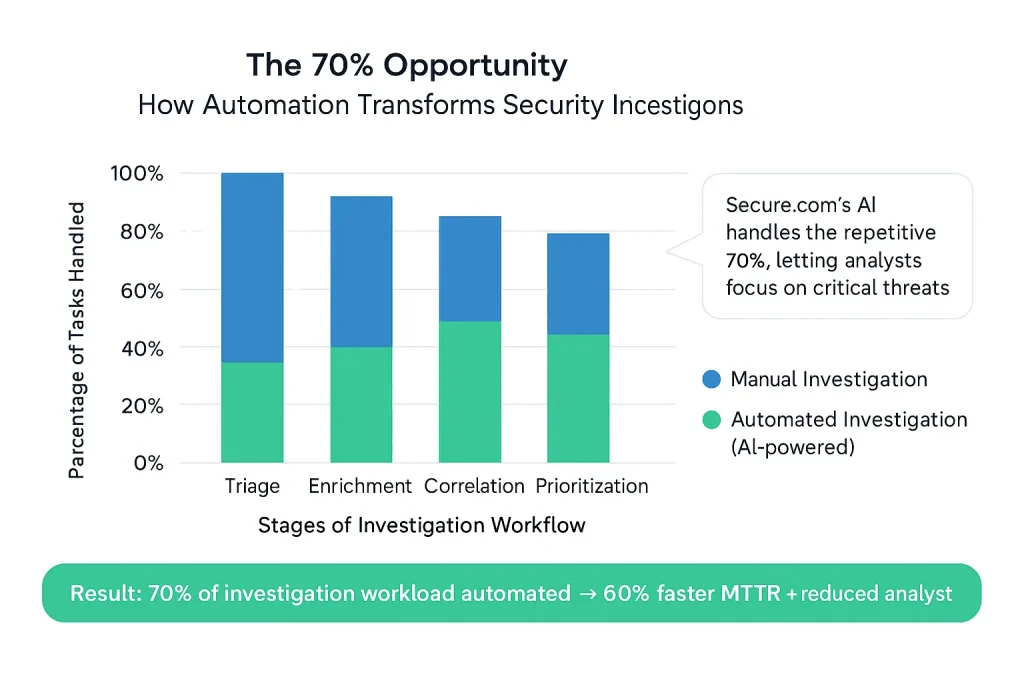
This isn’t about replacing analysts. It’s about removing the noise so your team can focus on high-risk, business-critical incidents — the 30% that actually need human judgment.
How to Decide Which Alerts to Automate VS Keep Human-in-Loop
It’s not just time savings when you automate security investigations. It’s a competitive advantage. When 70% of your workload is automated, your entire business benefits.
Here’s what organizations gain:
Dramatically Lower MTTR
By automating triage, enrichment, and response, teams can cut mean time to respond (MTTR) by up to 60%. Faster resolution means fewer breaches, less damage, and more uptime.
Reduced Analyst Burnout
Alert fatigue in cybersecurity is a real and expensive issue. Automating repetitive work frees up your analysts to focus on high-priority threats, threat hunting, and strategic defense planning. Result? Better morale, lower churn, and higher productivity.
Operational Cost Savings
By reducing manual steps per alert, your team can handle more threats without burnout, freeing up headcount for strategic initiatives instead of reactive firefighting, all without stretching your security budget. Leaner teams can now handle more volume without sacrificing quality.
Improved Security Posture
When you’re not drowning in alerts, you can actually investigate, understand, and act on what matters. Automated security investigations create space for proactive defense, not just reactive response.
Better Reporting and Audit Readiness
Automation also means structured, consistent investigation records. That leads to easier compliance reporting, faster audits, and better visibility for leadership.
What Tools and Frameworks Can Handle Automated Investigations?
Automation doesn’t have to be an elaborate redesign. By selecting a suitable strategy and using the best platforms, teams can start small and scale quickly.
1. Look at Where the Noise is Coming From
Every team has that one tool (or five) that is always spamming the inbox with alerts. Your SIEMs, EDRs, firewalls, and cloud tools: take inventory of the tools with the most alerts and which ones utilize time across your team.
2. Spot the Repeats
Not every alert needs deep investigation. Some show up over and over again, known bad IPs, repeated login failures, and obvious malware flags. These are the ones you can confidently start to automate. That said, automating responses to even common alerts often requires following established SOC playbooks, workflows, and approvals to avoid operational risk.
3. Write Down What You Already Do
You’re probably already following a playbook, whether it’s written or not. Map out the usual steps: check this log, pull the relevant IP, and escalate if needed. Once it’s on paper, it’s easier to automate.
4. Find a Platform That Fits (Not Fights) Your Stack
Pick a platform that doesn’t ask you to change everything. Look for something that plugs into your existing tools and makes life easier, not more complex. This is where Secure.com shines—simple integrations, smart automation, and no steep learning curve.
5. Start in “Watch Mode”
You don’t have to flip the switch overnight. Run your new workflows in parallel. Let automation handle the work in the background while your team keeps a close eye on things. You’ll build trust fast.
6. Scale What Works
Once you see it working, faster investigations, fewer manual tasks, and less stress, you can scale it. Add new alert types. Build more workflows. Even automate parts of your response, such as isolating endpoints or initiating case creation.
Can Automation Improve Response Times and Reduce False Positives?
Most security platforms drown you in alerts. Secure.com is built to do the opposite. We take the repetitive, time-consuming 70% of investigations off your team’s plate so that you can focus on real threats, not noise.
Here’s how:
Smarter Triage
Secure.com doesn’t just take in alerts; it makes sense of them. With AI-powered analysis, it filters out false positives, connects related activity, and highlights the incidents that actually need attention. So instead of drowning in noise, your team gets a clear, focused signal. And while automation handles the repetitive work, it works best with human oversight, making sure responses stay smart, safe, and aligned with your goals.
Automated Enrichment and Cross-Tool Correlation
With deep integrations across your EDR, SIEM, identity tools, cloud infrastructure, and more, Secure.com to enrich each alert automatically. It connects the dots across your environment and turns fragmented events into complete, ready-to-act investigation cases.
Risk-Based Prioritization
Severity isn’t enough. Secure.com scores and ranks alerts based on asset value, user sensitivity, and real-world risk to your organization. That means high-impact threats rise to the top—without your analysts having to dig.
Drag-and-Drop Workflows
Secure.com helps your team streamline triage and response with intuitive, drag-and-drop workflows. From containing suspicious activity to notifying key stakeholders, you can automate common steps quickly, while still following the necessary approvals, controls, and policies that your organization requires. It’s flexibility without the bottleneck.
Clean, Transparent Case Management
Every investigation—automated or manual—is tracked in a unified case timeline. That means full auditability, built-in reporting, and zero guesswork when leadership asks, “What happened?”
FAQS
How can automation reduce alert fatigue in SOC teams?
What are best practices for balancing automation and oversight?
What metrics measure the success of automation in SOCs?
What’s the ROI of automating investigations for a mid-sized company?
How can machine learning enhance automated investigations?
How to Start Implementing Security Automation Safely
The volume of alerts security teams face today isn’t going to slow down. If anything, it will only grow as your infrastructure expands and threat actors get more sophisticated.
But you don’t have to keep playing defense on every alert.
Secure.com not only accelerates investigations but also ensures audit readiness and compliance through structured case management and traceable AI oversight. You can automate 70% of your security investigations, reduce alert fatigue, and finally give your analysts the time and space to focus on real threats.
This isn’t about doing more with less. It’s about doing the right things automatically so your team can move faster, stay sharp, and drive results that actually matter.
Ready to manage alerts? Book a personalized demo today and start automating what’s holding your security team back.