TL;DR
Digital Security Teammates create a measurable force multiplier: one analyst with a Digital Teammate handles the workload of three traditional analysts. The numbers are real: 3x alert capacity, 95% automated triage, 20+ hours saved per week per analyst, 30-40% MTTD reduction, and 45-55% MTTR improvement, all without adding headcount.
Introduction
3.4 million! That’s how many cybersecurity positions sit unfilled globally while your lean SOC team drowns in 200-500+ alerts per analyst daily. The numbers are stark: it takes 247 days on average to fill a single SOC analyst role, and by the time you find someone, your threat landscape has doubled.
But what if there was a multiplier effect (like the greatest NBA player of all time, Michael Jordan, elevating an entire team’s performance) that could significantly expand your SOC’s operational capacity without adding headcount, enabling a small team to handle enterprise-level alert volumes?
That’s the Jordan Effect: measurable productivity gains when security analysts work alongside AI-powered Digital Security Teammates. The name references how a force multiplier elevates an entire team’s performance—not by replacing players, but by amplifying what they can accomplish together.
Key Takeaways
- The Force Multiplier is Real: One SOC analyst + Digital Teammate = productivity of ~3 traditional analysts through 3x alert handling capacity (10-15/day → 35-40/day)
- Time Savings Are Concrete: 20+ hours saved per analyst weekly via automated investigation (30-45 min → 2 min) and escalation (20-30 min → 2 min)
- Scale Without Hiring: Avoid 2-3 additional analyst hires ($200,000 to $300,000/year) while maintaining 24/7 coverage and handling 3x alert volume
- Faster Threat Response: 30-40% MTTD reduction and 45-55% MTTR improvement through continuous monitoring and autonomous workflows
- Governed Autonomy Maintains Trust: Human-in-the-loop oversight with audit trails, explainable decisions, and reversibility ensures control while delivering speed.
What Automation Really Means in Security (And Why Most Get It Wrong)
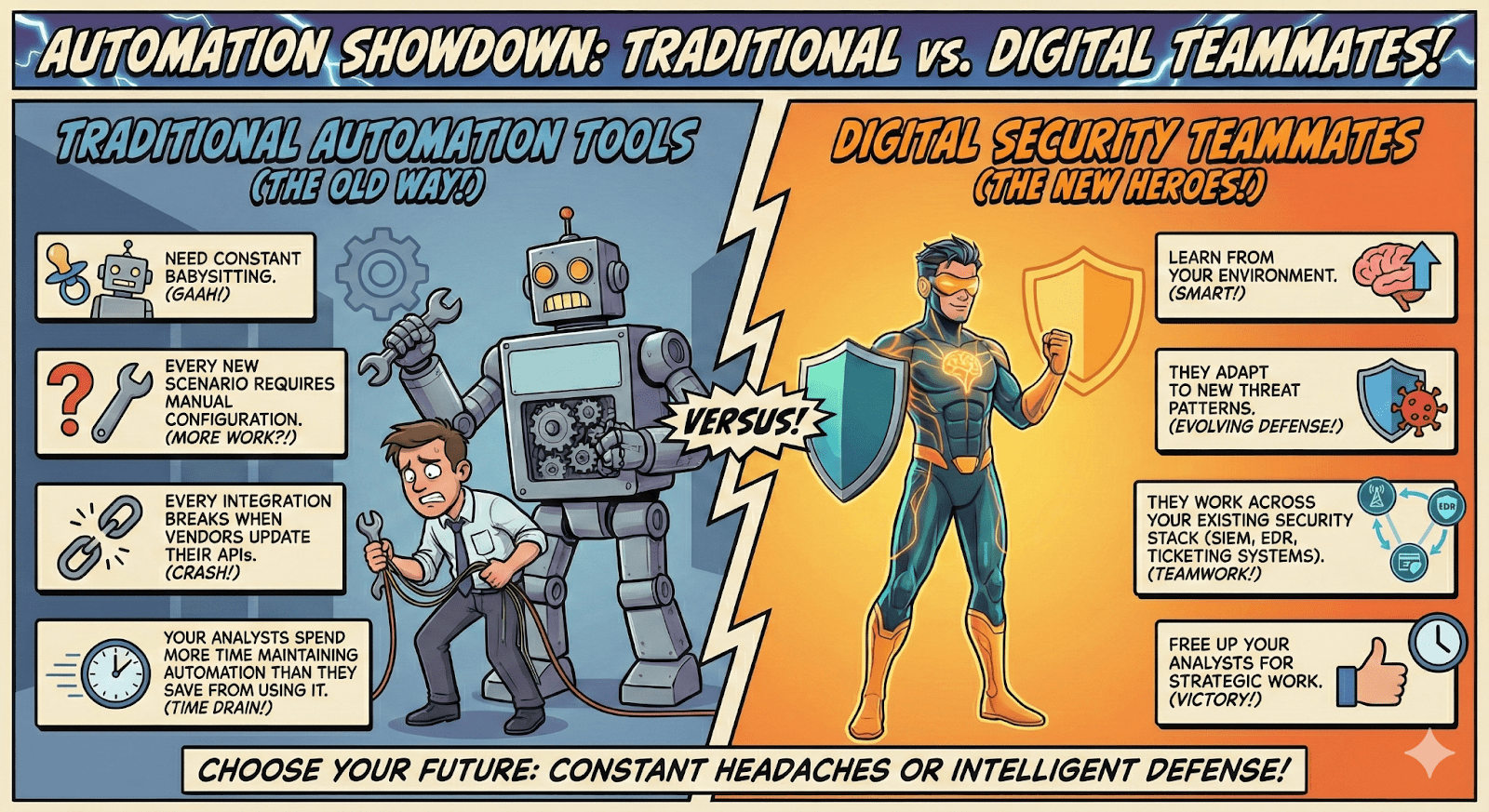
Security automation isn’t new, but most teams are still doing it wrong. Digital Security Teammates operate differently.
The Five Pillars That Make It Work
- Autonomous Workflow Orchestration: Creates and executes complex workflows independently (from data correlation to user follow-ups) with transparent activity monitoring so you always know what’s happening.
- Omnichannel Communication: Meets your team where they already work, providing updates and insights via Slack, Teams, or email in plain language, not cryptic security jargon.
- Context-Aware Intelligence: Leverages your platform’s knowledge base and real-time context to proactively surface relevant insights, eliminating the need to hunt through dashboards.
- Admin Personalization & Control: Customizes to your team’s culture with personalized names, email addresses, and behaviors that match your operational workflows.
- Unified Command Interface: Enables quick actions through simple text commands, serving as a non-intrusive channel for notifications and interactions.
The Manual Trap: Why Traditional Security Measures Can’t Scale
Every SOC analyst knows the feeling. You arrive on Monday morning to 240 new alerts. By Tuesday afternoon, you’ve triaged 80. By Wednesday, another 240 had piled up. You’re drowning, and the real threats are hiding somewhere in that backlog.
The Alert Overload Reality
- Average enterprises generate over 10,000 security alerts daily across SIEM, EDR, cloud security, and other monitoring tools.
- Lean SOC teams handle 200-500+ alerts per analyst.
- Analysts spend 25% of their time investigating and documenting false positives.
- Industry research shows that 40-55% of alerts go uninvestigated due to resource constraints, with some organizations reporting even higher rates.
The Headcount Crisis Nobody Talks About
- The global cybersecurity workforce gap sits at 3.4 million unfilled positions.
- Mid-sized companies can’t compete with enterprise salaries.
- Expect 247 days on average from job posting to the first day.
- Analyst burnout from alert fatigue drives 40-50% annual turnover in some orgs.
Manual Investigation: The Hidden Time Thief
- Traditional manual triage takes 30-45 minutes per alert.
- Escalation handoffs to senior analysts consume another 20-30 minutes as junior analysts explain their investigation steps.
- If each analyst handles 15 alerts daily at 45 minutes each, that’s 11.25 hours of investigation time, which is more than a full workday.
Why You Need Digital Security Teammates (6 Benefits That Actually Matter)
The Jordan Effect isn’t theoretical. It’s the measurable productivity multiplier that occurs when you pair human analysts with AI-powered Digital Security Teammates. Here’s what that multiplication looks like in practice.
1. Enhanced Productivity: From 15 to 40 Alerts Daily
- Digital Security Teammates automate 95% of alert triage.
- Investigation time drops from 30-45 minutes to under 2 minutes/alert.
- Escalation handoffs shrink from 20-30 minutes to 2 minutes.
- Alert handling capacity increases significantly through automated triage
2. True Business Scaling: The Force Multiplier Effect
- A lean SOC team can handle enterprise-level alert volumes.
- You get 24/7 monitoring without 24/7 staffing requirements.
- Junior analysts perform at senior levels with AI guidance.
- Senior analysts focus on strategic work instead of triage.
3. Future-Proof Data Security: Continuous Learning
- Digital Teammates don’t just follow playbooks; they learn from your environment.
- They adapt to new threat patterns.
- They improve accuracy through continuous feedback loops from analyst decisions.
- Attack path analysis and risk modeling help identify potential vulnerabilities before exploitation.
- Real-time risk scoring considers business context, not just technical severity.
- Configuration drift is detected in real-time with automated remediation workflows for approved changes.
4. Reduced Human Error: Consistency at Scale
- When you’re investigating your 200th alert of the week, details slip.
- Digital Teammates maintain a consistent investigation methodology regardless of volume or time of day.
- They don’t get tired.
- They don’t take shortcuts.
- Every alert receives the same thorough analysis with automated evidence collection for compliance and forensics.
5. Constant Risk Assessment: Zero Detection Gaps
- Suspicious activity at 2 AM gets the same immediate attention as activity at 2 PM.
- Ransomware indicators trigger containment workflows within minutes, not hours.
- Attack paths get analyzed and closed proactively.
- Vulnerability exploitation attempts are detected in real time.
- High-risk configuration changes get flagged immediately.
- You maintain a continuous security posture during off-hours.
6. Business-Specific Controls: Customization That Actually Works
- Digital Teammates adapt to your organization’s specific needs.
- Customize their persona (name, email, Slack handle) to align with your team’s culture.
- Modify behaviors to align with your operational workflows.
- Pre-approve playbooks for your specific environment.
- Set boundaries for autonomous action versus human escalation.
- Define what constitutes high-risk decisions requiring approval.
- Adjust sensitivity for different asset types or user roles.
- The AI works within your rules, not generic defaults.

ROI of Digital Security Teammates: The Numbers That Matter to Your CFO
Time Savings: 20+ Hours Per Analyst Weekly
- Alert triage automation: 95% automated analysis coverage (vs. industry baseline of 40-55%), with 70% reduction in manual triage workload.
- Investigation time: Reduced from 30-45 minutes to under 2 minutes per alert through automated enrichment and correlation.
- Escalation handoffs: Reduced from 20-30 minutes to 2 minutes through automated context packaging as context gets automatically packaged and transferred.
- Automated evidence collection and case documentation reduce manual reporting overhead.
Total: 20+ hours saved per analyst per week through automated triage, investigation, and workflow execution
Threat Response Velocity: Faster Detection and Resolution
- MTTD (Mean Time to Detect) reduced by 30-40%: Continuous 24/7 monitoring with automated correlation catches threats faster than human-only operations. Sophisticated attacks get flagged within minutes instead of hours or days.
- MTTR (Mean Time to Respond) reduced by 45-55%: Pre-approved playbooks execute containment actions immediately. Ransomware gets isolated in minutes rather than hours. Credential compromises get remediated before lateral movement occurs.
Cost Impact Analysis: The Financial Bottom Line
- Avoid 2-3 additional analyst hires: At $100,000 to $150,000 per analyst, avoiding 2-3 hires represents $200,000 to $450,000 in annual salary costs. Digital Security Teammates cost a fraction of this while delivering the same level of productivity.
- Reduce operational overhead through faster incident resolution and automated case handling.
- Compliance audit efficiency: Automated evidence collection and continuous compliance monitoring significantly reduce audit preparation time.
- Breach impact mitigation: IBM’s Cost of a Data Breach Report shows that every minute counts in limiting damage from ransomware, data exfiltration, and system compromise.
Analyst Retention: The Hidden ROI
- Eliminating burnout: Removing repetitive triage work lets analysts focus on interesting, challenging security problems.
- Enabling career development: Time freed from alert fatigue gets invested in skill development, certifications, and advanced training.
- Improving work-life balance: Analysts leave on time instead of staying late to clear alert backlogs. Weekends stay weekends instead of becoming emergency incident response sessions.
- Reducing turnover costs: Improved analyst satisfaction and reduced burnout help retain experienced team members, avoiding significant replacement and training costs.
How Secure.com Automates Security Operations (Without Replacing Your Stack)
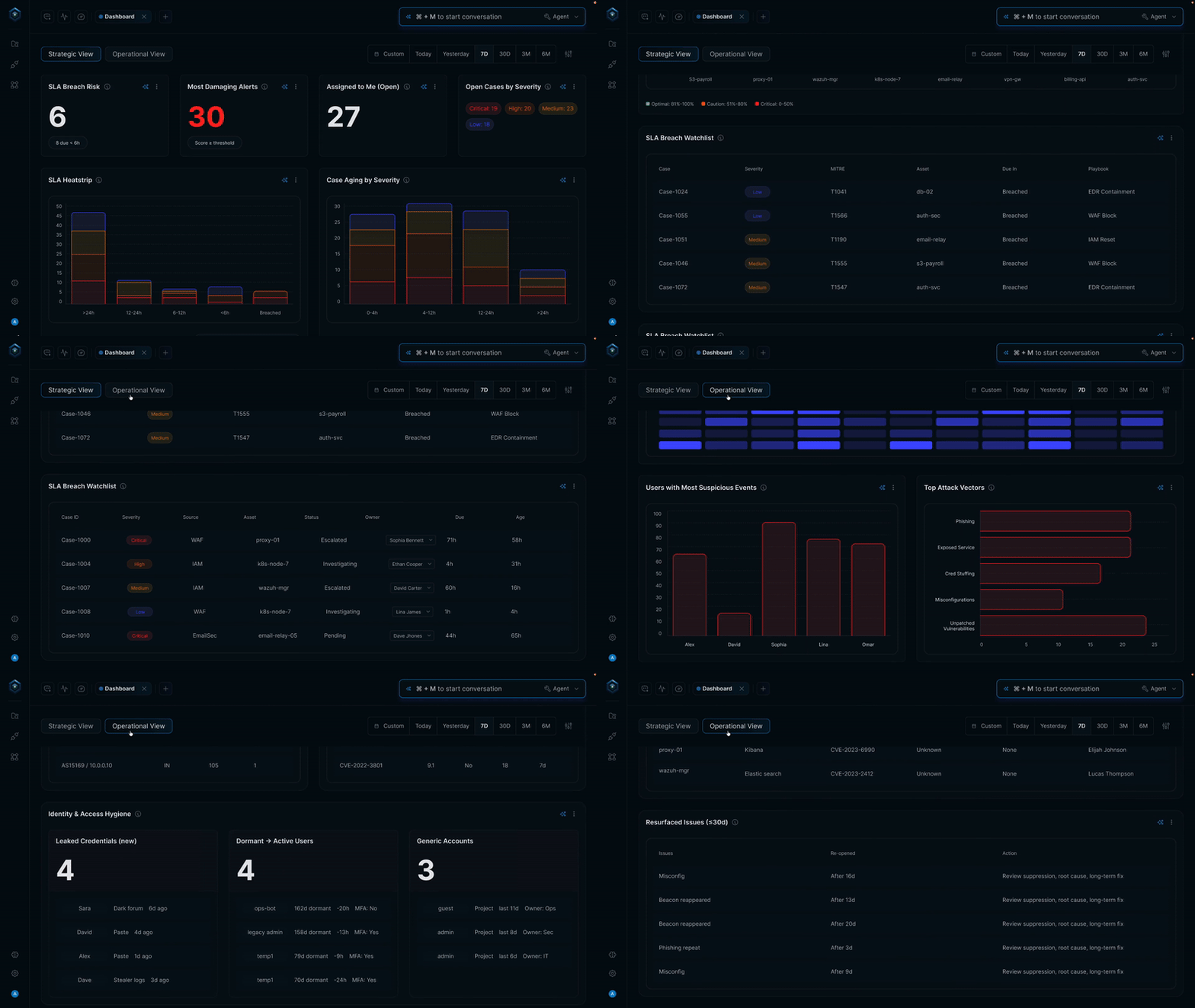
- Plug-and-Play Integration: They operate directly in Slack (with Teams support planned), posting plain-language alerts (e.g., suspicious login, country mismatch) and auto-creating tickets in your existing systems.
- Always-On Visibility: Unified risk scores combine identity, asset, and telemetry data, helping you prioritize threats by business impact rather than just severity.
- Governed Remediation: Actions are reversible and explainable, giving you safety and oversight—not fear of automation errors.
- Automated compliance workflows and continuous evidence collection significantly reduce audit preparation time.
- Unified Command & Control: Analysts can trigger complex actions with simple text commands, while the system highlights relevant insights contextually.
Deployment in Days, Not Quarters
Days 1-2
Connect to your existing security stack through standard integrations. Customize persona and behaviors to match your team culture.
Day 3-5
Start automated alert triage on low-risk, high-volume alerts. Monitor accuracy and adjust sensitivity.
Week 2-3
Expand to investigation assistance and threat enrichment. Pre-approve playbooks for common response scenarios.
Week 4+
Full autonomous operation with human oversight. Continuous learning improves accuracy over time.
FAQs
How is a Digital Security Teammate different from SOAR or traditional automation?
Will Digital Security Teammates replace our security analysts?
How quickly can we actually deploy a Digital Security Teammate?
How do we trust AI to make security decisions without human approval?
Conclusion
The Jordan Effect isn’t about replacing your security team. It’s about multiplying what they can accomplish through governed autonomy and intelligent automation.
Your analysts stop drowning in alert fatigue and start doing meaningful security work. Your security posture strengthens through continuous monitoring, proactive threat hunting, and faster incident response.
Traditional security approaches force an impossible choice: hire more analysts (if you can find them) or accept security gaps (which you can’t afford). Digital Security Teammates offers the third path: intelligent automation that scales your existing team without adding enterprise headcount, budget strain, or operational disruption.
Ready to create your own Jordan Effect?
Discover how Secure.com’s Digital Security Teammates can transform your lean SOC into enterprise-grade security operations.