72 Hours with Alex: What a Digital Security Teammate Actually Does
Follow Alex through 72 hours as Secure.com's Digital Teammate transforms Grumpy's team from reactive firefighters to proactive threat hunters, cutting MTTR by 45% and freeing 20+ hours weekly.
By Secure.com
Meet The Overwhelmed SOC.. Mr Grumpy
Grumpy who is a Level 1 SOC analyst at a mid-sized fintech company with 300 employees. He's part of a lean security team with just three analysts covering 24/7 monitoring for the entire organization.
The Daily Reality
240+ alerts flood the queue every single day
Most require manual investigation, checking IPs against threat intel, analyzing login histories, correlating events across multiple tools
The team is drowning in repetitive work while real threats slip through the cracks
Current Pain Points
Alert fatigue: Chasing 240 alerts daily when 70% turn out to be false positives
Manual grind: Spending 30-45 minutes per alert enriching IPs, checking user history, correlating host events—all by hand
Tool chaos: Jumping between SIEM, EDR, threat intel feeds, and ticketing systems with focus shattered and productivity destroyed
Time Spent
6-8 hours daily on repetitive triage and investigation
Less than 2 hours for actual threat hunting or strategic security work
Grumpy processes 10-15 alerts per day maximum—leaving 185+ alerts in the queue
"I became a security analyst to hunt threats, not to manually check the same IP addresses in VirusTotal fifty times a day." - Grumpy
Day 1 (Monday 9 AM - Tuesday 9 AM): Before Alex
Hour 0-8: Alert Queue Chaos
9:00 AM: Grumpy logs in to find 47 new alerts from the weekend.
12 suspicious login attempts from various geographic locations
23 potential malware detections that need investigation
8 configuration change alerts
4 privilege escalation warnings
Reality check: Each alert requires him to manually open multiple tools, cross-reference data, and document findings. He triages the obvious false positives first, wasting 2 hours on noise.
Hour 8-16: Stuck Investigating False Positives
11:30 AM: A suspicious login alert for [email protected] catches his attention.
The manual investigation process:
Copy IP address → Paste into VirusTotal → No hits
Check AbuseIPDB → Clean
Open SIEM → Search user's login history manually
Export data → Analyze in spreadsheet
Check geographic location against user's typical patterns
Correlate with host events in EDR tool
Document findings in ticketing system
Total time: 35 minutes.
Conclusion: False positive—user was traveling for business.
3:00 PM: Three more similar investigations. Two more false positives. Grumpy's frustration builds because he has invested four hours and found zero real threats.
Hour 16-24: Critical Alert Comes in Overnight
11:47 PM: A high-priority alert fires—unusual encryption activity detected on finance-db-01.
The problem: Grumpy left at 6 PM. The small team doesn't have 24/7 coverage. The alert sits unnoticed in the queue overnight.
7:30 AM Tuesday: The on-call analyst finally sees it—8+ hours after initial detection. By then, 1,200 files have been encrypted.
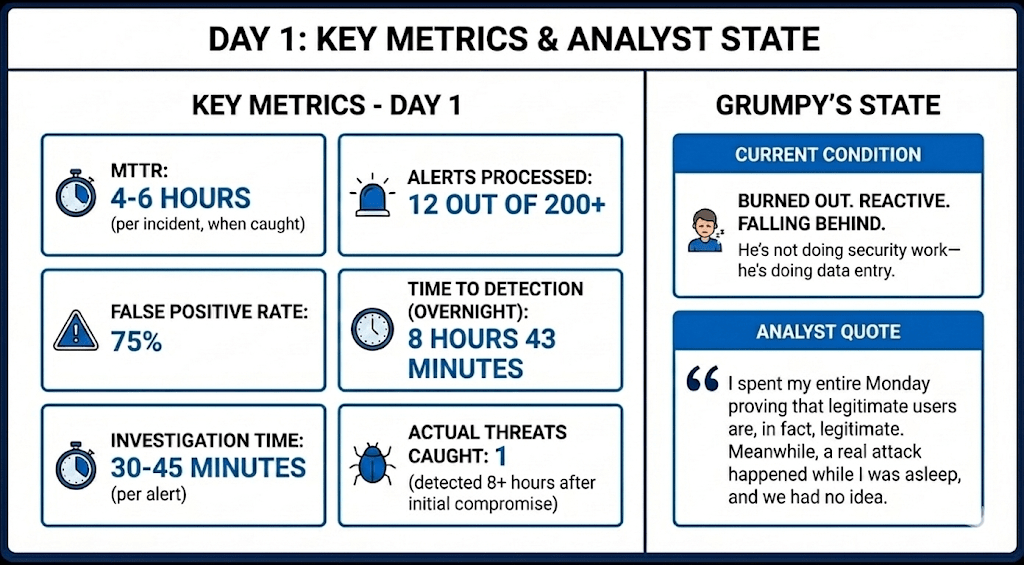
Key Metrics: Day 1
MTTR: 4-6 hours per incident (when caught)
Alerts processed: 12 out of 200+
False positive rate: 75%
Time to detection (overnight alert): 8 hours 43 minutes
Investigation time per alert: 30-45 minutes
Actual threats caught: 1 (detected 8+ hours after initial compromise)
Grumpy's State
Burned out. Reactive. Falling behind. He's not doing security work—he's doing data entry.
"I spent my entire Monday proving that legitimate users are, in fact, legitimate. Meanwhile, a real attack happened while I was asleep, and we had no idea."
Day 2 (Tuesday 9 AM - Wednesday 9 AM): Activating Alex
Hour 24-32: Alex Deployed
9:15 AM Tuesday: The security lead deploys Alex, Secure.com's Digital Security Teammate. Grumpy receives a brief orientation, which explains how the system will now handle autonomous triage and proactively notify him via Slack.
10:03 AM: First notification appears in Grumpy's Slack.
The message:
"Hi Grumpy, I've finished investigating a 'Suspicious Login' for [email protected]. Confidence in malicious activity is high. [View Investigation]"
Grumpy's reaction: Skeptical. He's seen "AI tools" before that just generate more noise. But curiosity wins—he clicks the link.
Hour 32-40: Plain-Language Analysis
10:04 AM: Grumpy lands on the alert page. A new Alex (Digital Security Teammate) panel displays clear, readable analysis:
Investigation Summary
Login from IP 185.220.101.47—flagged as malicious IP in Romania, known for credential stuffing attacks
Travel pattern violation detected: User was in San Francisco 2 hours ago (impossible travel scenario)
Cross-reference complete: IP matches STIX/TAXII threat feeds for active phishing operation"
Authentication method: Password-only (MFA not enabled)—account at high risk for compromise
What Alex did automatically
Ingested and parsed the alert
Enriched the IP address against threat intelligence feeds
Analyzed Sarah's login history for anomalies (detected impossible travel)
Correlated other events on the host (found no suspicious activity yet)
Generated complete summary in under 90 seconds
Total investigation time: Under 2 minutes (automated).
Grumpy's review time: 30 seconds.
Hour 40-48: One-Click Remediation
10:05 AM: Grumpy sees the evidence thinking this is real. He clicks "Isolate Host" in Alex’s panel.
Confirmation prompt appears:
"I have the 'isolate-host' workflow ready to run on HR-workstation-42. This will block its network access. Please confirm to proceed."
Grumpy clicks "Confirm."
What happens automatically:
Host isolated via EDR within 15 seconds
User account disabled in Azure AD
ServiceNow ticket created with full investigation details
Security team notified via Slack
Complete audit trail logged
Time from alert to remediation: 15 minutes.
Traditional manual process would have taken: 3-4 hours (if caught quickly), based on industry benchmarks for manual investigation and remediation workflows.
2:30 PM: Five more similar alerts processed the same way. Three were false positives (automatically downgraded). Two were real threats—both contained within minutes.
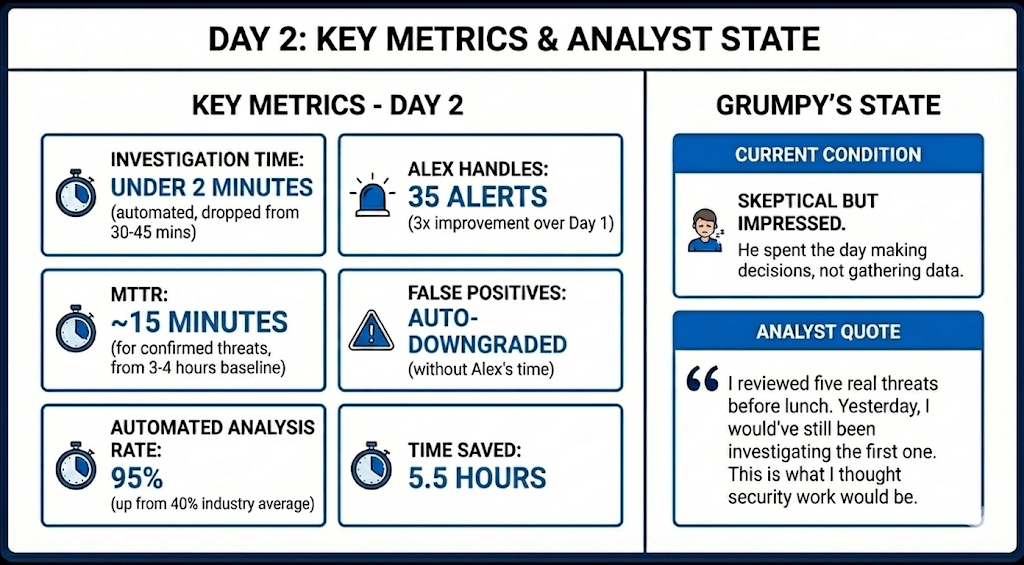
Key Metrics: Day 2
Investigation time: Dropped from 30-45 minutes to under 2 minutes (automated)
Grumpy handles: 35 alerts (3x improvement over Day 1)
MTTR: Reduced to approximately 15 minutes for confirmed threats (from 3-4 hours baseline)
False positives: Auto-downgraded without Grumpy's time
Automated analysis rate: 95% (up from 40% industry average)
Time saved: 5.5 hours
Grumpy's State
Skeptical but impressed. He spent the day making decisions, not gathering data.
"I reviewed five real threats before lunch. Yesterday, I would've still been investigating the first one. This is what I thought security work would be."
Day 3 (Wednesday 9 AM - Thursday 9 AM): The New Workflow
Hour 48-56: Proactive Ransomware Detection
11:20 AM Wednesday: Slack notification from Alex (Digital Security Teammate)
"🚨 Critical Alert: Unusual encryption activity detected on finance-db-01. I've automatically isolated the endpoint. [View Details]"
What Happened
SIEM detected ransomware signature matching known campaign IOCs
Alex cross-referenced with STIX feeds and confirmed ransomware IOC match
VERIS case record created automatically with impact metrics
All within approximately 90 seconds of initial detection (automated investigation and response execution)
Grumpy's role: Review Alex's actions > Confirm the response was appropriate > Notify the finance team about the isolated workstation.
Time spent: 10 minutes reviewing automated responses and communicating with the affected team.
Threat contained: Before encryption spread beyond the initial host.
Hour 56-64: Escalating Complex Threats
3:45 PM: Another alert—potential phishing campaign with login attempts from 15 suspicious IPs.
Grumpy's assessment: This is complex. The IPs are linked to known phishing operations, but several VPs are affected. He needs L2 input before taking aggressive action.
The escalation process:
Grumpy clicks "Escalate to L2"
Alex prompts: Adding a note for the L2 team
Grumpy types: "Suspicious IPs tied to phishing campaign. Multiple VP accounts affected. Need verification before the account is disabled."
What happens automatically:
Ticket formally reassigned to L2 analyst Maria
Comprehensive Slack notification sent to L2 channel with complete investigation summary, all correlated evidence, and Grumpy's context
Maria receives everything she needs to act immediately—no context lost
Time for handoff: 2 minutes.
Traditional manual handoff time: 20-30 minutes of Slack messages, forwarded emails, and repeated context-gathering.
Hour 64-72: Actual Security Work
5:00 PM: With Alex handling routine triage, Grumpy finally has time for what he was hired to do.
Activities:
Reviews attack path analysis showing how internet-facing servers with KEV vulnerabilities could pivot into sensitive environments
Identifies three critical exposure chains the team hadn't spotted
Triggers remediation workflows directly from the attack path visualization
Updates security runbooks based on the day's incidents
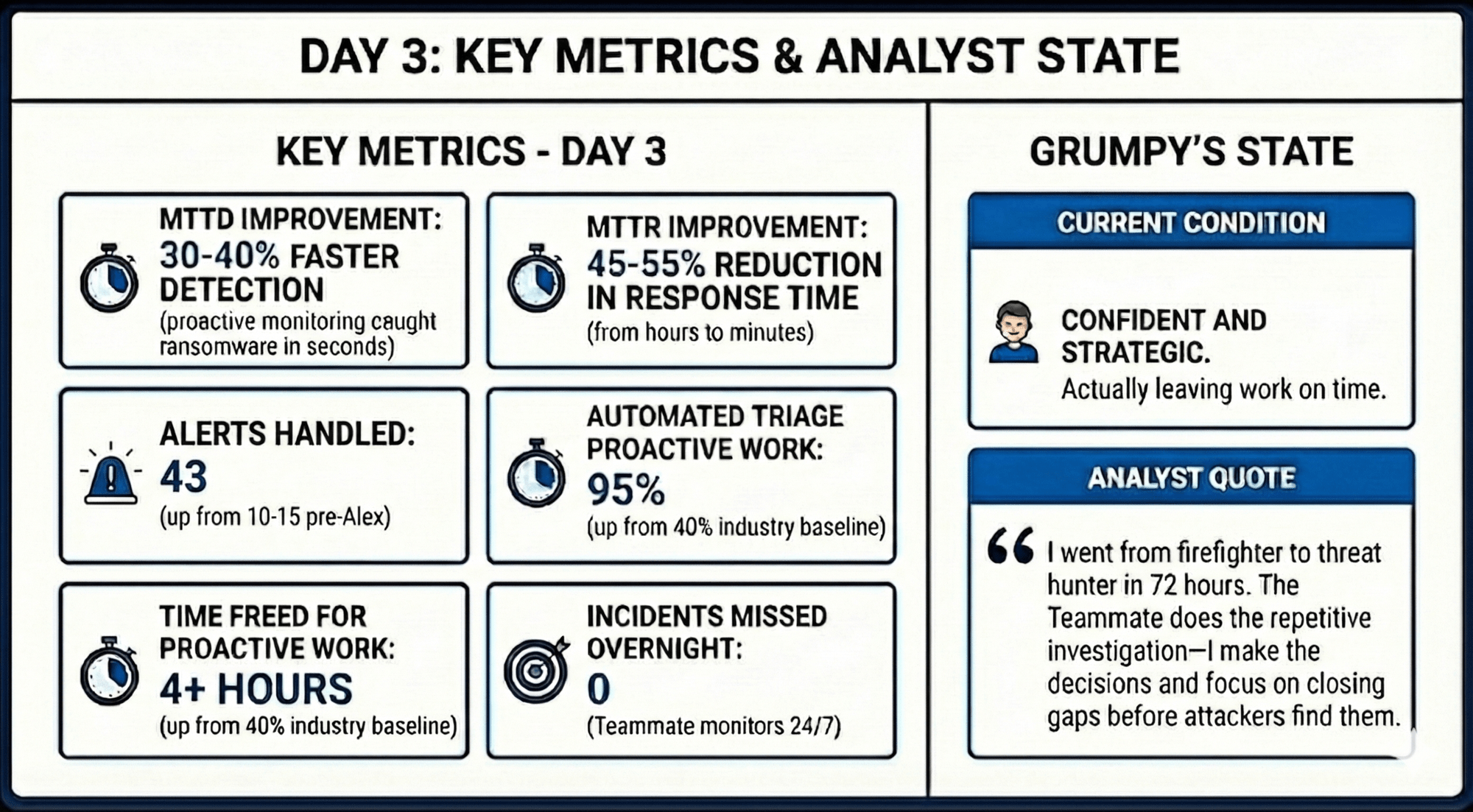
7:15 PM: Grumpy reviews the day's metrics dashboard.
Confident and strategic. Actually leaving work on time.
"I went from firefighter to threat hunter in 72 hours. Alex does the repetitive investigation—I make the decisions and focus on closing gaps before attackers find them."
The Transformation: What Changed for Grumpy
Before Alex (Digital Security Teammate)
10-15 alerts processed per day
6-8 hours on manual investigation
1-2 hours for strategic security work
After Alex (Digital Security Teammate)
35-40 alerts processed per day (3x increase from 10-15 baseline)
30 minutes reviewing automated investigations
6+ hours freed for threat hunting, attack path analysis, and proactive security improvements
Key enabler: Autonomous triage handling 95% of the investigation work automatically.
Mental Shift
Before: Reactive Firefighting
Constantly behind, drowning in alert queue
Spending entire days proving false positives are false
Missing real threats due to volume
Burned out from repetitive data gathering
After: Proactive Defense
Making decisions instead of gathering data
Time to analyze attack paths and close gaps before exploitation
Confidence that critical alerts get immediate attention 24/7
Energy for actual security work
Team Impact
The lean SOC team now performs like a larger operation
30-40% reduction in MTTD (mean time to detect)
45-55% reduction in MTTR (mean time to respond)
70% of case handling automated
20 hours per week saved per analyst
$25K annual cost reduction from faster, more reliable incident resolution
The force multiplier effect: Three analysts with Alex (Digital Security Teammate) handle the workload that would traditionally require 6-7 analysts, based on 3x productivity improvement per analyst.
Business Outcome
Faster threat response
Ransomware contained in minutes instead of hours
Credential compromise detected and remediated before lateral movement
Phishing campaigns escalated with full context to senior analysts
Mid-sized companies can't compete with enterprise salaries
Average time-to-hire for SOC analyst: 3-6 months
Overwhelming Alert Volume
Average enterprise generates 10,000+ alerts daily (with lean SOC teams handling 200-500+ alerts per analyst)
SOC analysts spend 25% of time on false positives
Alert fatigue causes real threats to be missed
The traditional solution doesn't scale: Hiring more analysts is expensive, slow, and still leaves you with manual processes that can't keep up with modern threat volume.
How Alex Solve the Headcount Challenge
Not Another Tool but a True Coworker You Can Rely On
See How Your SOC Team Can Work Like Grumpy Does Now
Grumpy's team went from overwhelmed and reactive to confident and proactive in 72 hours. Alex, the Digital Security Teammate, didn't replace anyone, but it augmented what each analyst could accomplish, multiplying their productivity by 3x.
Your Lean SOC Team Can Achieve the Same Transformation
Handle 3x more alerts with the same headcount
Reduce MTTR by 45-55% through autonomous response
Free 20+ hours per week for strategic security work
Achieve 24/7 monitoring without 24/7 staffing
Ready to see how Alex (Digital Security Teammate) transforms lean SOC teams?