SAP NetWeaver Flaws Let Strangers Sign In as Your Admin
Who should care: Any company running SAP ABAP systems, SAP Web Dispatcher, or SAML single sign-on into Fiori.
What could go wrong: An outsider with network access runs code on your ERP or signs in as your admin.
Do this: Patch Web Dispatcher, ICM, and Gateway today. SAML2 right after.
Worth remembering: None of the four are exploited yet. That clock started this morning.
SAP shipped its November fixes today, and four of them hit the maximum CVSS score of 10.0. These SAP NetWeaver vulnerabilities sit in the plumbing every SAP ABAP system runs on. None need a login, a stolen password, or a user click.
What Happened?
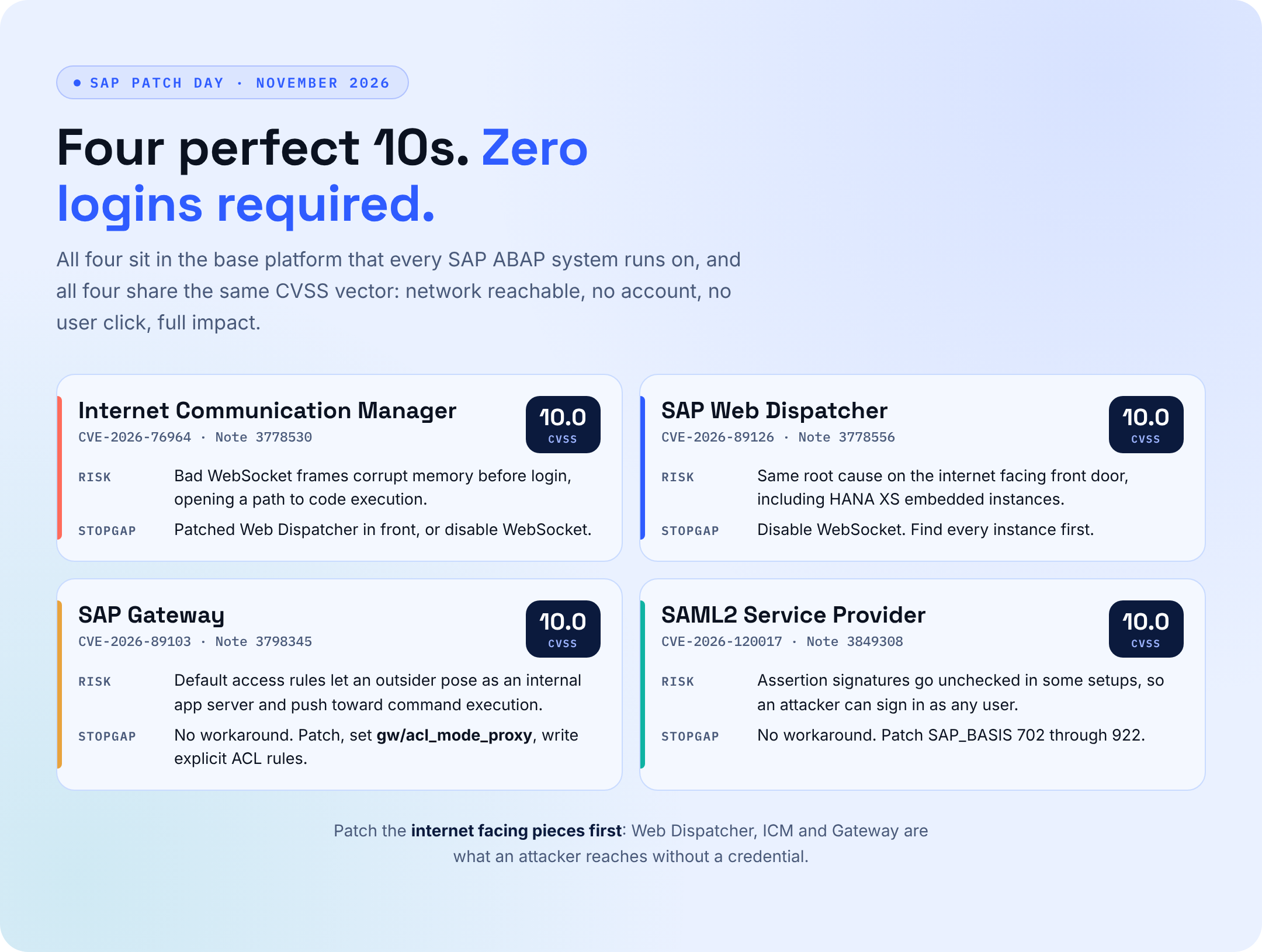
SAP’s November Security Patch Day delivered 35 new security notes, four GitHub advisories and three updated notes, according to RedRays. Nine are rated Critical. Four of the SAP NetWeaver vulnerabilities score a perfect 10.0, as The Hacker News reports:
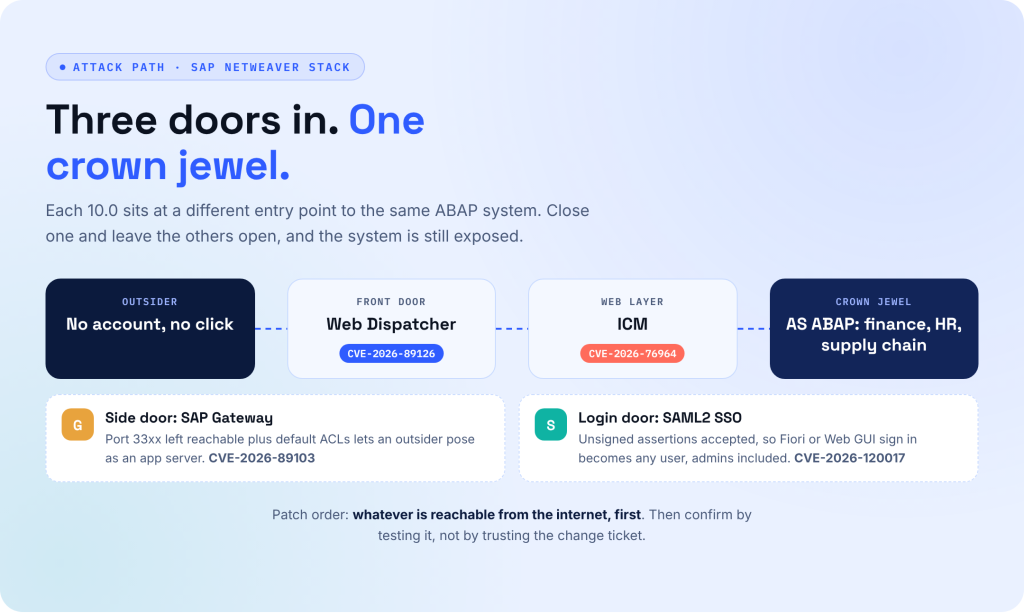
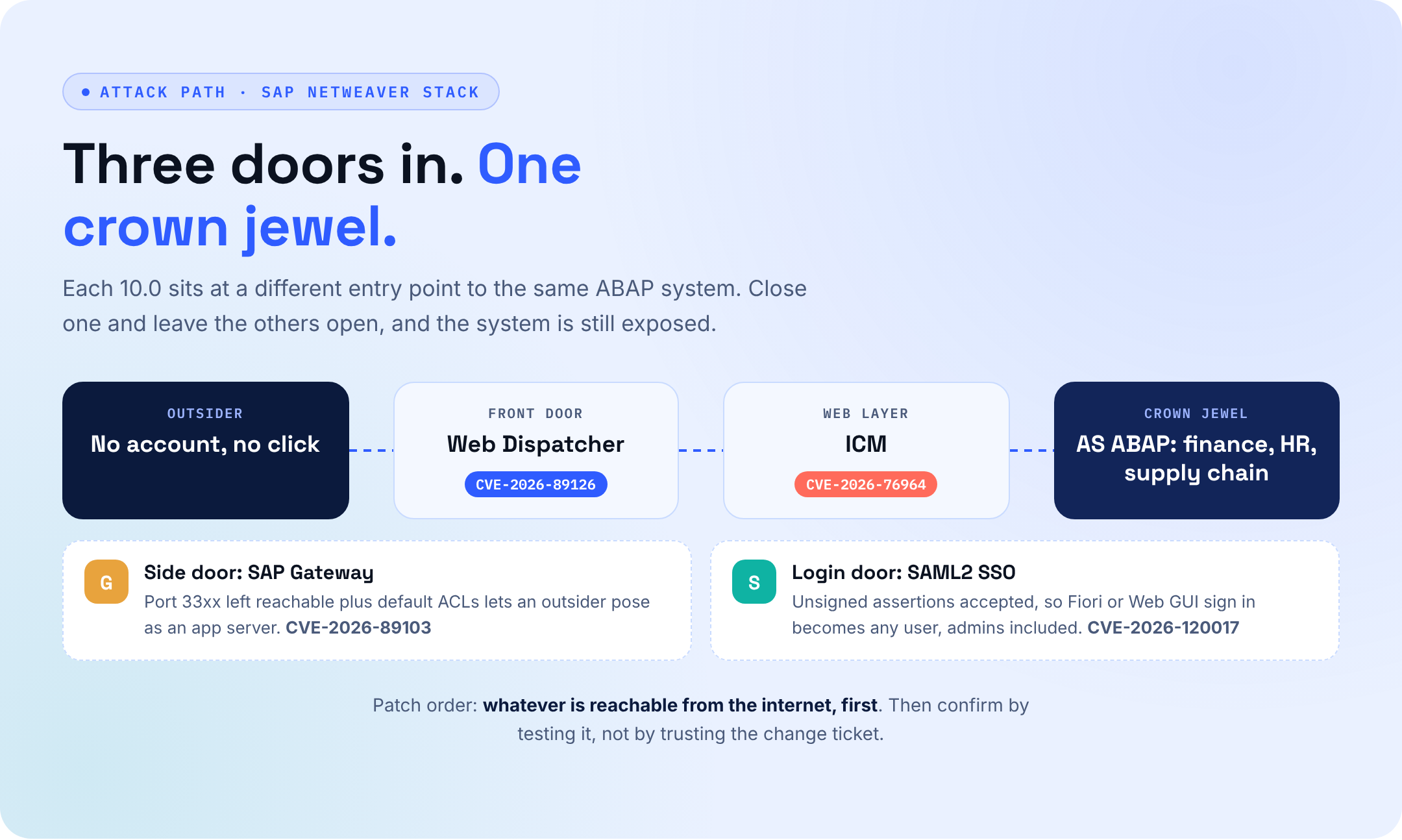
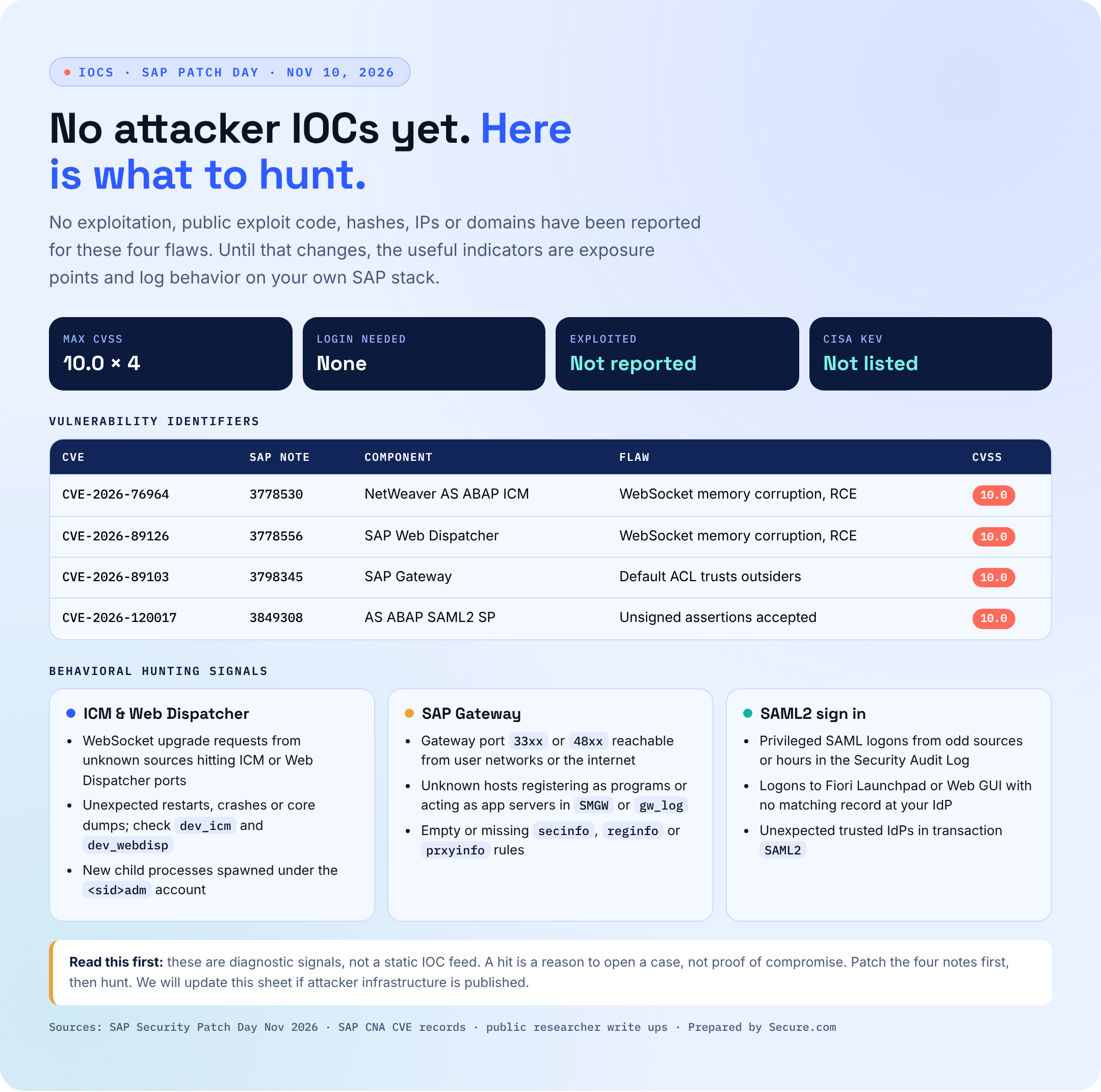
- CVE-2026-76964 (Note 3778530): malformed WebSocket frames corrupt memory in the Internet Communication Manager before login, opening a path to code execution.
- CVE-2026-89126 (Note 3778556): the same bug class in SAP Web Dispatcher, which takes traffic straight from the internet. This includes the copies embedded in HANA XS.
- CVE-2026-89103 (Note 3798345): SAP Gateway falls back to default access rules that trust the system’s own app servers. An outsider can pose as one.
- CVE-2026-120017 (Note 3849308): The SAML2 service provider skips signature checks in some setups, so an attacker can sign in as anyone, admins included.
Three more Critical flaws score 9.9, but each one needs a low-privileged account first (SecurityOnline has the full list).
What’s the Impact?
SAP is where finance, payroll, and supply chain data live. Code execution on the web layer or a forged admin session puts it all within reach. SAP reports no exploitation of these SAP NetWeaver vulnerabilities, and none of the four appear in CISA’s KEV catalog. Attackers read patch notes too, though, and SAP bugs have been turned into working attacks within days before.
That’s why reachability should drive the order of work, not the score alone. Our exposure prioritization playbook explains how to rank fixes by what an attacker can actually touch.
Indicators of Compromise
No hashes, IPs, or domains have been published for the SAP NetWeaver vulnerabilities so far (Rescana and Cybersecuritynews confirm the same). The IOC sheet below lists the CVE identifiers, exposed ports, and log behavior worth hunting for.
How to Protect Against SAP NetWeaver Vulnerabilities
- Patch the four notes now, starting with any system reachable from the internet. Set clear vulnerability remediation SLAs so a 10.0 never waits for the next change window.
- Find every Web Dispatcher, standalone and embedded. One forgotten instance keeps the hole open, so improve asset visibility before you call the job done.
- Turn off WebSocket support as a stopgap if you can’t patch today. It breaks ABAP Push Channels and some Fiori features.
- Lock down SAP Gateway after the fix: set
gw/acl_mode_proxy, keepgw/acl_modeat 1, write explicit secinfo, reginfo and prxyinfo rules, and block port 33xx from user networks. - Review every trusted identity provider in transaction SAML2, and audit privileged SAML logons.
Patching Is a Promise. Proving It Is the Job.
Four 10.0s in one release gives you a patch list, but a vulnerability risk scoring framework only tells you so much. The harder question is which of your SAP systems an attacker can reach right now, and whether the fix for these SAP NetWeaver vulnerabilities actually landed.
- Red AI Teammate attacks your exposed SAP surface under your rules and confirms what an outsider can really reach.
- Cloud Security AI Teammate finds every Web Dispatcher and open gateway port, including the ones nobody wrote down.
- SOC AI Teammate hunts for ICM crashes, rogue gateway registrations, and odd SAML logons, and builds the case before anyone gets paged.
- GRC AI Teammate keeps patch deadlines, risk acceptances, and retest evidence in one audit trail.
- Every fix gets retested, so the record proves the hole is closed.
Attack. Harden. Prove. Repeat. Your team sets the rules. AI teammates do the work.
FAQs
What SAP NetWeaver vulnerabilities were patched in November 2026?
Are any of these flaws being exploited right now?
Is there a workaround if I cannot patch today?
Which SAP systems should I patch first?
How do I check whether my SAP stack was targeted?
Related reading from Secure.com: