
Dateline: May 21, 2026
TL;DR: What you need to know in 30 seconds
- Vulnerability: nginx-poolslip — unauthenticated remote code execution
- Affected version: NGINX 1.31.0 (latest stable release)
- CVE ID: Not yet assigned (pending responsible disclosure)
- Official patch: Not yet available from F5/NGINX
- Discovered by: Researcher “Vega” of NebSec, publicly disclosed May 21, 2026
- Risk level: Critical — remote code execution without authentication
- Recommended action: Apply compensating controls immediately, monitor for behavioral IOCs, and do not wait for the patch to start your response.
A critical nginx zero day vulnerability in NGINX 1.31.0 puts millions of web servers at immediate risk of remote takeover. Security researchers named the flaw nginx-poolslip after discovering it allows attackers to execute arbitrary code on affected systems without authentication.
What Happened?
The nginx-poolslip flaw targets NGINX version 1.31.0, the most recent stable release of the popular web server software. Researchers found the bug grants remote code execution capabilities, meaning attackers can run malicious commands directly on targeted servers. The vulnerability exists in the core memory-handling logic of NGINX 1.31.0 and affects the way the server processes certain network requests.
The flaw was disclosed on May 21, 2026 by security researcher Vega of the NebSec team via a public announcement on X. NGINX powers an estimated 30 to 40 percent of all web servers globally, making this discovery particularly concerning for internet infrastructure. The affected version 1.31.0 was released recently as the latest stable build, meaning organizations that updated to stay current inadvertently exposed themselves to this new risk.
Critically, nginx-poolslip is described as a successor to “nginx-rift,” an earlier memory pool vulnerability that NGINX 1.31.0 was meant to patch. NebSec’s research confirms that the previous patch failed to fully remediate the underlying memory pool attack surface, leaving the door open for this new exploit to emerge in the updated codebase.
Cybersecurity researchers who identified the flaw have not yet disclosed the specific technical details of how the exploit works. This approach, called responsible disclosure, gives NGINX developers time to create and distribute a fix before attackers can reverse-engineer the vulnerability from public information. NebSec has committed to a 30-day disclosure window before publishing the full technical write-up, including an ASLR bypass.
The vulnerability carries a high severity rating due to its remote execution capabilities and the widespread deployment of NGINX servers. Attackers exploiting nginx-poolslip could gain complete control over affected web servers, steal sensitive data, install malware, or use compromised systems as launching points for additional attacks.
The Impact
Web hosting companies, cloud providers, and enterprise networks running NGINX 1.31.0 face immediate exposure to potential attacks. The vulnerability affects any organization that upgraded to the latest stable version, ironically putting security-conscious administrators who kept their software current at greater risk than those running older versions.
The timing creates additional complications for system administrators. Many organizations schedule updates during planned maintenance windows, but this vulnerability requires emergency patching outside normal schedules. Companies must balance the risk of exploitation against the potential disruption of emergency updates to production systems.
Security experts warn that once technical details become public, attackers typically develop working exploits within days or weeks. The window for protective action is closing rapidly as threat actors race to identify vulnerable targets before patches get applied.
CVEs Affected
No CVE has been assigned to nginx-poolslip yet. NebSec is following a 30-day responsible disclosure timeline and will publish the full technical write-up — including the ASLR bypass — only after F5 ships an official patch. Track the National Vulnerability Database and the F5 security advisories page for the assigned CVE identifier.
Organizations running NGINX 1.31.0 should also confirm they have not regressed on the recent CVE wave that this version was meant to patch. If you downgrade to a branch older than 1.30.1 as a stopgap, you may re-expose yourself to the following flaws:
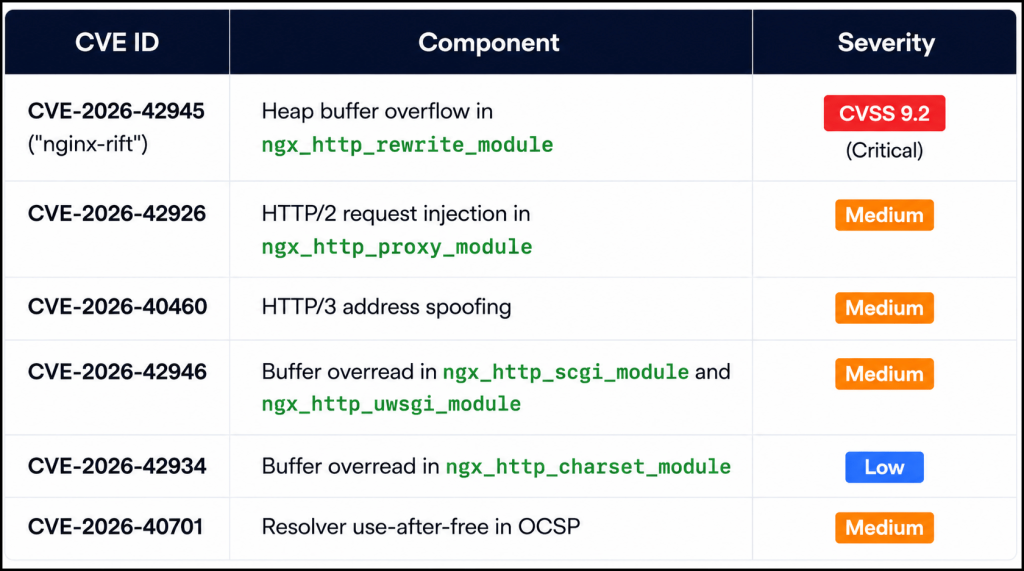
If you must roll back, choose NGINX 1.30.1 rather than an older branch — it carries the same patch wave as 1.31.0 minus the new exposure window. CVE-2026-42945 alone reportedly exposed roughly 5.7 million internet-facing NGINX servers before the 1.31.0 fix, so reverting too far is its own significant risk.
Indicators of Compromise (IOCs) to Monitor
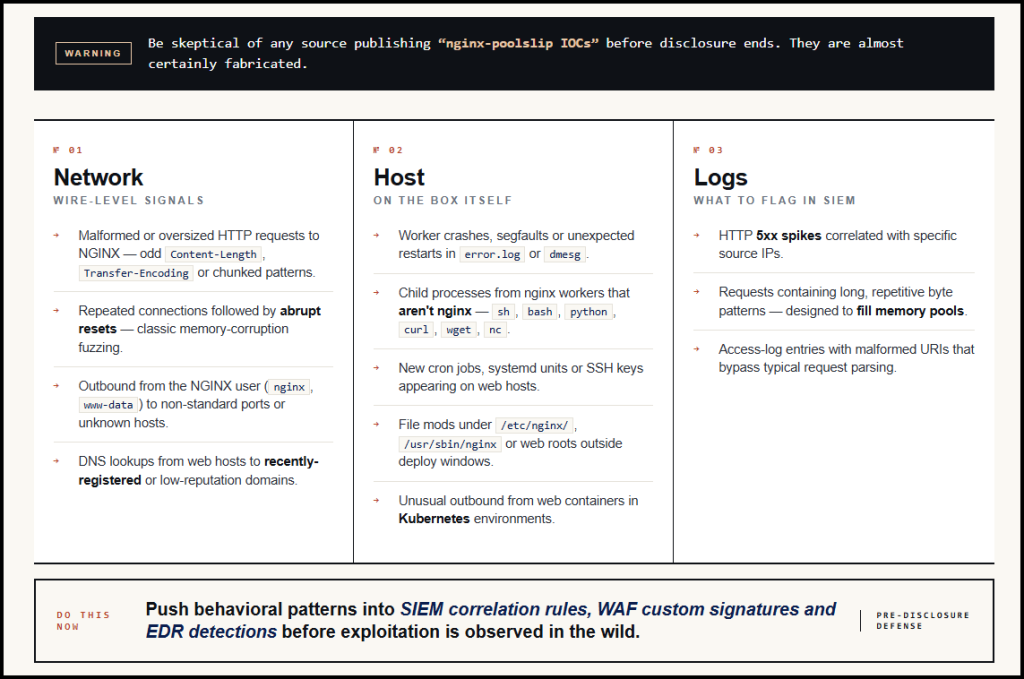
Atomic IOCs (specific IP addresses, payload hashes, or malware signatures) have not been published for nginx-poolslip and will not be available until responsible disclosure ends.
In the meantime, behavioral IOCs based on the vulnerability class give you meaningful detection coverage. Push these patterns into your SIEM correlation rules, WAF custom signatures, and EDR detections now, before exploitation is observed in the wild.
How to Mitigate This Right Now
System administrators should immediately audit their infrastructure to identify servers running NGINX 1.31.0. You can check your version by running nginx -v on affected systems or by reviewing your deployment configurations.
The most direct protection is reverting to NGINX 1.30.1 until an official security patch is available. Downgrading introduces friction, but the remote code execution threat outweighs concerns about missing recent features or performance improvements.
Other compensating controls to apply now:
- Enable ASLR system-wide by setting /proc/sys/kernel/randomize_va_space to 2. This blunts the exploit’s effectiveness even where the underlying flaw remains.
- Restrict public exposure of NGINX admin interfaces. Move them behind a VPN or IP allow-list.
- Deploy WAF rules to reject malformed requests with anomalous Content-Length or Transfer-Encoding headers.
- Increase logging verbosity on NGINX error logs and forward them to your SIEM for correlation against the behavioral IOCs above.
Network-level protections add another defense layer. Web application firewalls, intrusion detection systems, and network monitoring tools should be tuned for the patterns listed above. Review access logs for suspicious activity and consider temporarily restricting access to administrative interfaces. For a deeper look at structuring this kind of response, see our guide to the vulnerability management lifecycle.
How Secure.com Helps You Respond to an Nginx Zero Day Vulnerability Faster
When a flaw like nginx-poolslip drops, the clock starts immediately and the hardest part isn’t applying the patch. It’s knowing exactly which servers across your environment run NGINX 1.31.0, who owns each one, which are internet-facing, and proving to auditors that you closed every gap inside SLA.
Secure.com’s Digital Security Teammates handle that operational weight:
- Continuous asset discovery maps every NGINX instance across cloud, on-premises, and hybrid infrastructure. No manual nginx -v sweeps across thousands of hosts.
- KEV and exploitation context correlates new zero-days with your live asset inventory the moment they hit public catalogs, then routes urgent cases to the right owners with built-in SLA clocks.
- SIEM and EDR correlation pushes the behavioral IOCs above into Secure SIEM rules and case workflows, so any pattern match opens a tracked case with the affected asset and owner already attached.
- Automated workflows push patch tickets into Jira or ServiceNow, trigger compensating controls, and escalate stuck remediations, all from inside Slack or Teams.
- Immutable audit trail captures every action so you can prove timely response to auditors, boards, or customers after the fact.
Read More: One Third of the Web Runs NGINX. A New Critical Bug Affects All of It.