Apache HTTP Server RCE: What CVE-2026-119618 Means for Your Web Stack
- Who should care: Anyone running Apache HTTP Server 2.4.55 through 2.4.70 with HTTP/2 switched on. That includes reverse proxies and container images nobody has rebuilt in months.
- What could go wrong: This Apache HTTP Server RCE lets a remote attacker corrupt server memory and run commands as your web server.
- Do this: Upgrade to 2.4.71 today. If you can’t, fall back to HTTP/1.1 until you can.
- Worth remembering: An AI scanner found this bug first. Next time, someone who won’t report it could find it first.
Introduction
On November 11, Apache shipped HTTP Server 2.4.71 to fix CVE-2026-119618, a critical Apache HTTP Server RCE flaw in mod_http2. It turns a race condition into remote code execution, and Wiz data puts it in the internet-facing servers of half of all cloud environments.
What Happened?
The bug is in assign_headers() inside mod_http2, the module that handles HTTP/2 traffic. Apache calls it a concurrency problem: two code paths touch the same shared memory without proper locking. As a result, an attacker who wins that race can corrupt the heap. From there, the attacker can turn that corruption into code execution with the web server’s privileges.
Anthropic’s OSS Scanner reported the flaw to Apache on October 26. Then Google Cloud’s Vulnerability Research team found it independently and reported it on November 3. The fix shipped eight days later, according to Cyber Security News. The bug also hits standalone mod_h2 builds 2.0.8 through 2.0.42, and version 2.0.43 fixes them.

What’s the Impact of This Apache HTTP Server RCE?
Wiz says 64% of the cloud environments it monitors contain vulnerable resources, and 51% have a vulnerable instance exposed to the internet. However, those figures count versions, not configs, so the real number may be lower. Still, an Apache HTTP Server RCE on your front door is about as bad as findings get.
There’s no CVSS score yet, no public exploit, and no confirmed attack. In other words, you have a short window, so use it.
Two more fixes ride along in 2.4.71, as GBHackers reports:
- CVE-2026-106023 (important): a NULL pointer bug in mod_md that crashes child processes. Affects 2.4.30 through 2.4.70.
- CVE-2026-109163 (low): a single-byte stack overflow in mod_vhost_alias. Affects 2.4.69 and 2.4.70 only.
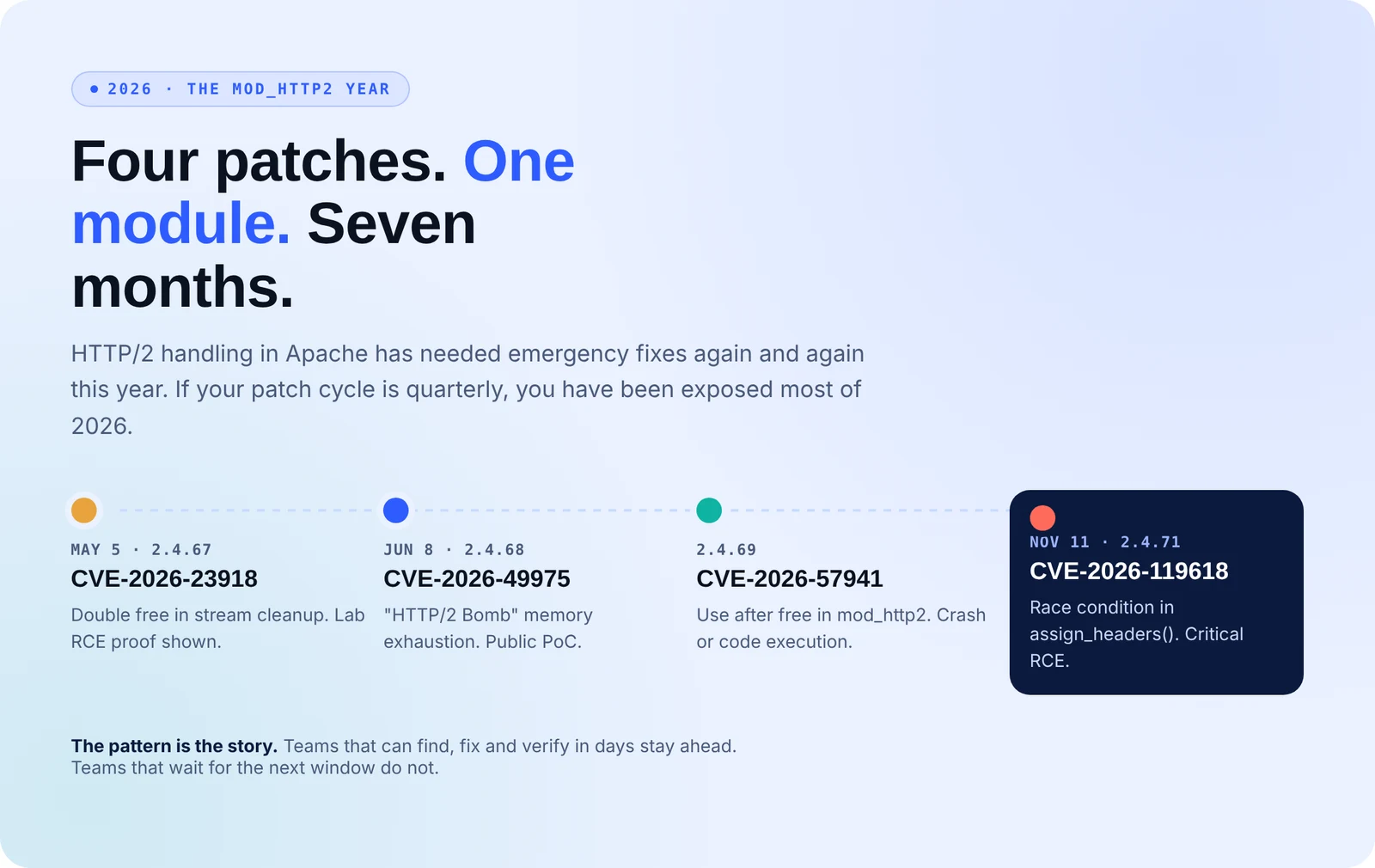
This keeps happening. It’s the fourth mod_http2 scare of 2026. There was a double free RCE in May (2.4.67), an “HTTP/2 Bomb” memory exhaustion bug in June (2.4.68), a use-after-free in 2.4.69, and now this one. So if you patch once a quarter, your servers sat exposed for most of the year.
How to Avoid This Apache HTTP Server RCE
- Patch first. Move to Apache HTTP Server 2.4.71, or mod_h2 2.0.43 if you build from GitHub. Check the Apache security page and pull distro packages as Debian, Ubuntu, RHEL, and SUSE publish them.
- No patch window today? Set
Protocols http/1.1and reload. However, test it first, because some clients and performance will feel the change. - Rebuild your images. Containers pinned to old httpd tags keep the bug long after you fix the hosts.
- Watch your logs. Repeated
AH00052 ... exit signal Segmentation faultentries on an HTTP/2 host could mean someone is probing the race. - Find the hidden ones. Appliances, load balancers, and vendor products often have Apache inside them. For example, check anything that answers with ALPN h2.
Your Patch Window Just Got Shorter
AI found this bug, and attackers have AI too. Secure.com’s AI teammates attack your defenses, harden what they find, and prove the fix held. Your team sets the rules.
- Finds every Apache host serving HTTP/2, including the ones missing from your CMDB
- Ranks CVE-2026-119618 by exposure and asset value, not CVSS alone
- Retests after the change and logs the proof for audit
- Gives your team back the hours it would spend on version hunts and spreadsheet triage
- Opens the ticket and stages the patch or the HTTP/1.1 fallback, then waits for your approval

Attack. Harden. Prove. Repeat.
IOCs (Indicators of Compromise) at a Glance
No public indicators exist yet for this Apache HTTP Server RCE. Also, there is no exploit code, no confirmed attack and no published IOC list. Use these signals to hunt, and treat a hit as a lead, not proof of compromise.