Modern organizations discover thousands of vulnerabilities across endpoints, cloud workloads, applications, and network devices every month. Yet only a small percentage of those weaknesses are ever actively exploited in real-world attacks.
This creates a critical challenge: not every vulnerability represents equal risk. Treating all vulnerabilities the same leads to wasted resources, patch fatigue, and delayed remediation of truly dangerous threats.
Vulnerability prioritization addresses this imbalance by helping security teams focus on what matters most. Instead of chasing raw vulnerability counts, organizations evaluate risk based on exploitability, business impact, asset criticality, and threat context.
Without effective prioritization, remediation programs become reactive, overwhelmed, and disconnected from actual business risk.
How to Prioritize Vulnerabilities Beyond CVSS
CVSS tells you how severe a vulnerability is. It does not tell you whether attackers are actually using it against systems like yours. That gap is why teams that patch by CVSS score alone end up fixing the wrong things first.
Research from FIRST, the group behind both scoring systems, shows that only about 2.3% of vulnerabilities rated CVSS 7 or higher are seen being exploited in a given month. So a team that patches everything rated “high” spends most of its effort on threats that never get used.
To prioritize beyond CVSS, you add three signals CVSS cannot see:
- Exploitability: is there working exploit code, and is the flaw being used right now? The Exploit Prediction Scoring System (EPSS), also maintained by FIRST, scores each vulnerability from 0% to 100% on how likely it is to be exploited in the next 30 days.
- Asset criticality: does the vulnerable system run revenue, hold sensitive data, or sit on the public internet?
- Business impact: what breaks, and what does it cost, if this specific asset is hit?
This approach has a name: risk-based vulnerability management (RBVM). RBVM ranks fixes by real-world risk to your business instead of raw severity. FIRST research shows that fixing the top 10% of vulnerabilities by EPSS score covers roughly 76% of everything that actually gets exploited, so you cut the most risk with the least work.
How Vulnerability Prioritization Works
Effective prioritization follows a structured evaluation process designed to reduce noise and highlight true risk.
Asset identification and classification
The process begins with understanding what assets exist and how critical they are. This is how you connect vulnerabilities to business impact: a flaw only matters as much as the asset it sits on. Vulnerabilities on public facing production servers carry far more risk than the same flaw on an isolated test machine.
Asset context may include:
- Business function and revenue impact
- Data sensitivity
- Regulatory exposure
- Network exposure (internal vs. external)
- Role within critical workflows
Vulnerability discovery
Security tools identify weaknesses through scanning, penetration testing, configuration analysis, or software composition analysis. These findings typically include severity metrics such as CVSS scores.
However, severity alone does not equal risk.
Risk enrichment and contextualization
Prioritization improves when vulnerability data is enriched with contextual signals such as:
- Known exploit availability
- Active exploitation in the wild
- Threat intelligence indicators
- Asset exposure level
- Privilege requirements
- Compensating controls already in place
This enrichment separates theoretical risk from imminent risk.
Risk scoring and ranking
When vulnerabilities are evaluated, their priority is determined with an understanding of context. Some organizations use weighted risk scores for this, while others employ threat-based risk models that allow them to see changing priorities in real time as circumstances evolve.
Remediation planning
High-priority vulnerabilities are assigned remediation timelines based on risk level. Service-level objectives (SLOs) or risk-based remediation windows ensure accountability.
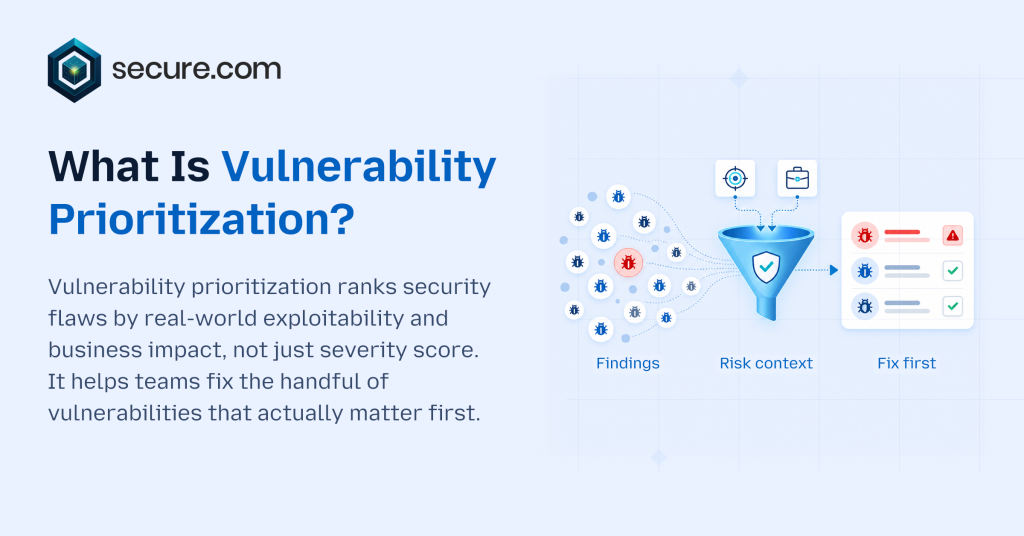
How to Turn 100,000 Vulnerabilities Into a Manageable List
A large environment can show over 100,000 open findings at once. No team can fix them all, and most never need fixing. The job is to shrink that number to the few hundred that carry real risk.
Prioritization works like a funnel. Each stage removes noise:
- Start with every open finding across endpoints, cloud, apps, and network.
- Keep only what is reachable. Drop findings on assets that attackers cannot get to.
- Keep only what is exploitable. Use EPSS and known-exploit data to drop flaws with no real-world exploitation.
- Keep only what hits critical assets. Rank what remains by business impact.
The result is a short, ranked list your team can actually clear. A backlog of 100,000 becomes a working queue of a few hundred, sorted by what threatens the business most.
Key Characteristics of Effective Vulnerability Prioritization
Risk-based decision-making
Prioritization is driven by real-world risk rather than static severity ratings. A medium-severity vulnerability on a mission-critical asset may outrank a high-severity vulnerability on a low-impact system.
Context awareness
Effective prioritization accounts for asset value, business impact, and environmental exposure. It connects technical findings to operational consequences.
Dynamic adjustment
Risk changes over time. Newly published exploits, threat campaigns, or asset exposure shifts can elevate previously low-priority vulnerabilities. Modern prioritization frameworks adapt accordingly.
Business alignment
Prioritization decisions are aligned with business objectives, regulatory requirements, and risk tolerance thresholds defined by leadership.
EPSS vs CVSS
CVSS and EPSS answer different questions. You need both.
- CVSS measures severity: how much damage a vulnerability could do if someone exploited it. It ranges from 0 to 10 and stays mostly fixed over time.
- EPSS measures likelihood: the chance a vulnerability will be exploited in the next 30 days. It ranges from 0% to 100% and updates daily as threat data changes.
- A vulnerability can score high on one and low on the other. A CVSS 9.8 flaw in software you do not run is not urgent. A CVSS 6.5 flaw that EPSS says is being actively exploited is. Reading them together tells you what is both dangerous and likely, which is what you fix first.
Technologies and Techniques Used in Vulnerability Prioritization
CVSS and severity scoring
Common Vulnerability Scoring System (CVSS) provides a standardized severity rating, but it represents only one input in prioritization.
Exploit intelligence integration
Threat intelligence feeds identify vulnerabilities actively exploited in real-world campaigns, enabling faster remediation of high-risk weaknesses.
Asset criticality mapping
Integration with asset inventories or configuration management databases (CMDBs) allows vulnerabilities to be mapped to business services and critical infrastructure components.
Exposure analysis
External attack surface visibility tools help determine whether a vulnerability is internet-facing, internally accessible, or segmented from sensitive assets.
Automated risk scoring
Advanced platforms apply machine learning or rule-based models to calculate real-time risk scores that adjust as new data emerges.
Applications and Impact of Vulnerability Prioritization
Reduced remediation backlog
By focusing only on high-risk vulnerabilities, organizations reduce patch fatigue and eliminate unnecessary remediation cycles.
Faster risk reduction
Security teams close the most dangerous gaps first, improving mean time to remediation (MTTR) for critical issues.
Improved compliance posture
Risk-based prioritization supports regulatory frameworks that require evidence of systematic vulnerability management.
Stronger executive reporting
Leadership gains visibility into risk trends based on business impact rather than raw vulnerability counts, enabling more informed decision-making.
Detecting and Defending Through Prioritized Remediation
Continuous vulnerability monitoring
Regular scanning and discovery ensure new weaknesses are quickly identified and evaluated.
Risk-based patch management
Remediation timelines are aligned with risk levels rather than arbitrary patch cycles.
Cross-team collaboration
IT, security, and DevOps teams coordinate remediation activities based on agreed-upon risk thresholds.
Automation and orchestration
Automated workflows reduce manual triage, ensuring critical vulnerabilities are escalated and addressed promptly.
Challenges and Risks of Vulnerability Prioritization
Overreliance on severity scores
Relying solely on CVSS scores can misrepresent actual business risk.
Incomplete asset visibility
Without accurate asset inventories, prioritization decisions may be based on outdated or partial information.
Data silos
Fragmented tools and disconnected security systems reduce contextual accuracy and delay decision-making.
Resource constraints
Even with prioritization, limited remediation capacity can delay resolution of critical issues.
The Future of Vulnerability Prioritization
Today, data storage is a complex landscape that includes remote cloud service providers, hybrid environments and even some on-premises setups. With this in mind, it’s vital for organizations to understand their exposure to vulnerabilities as they happen– not just after the fact.
To keep pace with rapidly changing threats, artificial intelligence (AI) will play an increasingly important role in predicting which software vulnerabilities are most likely to be exploited. Along with assigning context-based priority scores for urgent fixes, certain aspects of patch management may be automated too.
The traditional approach to risk assessment— checking off a list of potential threats every few months— will give way to continuous modeling based on a variety of inputs. In such a world, security platforms won’t just need to “see” assets and threats but also understand context in real-time: How those things relate to one another; what they mean for business continuity if attacked or disrupted; whether any parts of an operation stand to gain from (or lose out) because of current priorities.
Imagine a single solution combining all this plus automated response.
Frequently Asked Questions
How do you prioritize vulnerabilities beyond CVSS?
What is the difference between EPSS and CVSS?
How do you turn 100,000 vulnerabilities into a manageable list?
What is risk-based vulnerability management (RBVM)?
How do you connect vulnerabilities to business impact?
Does a high CVSS score mean a vulnerability is urgent?
Conclusion
Any good vulnerability management program needs more than just counting vulnerabilities: Prioritization based on risk is key.
By ranking vulnerabilities according to factors such as exploitability, exposure, and potential impact on the business, organizations can focus resources on the most critical issues— those that could cause real harm.
With new vulnerabilities emerging all the time, it’s no longer optional to prioritize effectively if you want to reduce risk, improve resilience, and keep operations running smoothly.