Security teams are drowning in access alerts. Every suspicious login, every permission change, every orphaned account—it all demands immediate attention. But with 11,000+ alerts per day and analyst teams stretched thin, unauthorized access often goes undetected until it’s too late. Access to these systems is typically restricted through authentication controls, permissions, and security policies designed to ensure that only authorized users can interact with specific resources.
When these controls are bypassed, misused, or compromised, unauthorized access occurs.
Unauthorized access is one of the most common entry points for cybersecurity incidents. From stolen credentials to exploited software vulnerabilities, attackers often seek to gain access to systems quietly before escalating their privileges or extracting sensitive data.
Because access violations can occur both externally and internally, preventing unauthorized access requires careful control of identities, permissions, and system visibility across the entire technology environment.
What is Unauthorized Access?
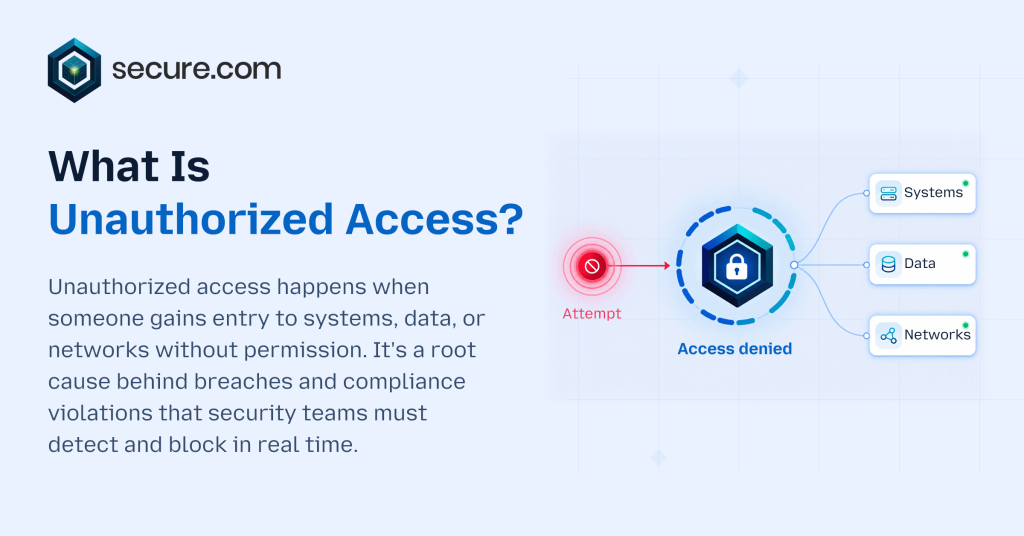
Unauthorized access refers to the act of accessing or attempting to access a system, network, application, or data without the required permission or authorization. This includes both external intrusions by attackers and situations where legitimate users access resources they are not permitted to use.
In cybersecurity terms, unauthorized access occurs whenever an action violates the organization’s defined access control policies.
This type of access may involve:
- Logging into accounts using stolen credentials
- Viewing confidential data without permission
- Exploiting software vulnerabilities to enter systems
- Using excessive privileges to access restricted resources
- Bypassing authentication or security controls
Unauthorized access does not always require hacking tools. It can also occur through simple mistakes, misconfigured permissions, or careless handling of credentials.
How Unauthorized Access Happens?
Unauthorized access incidents usually follow a progression in which attackers exploit weaknesses in systems, users, or access controls.
Credential compromise
Stolen usernames and passwords remain one of the most common ways attackers gain access. Phishing campaigns, password reuse, and brute-force attacks can expose login credentials that allow attackers to impersonate legitimate users.
Exploited vulnerabilities
Unpatched software flaws or misconfigured systems can allow attackers to bypass authentication mechanisms and gain direct access to internal systems.
Insider misuse
Employees or contractors with legitimate access may intentionally or accidentally access information beyond their authorized scope.
Misconfigured permissions
Overly broad permissions or poorly maintained access controls may expose sensitive resources to users who should not have access.
Social engineering
Attackers may manipulate employees into revealing credentials or performing actions that grant system access.
Key Characteristics of Unauthorized Access
Violation of access policies
The defining characteristic is that access occurs outside established permission boundaries or security policies.
Internal or external origin
Unauthorized access may originate from outside attackers or from insiders who misuse their legitimate credentials.
Often a precursor to larger attacks
Unauthorized entry frequently becomes the starting point for more complex threats such as data breaches, ransomware attacks, or espionage campaigns.
Can remain unnoticed
If attackers use valid credentials or blend into normal activity patterns, unauthorized access can persist for long periods before being discovered.
Techniques Commonly Used to Gain Unauthorized Access
Password attacks
Attackers attempt to guess, crack, or reuse passwords to gain entry into systems.
Phishing and credential harvesting
Malicious emails or websites trick users into revealing authentication information.
Exploiting system vulnerabilities
Attackers exploit flaws in software, operating systems, or applications to bypass authentication controls.
Privilege abuse
Users with legitimate access may escalate their privileges or access information beyond their authorized role.
Session hijacking
Attackers intercept active login sessions to impersonate authenticated users.
Applications and Impact of Unauthorized Access
Data breaches
Unauthorized access frequently leads to exposure or theft of sensitive information such as financial records, personal data, or intellectual property.
Operational disruption
Attackers may manipulate systems, delete data, or interfere with business operations once access is obtained.
Financial losses
Organizations may face fraud, legal penalties, and recovery costs following unauthorized access incidents.
Compliance violations
Access violations can lead to regulatory penalties under standards such as privacy laws and security compliance frameworks.
Reputational damage
Organizations that experience unauthorized access incidents often face long-term damage to customer trust and brand reputation.
Detecting and Preventing Unauthorized Access
Strong authentication controls
Multi-factor authentication and strong password policies help prevent unauthorized logins.
Role-based access control
Limiting user permissions to only what is necessary reduces the risk of internal misuse.
Continuous monitoring
Monitoring login activity, privilege changes, and unusual behavior helps identify suspicious access patterns.
Regular security updates
Patching vulnerabilities prevents attackers from exploiting known software flaws.
Access reviews and audits
Regularly reviewing user permissions ensures that only authorized individuals retain system access.
Challenges and Risks of Unauthorized Access
Credential reuse and password fatigue
Users frequently reuse passwords across multiple systems, increasing the risk of compromise.
Expanding digital environments
Cloud services, remote work, and third-party integrations create more access points that must be secured.
Insider threats
Employees with legitimate access can intentionally or accidentally expose sensitive data.
Visibility gaps
Organizations with fragmented security tools may struggle to detect access violations quickly.
The Future of Access Security
As digital infrastructure becomes more distributed across cloud platforms, remote devices, and third-party services, controlling access is becoming increasingly complex.
Security strategies are evolving toward stronger identity governance, continuous authentication, and integrated monitoring across identities, devices, and applications. These approaches aim to detect suspicious access behavior early and prevent attackers from moving deeper into environments.
Organizations that treat identity and access control as a core security discipline will be better positioned to prevent unauthorized entry and reduce the risk of major breaches.
Conclusion
Unauthorized access is one of the most fundamental cybersecurity risks. Whether caused by stolen credentials, system vulnerabilities, or insider misuse, it represents a breakdown in access control that can expose organizations to serious operational and financial consequences.
Preventing unauthorized access requires more than strong passwords—it requires clear access policies, continuous monitoring, and disciplined management of identities and permissions across systems.
By strengthening these controls, organizations can significantly reduce the likelihood that unauthorized users gain access to critical systems and sensitive data.