Most software today is built with far more than in-house code—often 80-90% comes from third-party components. A single application can include hundreds of open source libraries, third-party packages, APIs, containers, and dependencies pulled in from different places over time.
That creates a visibility problem.
When a new vulnerability appears, many organizations struggle to answer a basic question:
Where are we actually using this component?
That is where SBOM comes in.
What Is SBOM?
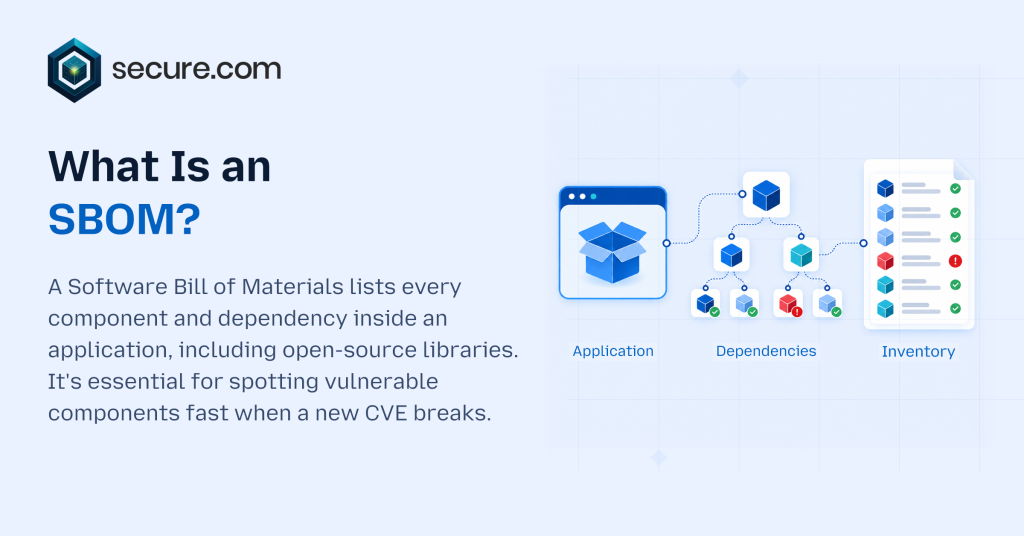
A Software Bill of Materials, or SBOM, is a structured record of all the software components used to build an application. It includes details such as component names, versions, suppliers, licensing information, and dependency relationships.
The goal is straightforward: give organizations a clear picture of what exists inside their software.
An SBOM can cover:
- Open source libraries
- Third-party frameworks
- Containers and images
- Internal components
- Commercial software packages
- Nested dependencies
Advanced SBOMs also include metadata about known vulnerabilities (CVEs), cryptographic hashes for integrity verification, and package origin tracking.
Without that visibility, security teams are often guessing during incident response.
Why SBOM Matters?
Most organizations rely heavily on open source software. Developers move fast, packages get reused constantly, and dependencies pile up quietly in the background.
That speed comes with risk.
If a vulnerable component enters the environment, attackers may gain an entry point long before anyone notices. Secure.com’s AppSec Teammate detects vulnerable dependencies during build time—before they reach production—and routes fixes to the right owners automatically. And if teams do not know where that component exists, remediation slows down fast.
SBOMs help organizations:
- Identify vulnerable components quickly
- Track software supply chain risk
- Respond faster to newly disclosed CVEs
- Support compliance and audit requirements
- Improve vendor transparency
- Reduce blind spots in software inventories
Most people think software risk starts with attackers breaking in directly. In reality, a lot of exposure begins with trusted software components that nobody reviewed closely enough. The SolarWinds breach affected 18,000+ organizations—not through a direct attack, but through a compromised software update.
How SBOM Works?
SBOM generation usually happens during the software development lifecycle.
Tools scan the application and collect information about included components and dependencies. That information is then exported into a standardized SBOM format.
Common SBOM formats include:
SPDX
SPDX, created by the Linux Foundation, focuses heavily on software licensing and component tracking.
CycloneDX
CycloneDX was designed with security use cases in mind, including vulnerability management and supply chain analysis.
SWID Tags
Software Identification Tags are standardized metadata tags often used in enterprise asset management and compliance environments.
Once generated, SBOMs can be shared internally, provided to customers, or integrated into security workflows for continuous monitoring. Secure.com automatically integrates SBOM data into your vulnerability management and risk analysis workflows, correlating components with known CVEs and prioritizing fixes by business impact.
What Information Does an SBOM Contain?
A detailed SBOM may include:
- Component names
- Version numbers
- Dependency relationships
- Package suppliers
- Licensing details
- Cryptographic hashes
- Vulnerability references
- Timestamps and build metadata
The exact level of detail depends on how the SBOM was created and what standard it follows.
Some organizations generate lightweight SBOMs for compliance purposes. Others use them continuously for threat detection and software governance.
SBOM And Software Supply Chain Security
Software supply chain attacks have changed how organizations think about trust.
Attackers no longer need to breach a target directly if they can compromise a trusted dependency upstream. One poisoned package can spread across thousands of environments very quickly.
SBOMs help security teams trace those relationships faster.
When a vulnerability is disclosed, teams can search SBOM records to identify affected applications instead of manually investigating every system. During large-scale incidents, that time difference matters: hours vs. weeks can mean the difference between contained exposure and a full breach.
You probably lived this during the Log4j crisis. Many organizations spent days figuring out whether they were even exposed before they could start fixing anything.
Regulatory And Compliance Pressure Around SBOMs
Governments and regulators are pushing harder for SBOM adoption, especially in critical infrastructure and federal procurement.
In the United States, Executive Order 14028 increased focus on software supply chain transparency and mandated SBOM requirements for federal software vendors.
Healthcare, finance, defense, and critical infrastructure sectors are also starting to treat SBOM visibility as part of broader cybersecurity risk management.
This isn’t only about compliance paperwork. Buyers increasingly want proof that vendors understand what’s inside their own software. Secure.com’s Cyber Assurance Program automates SBOM generation and compliance evidence collection, reducing audit preparation time by over 90%.
Challenges With SBOM Adoption
SBOMs sound straightforward until organizations try maintaining them at scale.
A few common challenges show up quickly:
Dependency Complexity
Modern applications may contain thousands of nested dependencies—a typical enterprise application averages 200-500 direct dependencies, each with its own dependency tree—many of which change with every build.
Incomplete Visibility
Some legacy systems, proprietary components, or dynamically loaded packages may not appear correctly in scans.
Continuous Maintenance
An SBOM becomes outdated fast if it is not refreshed regularly alongside development changes.
Tool Fragmentation
Different ecosystems and scanning tools may produce inconsistent outputs or partial coverage.
That’s often the frustrating part. Generating an SBOM once is easy. Keeping it accurate over time takes discipline—or automation. Secure.com’s AppSec Teammate continuously regenerates SBOMs with every build, automatically correlating new components with vulnerability databases and routing fixes to the right teams.
The Future Of SBOM
SBOMs are becoming part of a much larger push toward software transparency.
Security teams increasingly want real-time visibility into dependencies, vulnerabilities, build pipelines, and third-party risk. SBOMs help provide that foundation, especially when paired with continuous monitoring and automated vulnerability tracking.
AI-generated code may push this even further. As development speeds up, tracking where components come from and what risks they introduce becomes harder, not easier. Secure.com’s AI-powered risk analysis correlates SBOM data with threat intelligence, asset criticality, and exploitability to prioritize what matters most—automatically.
The organizations that already have mature SBOM practices will probably adapt faster than those still trying to inventory their software manually.
Conclusion
SBOM gives organizations a clearer view into the software they build, buy, and deploy. Secure.com’s AppSec Teammate automates SBOM generation, vulnerability correlation, and remediation routing—helping security teams track dependencies, respond 75% faster to vulnerabilities, and reduce supply chain blind spots that attackers increasingly exploit.
Most software environments are more interconnected than they appear on the surface. An SBOM helps expose those hidden connections before attackers do.