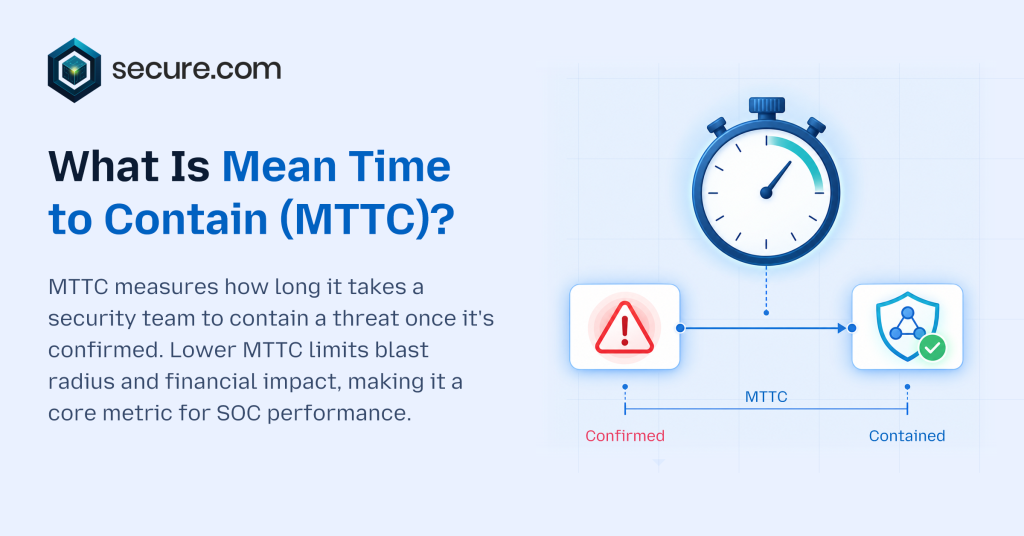
Mean Time to Contain (MTTC) is a cybersecurity metric that measures the average time it takes to contain a security incident after it has been identified or confirmed. Containment aims to limit an attacker’s ability to continue accessing systems, moving laterally, or causing additional damage.
A lower MTTC generally indicates that an organization can limit the spread and impact of security incidents more quickly.
What is Mean Time to Contain in Cybersecurity?
Mean Time to Contain measures how long, on average, it takes a security team to stop or limit the active impact of a security incident.
The measurement typically covers the period between incident detection or confirmation and the point at which effective containment is achieved. The exact starting and ending points should be clearly defined because organizations may use different methodologies.
A basic calculation is:
MTTC = Total time taken to contain incidents ÷ Number of contained incidents
For example, if a security team takes a combined total of 20 hours to contain five incidents, its MTTC would be four hours.
Containment actions may include:
- Isolating an affected endpoint
- Disabling or locking a compromised account
- Revoking active sessions or credentials
- Blocking malicious IP addresses or domains
- Restricting network access
- Removing access to affected cloud resources
- Stopping malicious processes
- Applying temporary security controls to limit further activity
Containment does not necessarily mean the incident has been fully resolved. The organization may still need to investigate the root cause, remove malicious components, restore systems, and implement longer term remediation.
How does MTTC differ from MTTR?
MTTC and MTTR measure different parts of the incident response process.
Mean Time to Contain measures how quickly a security team limits or stops the spread of an active incident.
Mean Time to Respond (MTTR) generally measures how long it takes to respond to an incident. However, MTTR can have different meanings depending on the organization. It may refer to Mean Time to Respond, Remediate, Resolve, Recover, or Repair.
| MTTC | MTTR |
|---|---|
| Measures time to contain an incident | Measures time for a broader response or resolution process |
| Focuses on limiting further damage | Can focus on responding, remediating, resolving, or recovering |
| May end once the threat is isolated or access is blocked | May continue until the incident is resolved or systems are restored |
| Often represents an earlier stage of incident response | Can cover multiple stages after detection |
For example, a SOC may detect a compromised endpoint and isolate it within 15 minutes. The endpoint may then require several hours or days of investigation, remediation, and recovery. In this case, the MTTC is 15 minutes, while the organization’s MTTR would likely be longer.
Because MTTR can mean different things, organizations should define exactly what they measure and ensure the metric is applied consistently.
Why is MTTC important?
The longer an attacker can operate without containment, the greater the opportunity for additional damage.
Reducing MTTC can help organizations:
- Limit lateral movement
- Reduce attacker dwell time
- Protect additional systems and data
- Reduce the blast radius of an incident
- Limit business disruption
- Improve incident response performance
- Measure containment effectiveness
MTTC is particularly important for incidents that can spread quickly, such as ransomware, credential compromise, malware infections, and active account takeover.
What affects MTTC?
Several factors can influence how quickly a security team can contain an incident.
Common factors include:
- Detection quality: Teams need sufficient confidence in an incident before taking disruptive containment actions.
- Investigation speed: Slow investigations can delay containment decisions.
- Alert context: Incomplete information can make it difficult to determine the appropriate action.
- Automation: Automated containment actions can significantly reduce response time for defined scenarios.
- Approval processes: Manual approvals can delay urgent actions.
- Tool integration: Disconnected security systems can slow containment.
- Incident complexity: Large or distributed incidents may require multiple containment actions.
- Business impact: Some systems cannot be immediately isolated without affecting critical operations.
How can organizations improve MTTC?
Organizations can reduce MTTC by improving the speed and consistency of containment decisions and actions.
Common approaches include:
- Automating containment for well defined threats
- Creating incident response playbooks
- Improving alert enrichment and investigation
- Integrating security and response systems
- Defining clear containment authority and escalation paths
- Prioritizing incidents based on risk and potential impact
- Regularly testing incident response procedures
- Using case management to coordinate containment activities
The goal is to contain genuine threats quickly while avoiding unnecessary actions that could disrupt legitimate business operations.
Challenges of Managing MTTC
MTTC can be difficult to measure and improve because incidents vary significantly in complexity and impact.
Common challenges include:
- Unclear measurement points: Teams may disagree about when containment begins or ends.
- Complex incidents: A single containment action may not fully stop an attacker.
- Business dependencies: Critical systems may require careful coordination before isolation.
- Manual processes: Human investigation and approval can increase containment time.
- Inconsistent workflows: Different teams may handle similar incidents differently.
- Metric differences: MTTR and other incident response metrics may overlap or be defined differently.
For meaningful measurement, organizations should establish a consistent definition of containment and track MTTC by incident type and severity.
The Future of MTTC
As security operations become more automated, organizations are increasingly focused on reducing the time between detection and containment. Automated investigation, alert correlation, and response workflows can help teams take appropriate action faster.
Future approaches are likely to focus on:
- AI assisted incident investigation
- Automated containment recommendations
- Risk based response prioritization
- Automated account and endpoint isolation
- Cross environment response workflows
- Continuous response optimization
- More detailed measurement of incident lifecycle performance
These capabilities can help security teams contain threats faster while maintaining appropriate human oversight for high impact actions.
Frequently Asked Questions
What is mean time to contain?
Why is containment time important?
How is MTTC different from MTTR?
What actions help contain a threat?
How can teams measure MTTC accurately?
How does automation reduce MTTC?
Conclusion
Mean Time to Contain is a cybersecurity metric that measures how quickly an organization can limit the spread and impact of a security incident. Unlike MTTR, which can measure a broader response, remediation, or resolution process, MTTC specifically focuses on containment. By improving detection, investigation, automation, and incident response workflows, organizations can reduce MTTC and limit the potential blast radius of security incidents.