Security incidents rarely unfold in a predictable way. Some alerts can be resolved quickly by frontline analysts or support teams, while others grow in complexity, affecting multiple systems, users, or business operations. When an incident exceeds the capability, authority, or time limits of the initial responder, it must be escalated so that the right expertise and decision-makers become involved.
Incident escalation ensures that issues do not remain stuck at the first level of investigation. Instead, they move through predefined response tiers until the necessary expertise, authority, or resources are engaged. Clear escalation paths help organizations respond faster, coordinate across teams, and reduce the potential impact of security incidents.
Without structured escalation procedures, organizations risk delayed response, miscommunication, and prolonged exposure to threats.
What is Incident Escalation?
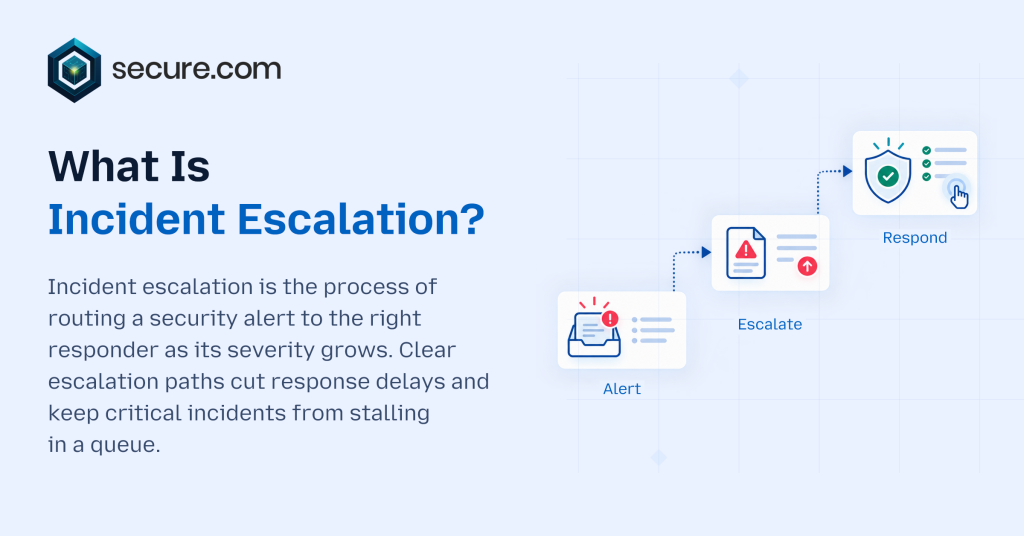
Incident escalation refers to the process of raising the priority of a security incident or transferring responsibility to individuals or teams with greater expertise, authority, or resources. It occurs when an incident cannot be resolved at the current level of response or when its severity requires broader organizational involvement.
In cybersecurity and IT operations, escalation is a formal part of incident management. It ensures that complex or high-impact incidents are handled by the appropriate specialists, incident managers, or leadership teams capable of coordinating response and mitigation efforts.
Rather than being an ad-hoc decision made during a crisis, escalation is typically guided by predefined policies that specify when an incident should move to the next response tier and who should be notified.
How Incident Escalation Works?
Incident escalation typically occurs within a structured response framework that defines roles, responsibilities, and decision points.
Initial detection and triage
An incident is first identified through monitoring alerts, user reports, or security tools. Frontline responders assess the issue, gather context, and attempt initial remediation.
Evaluation of severity and impact
Responders evaluate the incident based on factors such as system impact, data sensitivity, operational disruption, and the number of affected users.
Escalation trigger
If the incident cannot be resolved within the expected timeframe or requires additional expertise, it is escalated to the next response tier. Escalation may also occur immediately if the incident is classified as high severity.
Specialist involvement
More experienced engineers, security specialists, or incident response teams take over deeper investigation and remediation.
Management or executive escalation
For high-impact incidents—such as major data breaches or critical infrastructure disruptions—escalation may involve senior leadership, legal teams, or external stakeholders.
This structured progression ensures that incidents receive the appropriate attention and resources at every stage.
Key Characteristics of Incident Escalation
Defined escalation tiers
Most organizations structure incident response into tiers, such as Tier 1 (initial responders), Tier 2 (specialists), and Tier 3 (senior engineers or incident managers). Each tier has clearly defined responsibilities and authority levels.
Predefined triggers
Escalation is usually triggered by specific conditions, including severity level, time thresholds, or inability to resolve the incident within the current response tier.
Clear ownership transfer
When escalation occurs, responsibility shifts to the next team while maintaining full documentation of actions taken so far.
Structured communication
Effective escalation includes notifying the correct stakeholders and ensuring that all relevant incident details are shared with the next response level.
Types of Incident Escalation
Functional escalation
Functional escalation occurs when an incident is transferred to individuals with specialized expertise required to investigate or resolve the issue.
Example:
A security analyst escalates a suspected malware outbreak to a digital forensics specialist.
Hierarchical escalation
Hierarchical escalation involves notifying higher levels of management when an incident reaches a certain severity or business impact.
Example:
A ransomware attack affecting critical systems is escalated to executive leadership and legal teams.
Time-based escalation
Some incidents are escalated when predefined service level objectives are not met within a specific timeframe.
Example:
If a service outage is unresolved after a defined response window, it is automatically escalated to senior engineers.
Triggers for Incident Escalation
Organizations typically define escalation triggers in incident response policies or escalation matrices. Common triggers include:
- High or critical severity classification
- Failure to resolve the incident within the expected timeframe
- Impact on critical business services or infrastructure
- Potential regulatory or legal implications
- Need for specialized technical expertise
- Large number of affected systems or users
These triggers ensure escalation decisions are consistent and predictable rather than subjective.
Why Incident Escalation Matters
Faster resolution
Escalation brings the right expertise into the investigation sooner, reducing delays and improving response times.
Reduced operational impact
By quickly involving specialists and decision-makers, organizations can contain incidents before they spread or cause widespread disruption.
Clear accountability
Defined escalation paths ensure that every incident has clear ownership and oversight throughout the response process.
Stronger incident coordination
Complex incidents often involve multiple teams. Escalation enables coordinated response across security, IT operations, legal, and communications teams.
Challenges and Risks of Poor Escalation
Delayed escalation
If incidents remain too long at the initial response level, attackers may continue operating undetected.
Over-escalation
Escalating too many low-severity incidents can overwhelm senior responders and reduce efficiency.
Inconsistent procedures
Without clear escalation policies, responders may hesitate or escalate incidents inconsistently.
Communication breakdowns
Incomplete documentation during escalation can slow investigations and lead to duplicated effort.
The Future of Incident Escalation
As organizations operate across cloud platforms, remote work environments, and distributed infrastructures, incident escalation processes are becoming more structured and integrated into broader security operations frameworks.
Modern incident management increasingly focuses on:
- structured escalation workflows
- clear response tiers and responsibilities
- integrated visibility across security and IT environments
- faster coordination between technical teams and leadership
The goal is to ensure that high-risk incidents move quickly to the people best equipped to resolve them.
Conclusion
Incident escalation is a critical component of effective incident response. It ensures that security incidents are handled by the right people at the right time, preventing delays and minimizing operational impact.
By defining clear escalation paths, triggers, and responsibilities, organizations can respond to incidents more efficiently and reduce the risk of unresolved or mishandled threats. In modern security environments, well-designed escalation processes are essential for maintaining resilience and protecting critical systems.