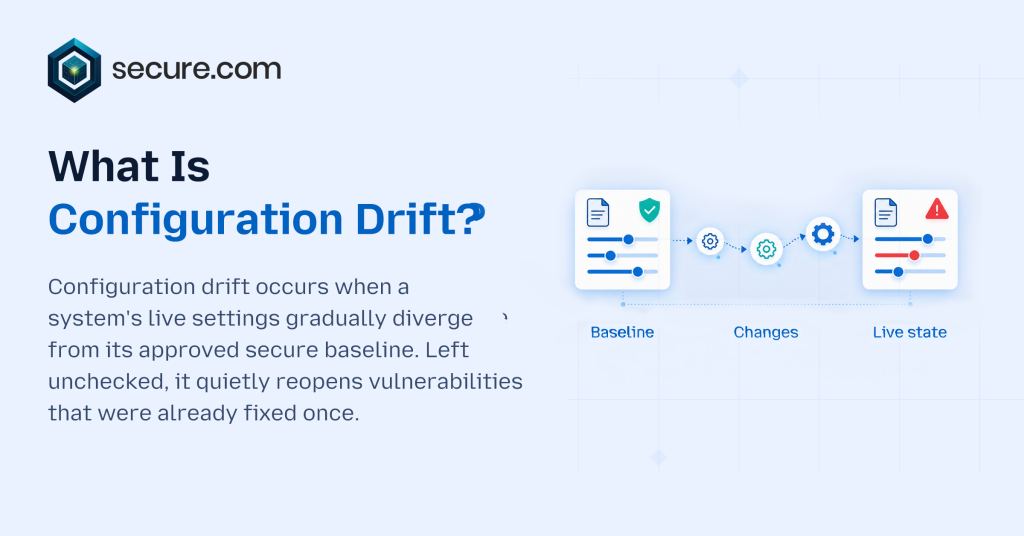
Configuration Drift is the gradual difference between an environment’s current configuration and its intended, approved, or baseline configuration. In cloud environments, drift can occur when resources are manually changed, updated, deployed, or modified without those changes being reflected in the organization’s defined configuration standards.
Configuration drift can create security risk when previously secure settings are changed or when unauthorized changes introduce weaknesses that remain undetected.
What is Configuration Drift in Cloud Environments?
Configuration drift in cloud environments occurs when cloud resources no longer match their intended security or operational configuration.
For example, an organization may establish a security baseline that requires a database to be private and encrypted. If someone later changes the database configuration to allow public access or disables encryption, the resource has drifted from its approved state.
Configuration drift can affect:
- Cloud storage permissions
- Firewall and security group rules
- Identity and access permissions
- Encryption settings
- Logging and monitoring configurations
- Network configurations
- Container and Kubernetes settings
- Infrastructure and application configurations
Drift can happen gradually across a single resource or across thousands of resources in a large cloud environment.
Why does Configuration Drift create security risk?
Configuration drift creates security risk because changes can introduce vulnerabilities or weaken security controls without being detected.
A resource that was previously secure may become exposed after a configuration change. For example, a restrictive firewall rule could be modified to allow broader network access, increasing the resource’s exposure to attackers.
Configuration drift can:
- Expose cloud resources to the internet
- Create excessive permissions
- Disable security controls
- Weaken encryption or authentication settings
- Reduce logging and monitoring visibility
- Create compliance violations
- Increase the attack surface
- Allow insecure configurations to persist
The longer an insecure configuration remains undetected, the greater the opportunity for attackers to take advantage of it.
What causes Configuration Drift?
Configuration drift can occur for several reasons, particularly in environments where infrastructure changes frequently.
Common causes include:
- Manual changes: Engineers or administrators modify resources directly through cloud consoles or command line tools.
- Emergency fixes: Temporary changes made during incidents may not be reverted.
- Inconsistent deployments: Different teams or deployment processes may apply different configurations.
- Infrastructure changes: New deployments or updates can unintentionally modify existing settings.
- Third party integrations: External services may change configurations or permissions.
- Lack of monitoring: Teams may not detect changes that move resources away from approved baselines.
- Configuration differences: Development, testing, and production environments may gradually become inconsistent.
How can organizations detect Configuration Drift?
Organizations can detect configuration drift by continuously comparing the current state of cloud resources against approved configurations or security baselines.
Common approaches include:
- Continuous configuration monitoring: Regularly checking cloud resources for changes.
- Baseline comparisons: Comparing current configurations against approved security standards.
- Change tracking: Recording who changed a resource, what changed, and when.
- Infrastructure as code: Defining desired configurations in code and comparing deployed resources against them.
- Automated alerts: Notifying teams when important security settings change.
- Compliance checks: Identifying configurations that no longer meet required standards.
Continuous monitoring is particularly important because cloud environments can change much faster than periodic manual reviews can detect.
How can organizations prevent Configuration Drift?
Preventing configuration drift requires organizations to control how infrastructure is changed and continuously verify that resources remain within approved configurations.
Effective approaches include:
- Using infrastructure as code where appropriate
- Restricting unnecessary administrative access
- Establishing secure configuration baselines
- Monitoring changes continuously
- Requiring approval for sensitive configuration changes
- Automating secure deployments
- Regularly reviewing cloud configurations
- Automatically reverting clearly defined unauthorized changes where appropriate
The goal is not necessarily to prevent every configuration change, but to ensure that changes are intentional, authorized, and secure.
Configuration Drift and Compliance
Configuration drift can also affect compliance because security frameworks often require organizations to maintain specific controls and configurations.
A cloud resource may initially meet a compliance requirement but fall out of compliance after a configuration change. Continuous monitoring can help identify these changes and provide evidence that security configurations are being maintained over time.
This makes configuration drift an important consideration for both cloud security and continuous compliance.
Challenges of Managing Configuration Drift
Managing configuration drift becomes increasingly difficult as cloud environments grow and change more frequently.
Common challenges include:
- Large environments: Thousands of cloud resources can make manual reviews impractical.
- Frequent changes: Continuous deployments can create configuration changes throughout the day.
- Multi cloud environments: Different cloud providers have different configuration models and security controls.
- Limited visibility: Teams may not know which resources have changed or why.
- Temporary changes: Emergency fixes can remain in place longer than intended.
- Alert fatigue: Continuous monitoring can generate large numbers of configuration findings.
- Remediation risk: Automatically changing a resource back to its baseline can sometimes disrupt legitimate workloads.
The Future of Configuration Drift Management
Configuration drift management is increasingly moving toward continuous and automated detection. As cloud environments become more dynamic, organizations are moving away from periodic configuration reviews toward systems that continuously compare actual infrastructure against its intended state.
Future approaches are likely to focus on:
- Continuous configuration monitoring
- AI assisted drift detection and prioritization
- Automated remediation of high risk changes
- Real time change analysis
- Stronger integration with infrastructure as code
- Context aware detection that distinguishes legitimate changes from risky drift
- Continuous compliance validation
These capabilities can help teams detect insecure changes sooner and maintain consistent security configurations as cloud environments evolve.
Frequently Asked Questions
What is configuration drift?
What causes configuration drift?
Why is configuration drift a security risk?
How do teams detect configuration drift?
How can teams prevent drift?
How does drift connect to compliance?
Conclusion
Configuration Drift occurs when cloud resources move away from their intended or approved configuration. Manual changes, rapid deployments, emergency fixes, and complex environments can introduce drift that weakens security controls or creates new exposure. By defining secure baselines, monitoring configurations continuously, controlling changes, and automating appropriate remediation, organizations can reduce the security and compliance risks associated with configuration drift.