Modern organizations rely heavily on web applications, APIs, and cloud-based software to deliver services, manage data, and support business operations. These applications handle sensitive information, interact with multiple systems, and are frequently updated through rapid development cycles.
This speed and complexity introduce security risk. Coding errors, insecure configurations, and flawed logic can introduce weaknesses that attackers may exploit. Issues such as injection flaws, broken access controls, and improper input validation can expose systems to data breaches or unauthorized access.
Application Vulnerability Management addresses this challenge through continuous identification, evaluation, and remediation of security weaknesses in software. Rather than treating vulnerabilities as isolated problems, it establishes an ongoing process to track risks across the application lifecycle—reducing the likelihood of exploitation before attackers can act.
What is Application Vulnerability Management?
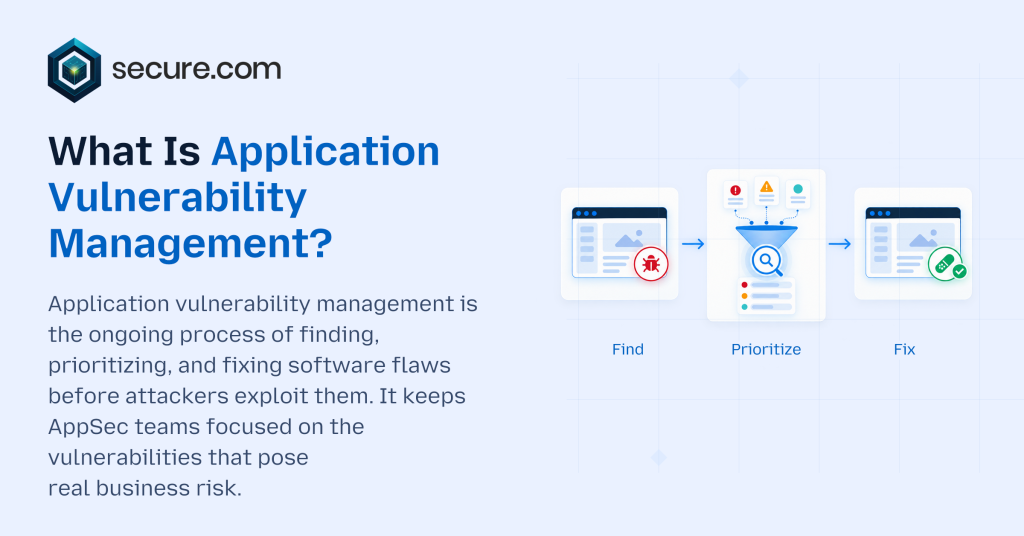
Application Vulnerability Management is the continuous process of identifying, analyzing, prioritizing, and remediating security vulnerabilities within software applications. Its purpose is to ensure that weaknesses in application code, architecture, or configuration are discovered and addressed before they can be exploited.
In practice, it combines vulnerability discovery, risk evaluation, and remediation workflows to continuously reduce application security risk. Instead of focusing on one-time scans or occasional assessments, vulnerability management operates as an ongoing cycle that continuously monitors applications for new weaknesses.
Applications evolve through frequent updates, integrations, and infrastructure changes—introducing new vulnerabilities at any stage of development or deployment. Application Vulnerability Management helps organizations maintain visibility into these risks and coordinate fixes across development, security, and operations teams—keeping humans focused on what matters most.
How Application Vulnerability Management Works?
Application vulnerability management typically follows a recurring lifecycle designed to identify weaknesses and ensure they are resolved effectively.
Asset and application discovery
The first step is identifying all applications that need to be monitored. This includes internal software, customer-facing applications, APIs, third-party integrations, and cloud services.
Without complete inventory, vulnerabilities remain hidden in forgotten or unmanaged applications—creating blind spots attackers exploit first.
Vulnerability discovery
Once applications are identified, organizations use multiple methods to uncover security weaknesses:
- Source code analysis
- Runtime application testing
- Dependency and library scanning
- Security configuration checks
- Manual security assessments
These methods help detect vulnerabilities such as injection flaws, insecure authentication logic, and improper access controls.
Vulnerability analysis and classification
Not all vulnerabilities represent the same level of risk. After discovery, security teams analyze findings to determine:
- Severity of the vulnerability
- Likelihood of exploitation
- Potential business impact
- Exposure of the affected application
This step separates critical risks from noise—ensuring teams focus where it counts.
Risk prioritization
Organizations often discover hundreds or thousands of vulnerabilities, making prioritization essential.
Security teams evaluate vulnerabilities based on factors such as:
- Sensitivity of affected data
- Internet exposure of the application
- Ease of exploitation
- Availability of known exploits
The goal: address vulnerabilities that pose the greatest business risk first—not just the highest CVSS scores.
Remediation and mitigation
Once prioritized, vulnerabilities are addressed through corrective actions such as:
- Fixing insecure code
- Updating vulnerable libraries
- Applying security patches
- Changing configurations
- Implementing additional access controls
In some cases, temporary mitigations are applied until permanent fixes are deployed.
Verification and continuous monitoring
After remediation, systems are reassessed to confirm vulnerabilities are resolved—closing the loop before moving to the next risk.
New vulnerabilities appear frequently, requiring continuous monitoring as part of an ongoing management cycle.
Key Components of Application Vulnerability Management
Continuous discovery
Applications constantly change through updates, new features, and integrations. Continuous discovery ensures newly introduced vulnerabilities are detected before attackers find them.
Risk-based prioritization
Effective vulnerability management focuses on business risk, not raw vulnerability counts. This ensures security teams concentrate on issues most likely to cause real damage—not just the longest CVE lists.
Integration with development workflows
Security findings must be integrated into development processes so developers can fix vulnerabilities early in the software lifecycle—when fixes are fastest and cheapest.
Tracking and reporting
Organizations need visibility into vulnerability trends, remediation progress, and outstanding risks. Tracking systems ensure accountability and maintain audit-ready records.
Technologies and Techniques Used
Application vulnerability management relies on several security testing techniques and assessment methods.
Static code analysis
Static analysis examines application source code to identify vulnerabilities such as insecure input handling or improper authorization logic before the application is deployed.
Dynamic application testing
Dynamic testing evaluates running applications from an external perspective, identifying security weaknesses by interacting with the application while it operates.
Dependency and component analysis
Many applications rely on third-party libraries and open-source components. Dependency analysis identifies vulnerabilities within these external components.
Manual security testing
Human-led assessments can uncover complex logic flaws and design weaknesses that automated tools may miss.
Applications and Impact
Application vulnerability management plays a critical role in protecting modern digital environments.
Protecting sensitive data
Applications often process customer data, payment information, or intellectual property. Addressing vulnerabilities prevents unauthorized access and data breaches—protecting what matters most.
Maintaining service reliability
Security flaws can disrupt application functionality or allow attackers to manipulate systems. Vulnerability management helps ensure stable and secure operations.
Supporting compliance and audits
Regulatory frameworks frequently require organizations to identify and remediate vulnerabilities as part of their security controls.
Reducing overall attack surface
By continuously eliminating weaknesses in applications, organizations make it harder for attackers to gain entry into their environments.
Challenges and Risks
Rapid software development
Frequent releases and agile development practices can introduce vulnerabilities faster than security teams can address them.
Large numbers of findings
Automated scans may produce large volumes of results, making it difficult to identify the vulnerabilities that truly matter.
Dependency complexity
Modern applications rely on numerous external libraries, which may introduce vulnerabilities outside the control of the development team.
Coordination across teams
Fixing vulnerabilities often requires collaboration between development, security, and operations teams, which can slow remediation if processes are not well defined.
The Future of Application Vulnerability Management
As applications become more distributed and cloud-native, vulnerability management is evolving toward continuous and integrated security practices.
Organizations are increasingly embedding vulnerability discovery and remediation directly into development workflows so that weaknesses can be addressed earlier in the software lifecycle. This shift reduces the cost and complexity of fixing vulnerabilities after applications are already deployed.
At the same time, improved visibility across applications, infrastructure, and dependencies is helping organizations better understand how vulnerabilities affect overall business risk.
Conclusion
Application Vulnerability Management provides a structured approach to identifying and resolving security weaknesses in software. By continuously discovering vulnerabilities, evaluating their risk, and coordinating remediation efforts, organizations can significantly reduce the likelihood of application-level breaches.
As applications continue to grow in complexity and importance, effective vulnerability management becomes essential for maintaining secure, reliable, and resilient digital services.