Meta Description: Learn how adversary emulation replicates real-world threat actor tactics, techniques, and procedures to validate security defenses, improve detection capabilities, and measure organizational resilience against known cyber threats.
Excerpt: Adversary emulation replicates the tactics, techniques, and procedures of real-world threat actors to test and validate an organization’s security defenses against known attack behaviors.
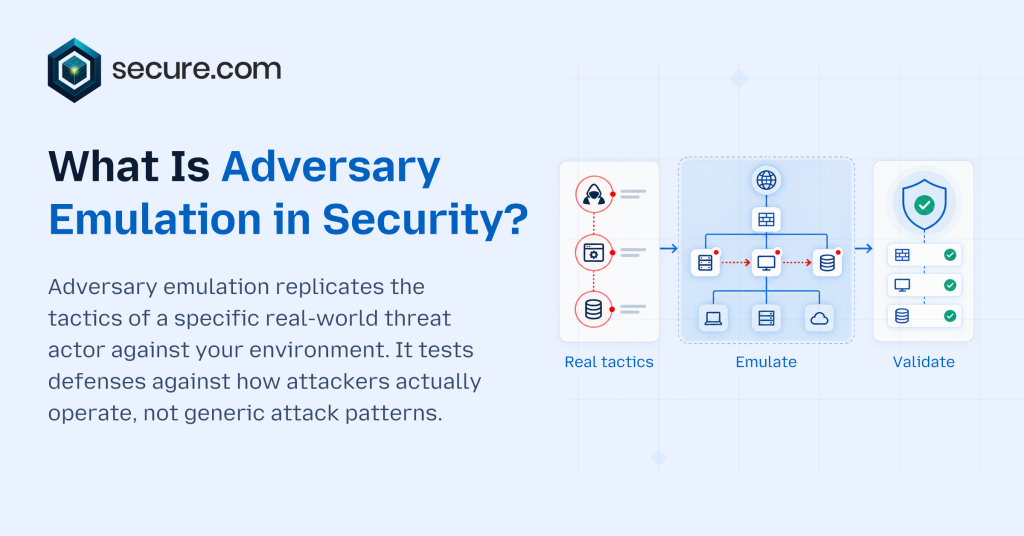
Adversary emulation is a proactive cybersecurity practice in which security professionals replicate the exact behaviors, tactics, techniques, and procedures used by known threat actors to assess how well an organization can detect, respond to, and withstand real-world attacks. Unlike general penetration testing, which focuses on finding exploitable vulnerabilities, adversary emulation is intelligence-driven. It uses documented threat intelligence to simulate specific adversary campaigns, providing organizations with a realistic measure of their defensive posture against the threats most likely to target them.
As cyberattacks grow more sophisticated and threat actors increasingly specialize in targeting specific industries, generic security assessments no longer provide sufficient assurance. Organizations need to understand how named threat groups such as APT29, FIN7, or Lazarus Group would operate within their environment. Adversary emulation bridges this gap by moving security validation from theoretical risk to evidence-based assessment grounded in real adversary behavior.
What Is Adversary Emulation in Security?
Adversary emulation is a structured security assessment methodology in which authorized security teams replicate the full attack lifecycle of a specific threat actor or threat group. This includes mimicking their reconnaissance methods, initial access techniques, persistence mechanisms, lateral movement strategies, data exfiltration methods, and command-and-control infrastructure.
The foundation of adversary emulation is threat intelligence. Security teams leverage frameworks such as MITRE ATT&CK, which catalogs adversary behaviors observed in real-world intrusions, to build emulation plans that accurately reflect how a particular threat actor operates. Each emulation engagement is mapped to specific ATT&CK techniques and sub-techniques, ensuring that testing is grounded in documented adversary tradecraft rather than hypothetical attack scenarios.
Adversary emulation differs from red teaming in scope and intent. While red team exercises broadly test an organization’s detection and response capabilities using creative and unrestricted attack methods, adversary emulation deliberately constrains its approach to replicate the behaviors of a specific threat actor. This constraint provides targeted, actionable insights into whether existing defenses can detect and disrupt the exact threats an organization faces.
What Is Adversary Emulation in Purple Teaming?
Adversary emulation in purple teaming is the practice of simulating the tactics, techniques, and procedures (TTPs) of real world threat actors during a purple team exercise to evaluate how effectively an organization’s security controls, detections, and response processes perform.
Rather than simply identifying vulnerabilities, adversary emulation recreates the behavior of known attackers, often using the MITRE ATT&CK framework, to test whether security teams can detect, investigate, and respond to realistic attack scenarios.
In a purple teaming engagement, the red team executes these emulated attacks while the blue team works alongside them to monitor activity, validate detections, and improve defenses in real time. This collaborative approach helps uncover detection gaps, optimize security controls, and strengthen incident response capabilities.
Key benefits of adversary emulation in purple teaming include:
- Tests security defenses against realistic attacker behavior.
- Validates detection rules and response workflows.
- Improves collaboration between red and blue teams.
- Maps security coverage to the MITRE ATT&CK framework.
- Identifies visibility and logging gaps for continuous improvement.
How Adversary Emulation Works
Threat Intelligence Gathering
The engagement begins with selecting a threat actor relevant to the organization’s industry, geography, or risk profile. Security teams collect intelligence from sources such as MITRE ATT&CK, threat intelligence platforms, government advisories, and industry-specific threat reports. This intelligence informs the emulation plan, detailing which techniques the adversary uses at each stage of the attack lifecycle.
Emulation Plan Development
Based on gathered intelligence, the team builds a detailed emulation plan that maps each phase of the adversary’s campaign to specific actions. The plan typically covers initial access, execution, persistence, privilege escalation, defense evasion, credential access, discovery, lateral movement, collection, exfiltration, and command-and-control. Each step is documented with the tools, scripts, and procedures the threat actor is known to employ.
Controlled Execution
The emulation team executes the plan within the target environment under defined rules of engagement. This execution mirrors the adversary’s operational tempo, tooling, and sequencing as closely as possible. The goal is not to cause damage but to generate the same telemetry and indicators of compromise that a real intrusion would produce.
Detection and Response Evaluation
During and after execution, the security team evaluates whether existing detection tools, security information and event management platforms, endpoint detection and response solutions, and security operations center analysts identified the emulated activity. Each technique is assessed for detection coverage, alert fidelity, and response effectiveness.
Reporting and Gap Analysis
The final deliverable includes a detailed mapping of emulated techniques to detection outcomes, identifying gaps where adversary activity went undetected or where response actions were insufficient. Recommendations prioritize improving detection rules, tuning security tools, updating incident response playbooks, and addressing architectural weaknesses.
Key Characteristics of Adversary Emulation
- Intelligence-driven methodology: Every action is based on documented threat actor behavior, ensuring assessments reflect realistic and relevant threats rather than generic attack patterns.
- MITRE ATT&CK alignment: Emulation plans map directly to the ATT&CK framework, providing a standardized language for describing adversary behavior and measuring detection coverage.
- Detection-focused outcomes: The primary objective is to evaluate and improve detection and response capabilities, not simply to demonstrate exploitation.
- Repeatable and measurable: Because emulation plans are structured and documented, organizations can re-run assessments after implementing improvements to measure progress over time.
- Threat-specific relevance: By targeting adversaries most likely to attack the organization, emulation delivers prioritized, actionable findings aligned with actual risk.
Technologies and Techniques Used in Adversary Emulation
- Emulation frameworks: Tools such as MITRE Caldera, Atomic Red Team, and Prelude Operator automate the execution of ATT&CK-mapped techniques.
- Custom tooling: Emulation teams often develop custom scripts and payloads to replicate adversary-specific tools and malware behavior without deploying actual malicious code.
- Command-and-control infrastructure: Teams establish controlled C2 channels that mirror adversary communication patterns, testing network monitoring and egress controls.
- Living-off-the-land techniques: Emulation frequently involves using legitimate system tools such as PowerShell, WMI, and scheduled tasks to replicate stealthy adversary behavior.
Applications and Business Impact
- Security control validation: Adversary emulation provides evidence-based assurance that security investments are effective against real threats.
- SOC readiness assessment: Organizations can measure whether security analysts detect and respond to adversary activity within acceptable timeframes.
- Compliance support: Frameworks including SOC 2, ISO 27001, and PCI DSS require organizations to validate security controls. Adversary emulation provides documented evidence of proactive testing.
- Risk prioritization: By identifying specific detection gaps tied to known threat actors, organizations can allocate security resources based on actual risk exposure.
- Incident response improvement: Emulation exercises reveal weaknesses in response playbooks, escalation procedures, and coordination between security teams.
Challenges and Limitations of Adversary Emulation
- Resource intensity: Building accurate emulation plans and executing them requires skilled personnel with deep knowledge of threat intelligence, offensive security, and defensive operations.
- Intelligence accuracy: Emulation quality depends on the accuracy and completeness of available threat intelligence. Adversaries continuously evolve their tradecraft, and intelligence may lag behind current operations.
- Scope constraints: Emulating every technique used by a threat actor may not be feasible within time and budget limitations, requiring careful prioritization.
- Environmental impact: Even controlled emulation carries risk of operational disruption if rules of engagement are not carefully defined and followed.
- Point-in-time assessment: Like penetration testing, a single emulation engagement captures defensive posture at one moment. Continuous or periodic emulation is necessary for ongoing assurance.
The Future of Adversary Emulation
Adversary emulation is evolving from periodic manual exercises toward continuous, automated threat validation. Platforms that integrate with the MITRE ATT&CK framework are enabling organizations to run automated emulation scenarios on a recurring basis, providing ongoing visibility into detection coverage and control effectiveness.
Artificial intelligence and machine learning are beginning to enhance emulation by dynamically adapting attack sequences based on defensive responses, more closely mimicking the decision-making of real adversaries. Integration with security orchestration, automation, and response platforms will enable organizations to automatically test and validate detection rules as part of their security operations lifecycle.
As threat landscapes grow more complex and regulatory expectations increase, adversary emulation is becoming a foundational practice in mature cybersecurity programs moving organizations from compliance-driven testing to continuous, intelligence-driven security validation.
Frequently Asked Questions
What is adversary emulation?
How is adversary emulation different from a standard pentest?
Why do teams use adversary emulation?
What does adversary emulation test?
How does adversary emulation improve defenses?
How does continuous emulation help over time?
Conclusion
Adversary emulation represents a critical advancement in how organizations validate their cybersecurity defenses. By replicating the exact behaviors of known threat actors, emulation provides realistic, evidence-based insight into whether security controls, detection capabilities, and response processes can withstand the threats most relevant to the organization.
While adversary emulation requires significant expertise and planning, it delivers actionable, prioritized findings that generic testing approaches cannot match. As cyber threats continue to evolve, organizations that adopt adversary emulation as a core practice will be better positioned to identify gaps, strengthen defenses, and build resilience against the adversaries targeting them.