TL;DR
Shift-Left security embeds controls in development pipelines to catch vulnerabilities early, but modern cloud-native systems change continuously after deployment—identities shift, services reconfigure, dependencies update, and new vulnerabilities emerge without code changes. AI-backed continuous analysis provides the necessary complement by delivering real-time environmental awareness, contextual reasoning, attack-path evaluation, and actionable prioritization.
Key Takeaways
- Shift-Left is a foundation, not a cure-all. It catches errors during the build but offers no protection against the environmental drift, new CVEs, or identity shifts that occur after deployment.
- Modern systems never stand still. Autoscaling, ephemeral workloads, and dynamic permissions create a constantly shifting landscape that static controls—designed for traditional environments—simply cannot track.
- AI bridges the visibility gap. Leverage AI (Digital Security Teammates) to evaluate millions of potential interactions to spot emerging attack paths and analyze real-time events at scale beyond human capacity.
- Context dictates priority. A vulnerability in an isolated service is a nuisance; the same flaw in a privileged service is a crisis. Continuous reasoning based on the context is necessary to distinguish between the two.
Introduction
Shift-left security embeds security controls early in the software development lifecycle, focusing on preventing vulnerabilities before systems reach production. Instead of relying on late-stage reviews, security controls are applied during design, development, and build phases so risks are identified when they are easiest and least costly to remediate.
Shift-left improves baseline security and development speed, but it primarily addresses pre-deployment risk and does not replace the need for runtime detection and response. An organization passed every “Shift-Left” check, only to be exposed a few hours later by a CVE that didn’t exist when the code was committed. The attack surface appeared after deployment, completely bypassing pre-production controls.
This is a common reality in cloud-native environments. While pre-production testing is vital, sole reliance on it could provide a false sense of security. This is because It cannot account for the dynamic nature of live environments where configuration drift, new threat intelligence, and shifting permissions constantly alter the risk profile.
Relying exclusively on Shift-Left without any post-production controls leaves a visibility gap in a world where infrastructure and dependencies change long after the code is released.
Real-World Examples
AWS Cloud Trust Report
The AWS Cloud Trust Report published in Q4 2025 surveyed enterprises on cloud adoption, trust, and security practices. The report notes that data breaches remain common, with roughly 79% of organizations experiencing at least one data breach incident in the past year.
The study reveals that the majority of security incidents stem from operational weaknesses. The primary causes are vulnerability exploitation (24%), compromised credentials (20%), misconfiguration (16%) and supply-chain issues (11%).
Human factors (both unintentional insider error and malicious intent) are also consistently significant contributors. This highlights that breaches frequently result from operational complexity and mistakes, rather than being solely attributable to external attacks.
Rapid7 Research: Crimson Collective Threat Actor Group
The cybersecurity firm Rapid7 published a report in October 2025 on the tradecraft of the threat actor group known as “Crimson Collective”. This group was observed in multiple incidents, including a claimed breach of Red Hat’s private GitLab repositories, and appears to focus on compromising long‑term AWS access keys and exfiltrating sensitive cloud data.
The group searches for valid AWS credentials. Once valid credentials are found, the attackers establish persistence by creating new IAM users and access keys, escalate privileges (often attaching the AdministratorAccess policy), and perform extensive discovery of the victim’s cloud infrastructure via APIs across EC2, RDS, S3, and networking services.
After mapping the environment, the group moves into data collection and exfiltration, including resetting database master passwords, creating database snapshots and exporting them to S3, and cloning EBS snapshots for extraction. The attackers often use AWS services such as Simple Email Service (SES) to send extortion demands from within the compromised environment itself.
This case highlights the importance of least‑privilege access, short‑lived credentials, proactive secrets scanning, and real‑time monitoring for anomalous IAM and API activity to protect cloud environments.
Cybernews Research: WorkComposer Public S3 Bucket
WorkComposer, a workplace surveillance app, had a public S3 bucket containing 21 million screenshots of employee systems. These captures revealed full-screen views of confidential materials, including emails, internal communications, and business documents. Crucially, they could also expose login pages, credentials, API keys, and other vital information that attackers could readily exploit.
Palo Alto Unit42 Research: JavaGhost’s Persistent Phishing Attacks From the Cloud
JavaGhost is a threat actor group which focuses on AWS environments. The group hunts for misconfigured environments that expose long‑term IAM access keys. With these exposed credentials, JavaGhost gains initial access and uses the victim’s own AWS resources to build and send phishing campaigns at scale.
JavaGhost was found to be leveraging overly permissive IAM permissions in the victim environment in order to use said victim’s Amazon Simple Email Service (SES) and WorkMail to send phishing emails. This also helps them bypass email protections as the emails seemingly originate from a known source.
Limitations of Shift-Left in Dynamic Environments
Vulnerability Emergence
Even a “clean” build can become vulnerable immediately after release. New CVEs may be disclosed in deployed libraries. Changes to the cloud platform may introduce new privilege interactions. Upstream open-source maintainers may reveal supply chain exposures.
Shift-Left cannot respond to vulnerabilities introduced externally or after deployment.
Dynamic Identity
Identity is the new perimeter. It is far less stable than traditional network topologies, driven by temporary tokens and just-in-time privileges. These shifting relationships constantly alter the security landscape, creating risks that are invisible to pre-deployment checks.
Shift-Left tools cannot model complex, emergent permission chains or dynamic trust boundaries. They validate identity configurations at a single point in time without understanding how those configurations interact with runtime behavior and privilege escalation opportunities.
Behavioral Drift
Operational adjustments—whether automated or human-driven—can cause drift between the intended configuration and runtime reality. This drift can introduce misconfigurations, weaken controls, or unintentionally expand attack surfaces.
Static security testing fails to account for deviations introduced by scaling, failover, incident response, or system tuning. The gap between “configuration as tested” and “configuration as running” grows continuously, creating blind spots that attackers exploit.
Non-Contextual Alerts
Detective security controls often create large volumes of issues yet treat each in isolation. Without context regarding deploy-time infrastructure, identity relationships, or business impact, organizations struggle to determine which findings are truly meaningful.
This leads to alert fatigue and prioritization challenges, widening the gap between detection and remediation. Security teams drown in findings without clear guidance on which vulnerabilities pose actual exploitable risk versus theoretical concerns.
How to Cover the Gaps
Continuous Environmental Awareness
Changes in the environment should be monitored in real time, and assets should be assessed regularly for misconfigurations, excessive permissions, and potential weaknesses throughout their lifecycle.
Contextual Risk Assessment
Vulnerabilities and misconfigurations should be evaluated in the context of the live environment. This includes identifying which services are internet-facing, which identities hold excessive permissions, which data stores contain sensitive information, and how potential attack paths connect these elements. By considering the full operational context, organizations can transform isolated vulnerability data into actionable insights that guide effective risk mitigation.
Rapid Evaluation of Emerging Vulnerabilities
When a new vulnerability (CVE) is published, organizations should quickly determine which components are affected, assess exploitability based on access levels and exposure, and identify potential attack chains. This allows teams to prioritize remediation based on actual risk rather than static severity scores.
Actionable Prioritization and Guidance
Not all vulnerabilities pose the same risk. Organizations should focus on those with a clear attack surface or pathways to high-value targets. This reduces alert fatigue, ensures remediation efforts are focused on issues that matter most, and aligns security actions with business objectives.
Leveraging AI as a Force Multiplier
Relying solely on human security teams without Digital Security Teammates to perform all post-deployment monitoring and risk assessment is unsustainable for several key reasons:
Scale and Complexity Overload
The modern cloud environment is not a static network; it’s a constantly evolving graph of thousands of interconnected components:
- Thousands of Permutations: Every change in an IAM policy, service configuration, or network access rule creates thousands of new potential interaction paths. Humans can review configurations, but cannot feasibly calculate every single potential attack path that emerges from the intersection of over-privileged identities and misconfigured services.
- Ephemeral Assets: Workloads, containers, and serverless functions are created and destroyed in seconds or minutes. A human analyst cannot track the security posture of assets that exist for only a brief period, leading to large-scale blind spots.
The Velocity of Change
In a Continuous Integration/Continuous Deployment (CI/CD) world, the time between a code commit and production deployment can be minutes, not weeks.
- Configuration Drift: Operational tooling, autoscaling, and even manual interventions cause the production environment to drift from its tested baseline continuously. Manually comparing the desired state to the running state across thousands of resources in real-time is impossible.
- Alert Fatigue: Traditional security tools generate tens of thousands of isolated alerts daily. Human analysts spend critical time sifting through noise, manually attempting to contextualize each alert—a process that slows response times and prevents focus on high-impact issues.
Contextual Reasoning Beyond Human Limits
Effective cloud security is not about identifying individual flaws, but understanding how multiple flaws chain together to create an exploitable path.
- Hidden Attack Paths: It takes advanced, high-velocity graph analysis to connect an isolated low-severity vulnerability in Service A with an over-privileged, internet-exposed Service B, which has a path to the core data store.
- Zero-Day Response: When a new CVE is disclosed, a human-centric response requires days or weeks to manually inventory all deployed assets, cross-reference them with the vulnerability, and assess the local exploitability. AI-driven systems perform this correlation and impact analysis in minutes.
AI acts as a force multiplier, performing the continuous, large-scale, contextual analysis that humans cannot, allowing security teams to focus their finite expertise on judgment and strategy:
Real-Time System Modeling
Effective security requires a dynamic, continuously updated map of the environment rather than a static snapshot. By maintaining an evolving representation of identities, configurations, workloads, and behaviors, organizations can move beyond development-time checks and perform continuous posture assessment that reflects the actual operational state. AI can assist by automatically aggregating and correlating telemetry from multiple sources to maintain an up-to-date model, highlighting changes and anomalies in real time.
Complex Reasoning at Scale
Understanding risk requires connecting the dots across complex infrastructure. For example, a vulnerable EC2 instance combined with an over-privileged service account could form a potential attack chain. AI can help by analyzing these relationships at scale, mapping possible attack paths, and identifying high-risk sequences that human teams might overlook.
Adaptation to Threat Intelligence
Threat intelligence is only valuable when contextualized. The system should correlate newly disclosed vulnerabilities and exploits with internal assets and configurations, filtering out irrelevant noise. AI (Digital Security Teammates) can accelerate this process by automatically assessing which vulnerabilities actually affect the organization, prioritizing them based on exposure, access, and potential impact.
Continuous Guidance
Detection is only half the battle. Organizations need actionable guidance to respond effectively while minimizing operational disruption. AI can utilize the organization and asset context (such as compliance requirements, asset exposure, asset criticality) to provide adaptive remediation recommendations, distinguishing between systems requiring immediate patching and those that can be updated in scheduled maintenance windows, ensuring that security improvements align with business continuity.
Operationalizing AI as a Continuous Defense Layer
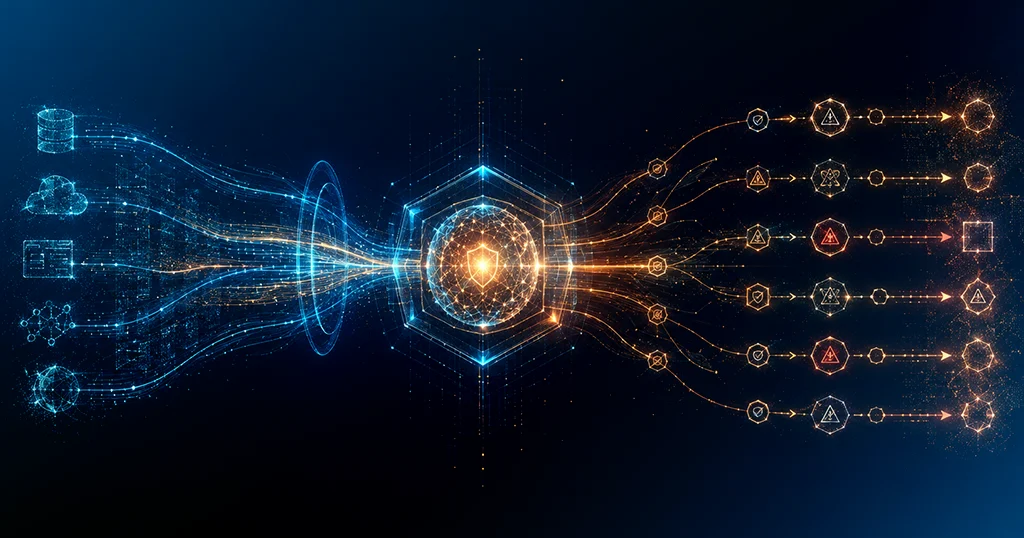
Data Inputs
Continuous security requires data streams such as:
- SaaS connected-app inventory and OAuth scopes (Salesforce, Google Workspace, etc.)
- Cloud control-plane logs, identity graphs, and telemetry
- API access patterns and anomaly detection
- Drift and configuration-change signals
Outputs
The system must produce:
- prioritized exposure maps (e.g., integration exposure by scope)
- attack-path narratives (how a compromised token could escalate)
- remediation workflows (token revocation, scope tightening, credential rotation)
- Contextualized threat intelligence
Human-in-the-Loop Governance and Explainability
Digital Security Teammates augment teams – they never replace human judgment. Human analysts maintain final approval authority for high-impact actions such as host isolation, permission revocation, and data quarantine – with full transparency into the teammate’s reasoning.
Measuring Effectiveness
Success metrics include:
- 30-40% reduction in MTTD, 45-55% reduction in MTTR
- Smaller exploitability-weighted vulnerability backlogs
- Measurable reduction in sensitive data exposure
FAQs
Do Digital Security Teammates replace Shift-Left security?
How does AI-driven analysis differ from traditional security monitoring tools?
What types of risks does Shift-Left miss that AI-driven continuous analysis catches?
How can AI-driven systems respond to newly disclosed vulnerabilities?
Conclusion
Shift-Left represents an essential evolution in secure development, enabling early detection of vulnerabilities and reducing remediation effort. However, its static nature prevents it from addressing risk introduced by mutable environments, emergent vulnerabilities, access changes, and dynamic system behavior.
AI-driven continuous analysis complements Shift-Left by delivering real-time environmental awareness, contextual reasoning, attack-path evaluation, vulnerability impact analysis, and actionable prioritization.
The combination of early-stage controls with ongoing AI reasoning forms a complete lifecycle approach to security in a world defined by constant change. Organizations that deploy both, preventing issues before production through Shift-Left and detecting emergent risks during production through AI, achieve a comprehensive security posture across the entire application lifecycle.