Understanding and Mastering Threat Exposure Management
Threat Exposure Management shifts security teams from drowning in endless CVE lists to fixing only what threatens the business now, prioritizing real-world exploitability over arbitrary CVSS scores.
By Secure.com
TL;DR
Threat Exposure Management connects technical vulnerabilities to real-world threats specific to your organization's environment and attack surface. It helps you identify the best course of action to eliminate or mitigate risk based on actual business impact.
Introduction
Traditional vulnerability management generates endless lists of CVEs ranked according to CVSS scores, often without considering exploitability, asset criticality, or business context.
Meanwhile, critical exposures that attackers actually exploit, misconfigured cloud storage, orphaned admin accounts, exposed APIs, receive no attention because they don't show up in traditional vulnerability scans.
TEM (Threat Exposure Management) is changing the way that security teams perform their day-to-day operations by shifting them away from being inundated with all potential vulnerabilities and concentrating only on those vulnerabilities that attackers may focus on targeting to cause harm to your business.
The fundamental shift is from "fix everything eventually" to "fix what threatens the business now."
Understanding Threat Exposure Management
What is Threat Exposure Management?
Threat Exposure Management (TEM) is the ongoing process of discovering, assessing, prioritizing, and addressing security exposures across your entire attack surface.
How is it Different?
TEM goes beyond traditional vulnerability scanning. It looks at misconfigured cloud resources, exposed credentials on the dark web, shadow IT apps, overly broad access permissions, third-party risks, and the attack paths that connect these weaknesses.
TEM is proactive, not reactive. Instead of waiting for a breach, it asks: "What could an attacker reach right now? How could they move next? How do we close those paths?"
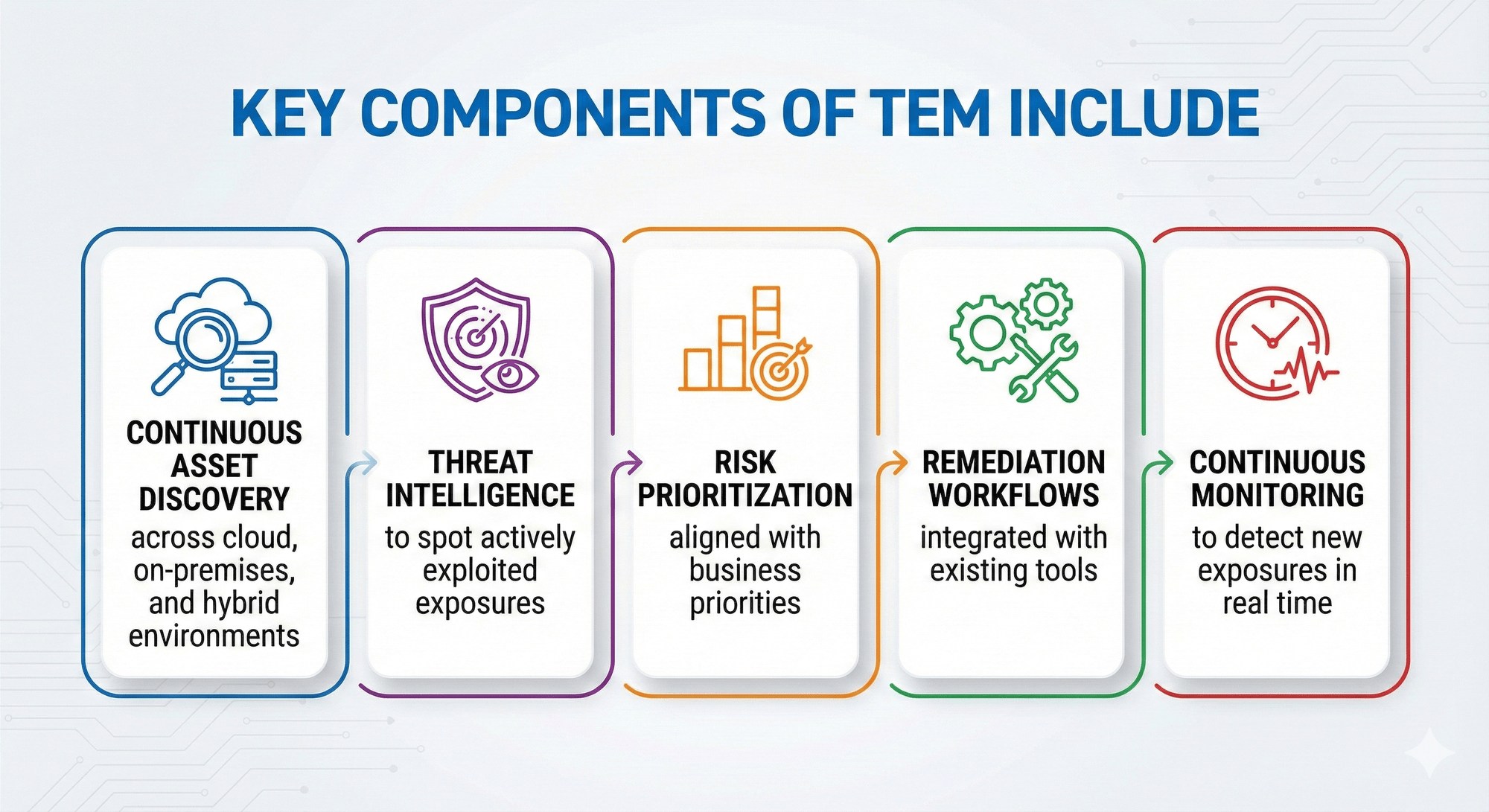
Key Components of Threat Exposure Management Include
How Does Threat Exposure Management Address Risks from Cloud and Hybrid Environments?
The Cloud or Hybrid Challenge
Hybrid environments make visibility even more complex. On-premises security tools may not see cloud workloads, while cloud-native solutions often miss connections to on-premises infrastructure. This creates dangerous blind spots where attackers can pivot between environments undetected, exploiting the seams in your security architecture.
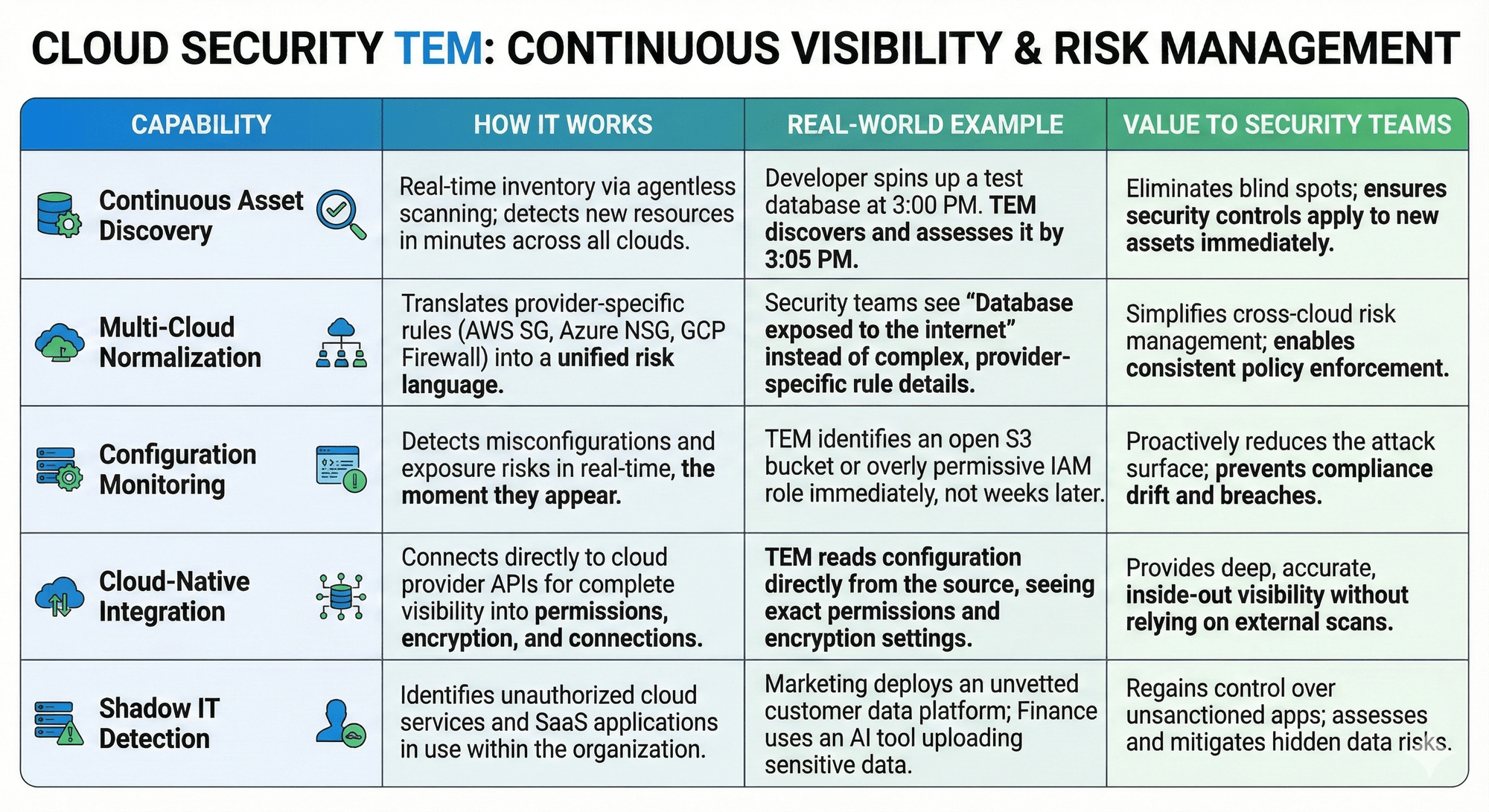
Threat Exposure Management Solutions for Cloud or Hybrid Environments
How Can Threat Exposure Management be Tailored for Organizations with Remote or Distributed Workforces?
Remote Workforce Security Challenges
Remote work demolished the network perimeter. Employees access production systems from home networks, coffee shops, and airports. Personal devices mix with corporate laptops in BYOD policies. Traditional "trust the internal network" security fails completely.
Endpoint security varies wildly. Corporate laptops receive managed updates and security software. Personal devices used for work might run outdated operating systems with no endpoint protection. Attackers specifically target remote workers through phishing campaigns designed to steal credentials.
TEM for Distributed Teams
Endpoint exposure assessment evaluates the security posture of remote devices: What operating system version is running? Are security patches current? Is endpoint detection software installed and functioning? Does the device meet baseline security requirements?
With remote work, identity has become the new security perimeter, a core principle of zero-trust architecture. Threat Exposure Management (TEM) keeps tabs on who can access what, from where, and at what time. It catches unusual behavior like a developer suddenly logging into financial systems at 2 AM from another country.
Behavioral analytics detects suspicious activity even when credentials are valid. For example, an employee logs in from their usual location but suddenly starts downloading customer databases they've never accessed before. Valid credentials, anomalous behavior—TEM flags it for review.
Zero-trust integration uses TEM data to inform access policies. Assets with high exposure receive the strongest access controls, multi-factor authentication, device compliance checks, and just-in-time privileged access. Lower-risk resources receive lighter controls to balance security with usability.
Credential exposure monitoring scans dark web markets and paste sites for compromised employee credentials. When employee passwords appear in breach databases, TEM alerts security teams for immediate password resets before attackers exploit them.
Third-party risk assessment evaluates exposures from contractors and vendors accessing systems remotely. That contractor helping with the website migration shouldn't have database admin rights. TEM identifies overly permissive third-party access and recommends restrictions.
Prioritization for Remote Work
Start by focusing on exposures that enable lateral movement from a compromised remote device. If an attacker compromises an employee's laptop, what systems could they pivot to? Close those attack paths first by implementing network segmentation and least-privilege access controls.
Pay close attention to credential risks. Remote employees are prime phishing targets, so enforce phishing-resistant multi-factor authentication (FIDO2/WebAuthn) and remove accounts with weak or missing protections.
Monitor shadow IT and unauthorized cloud services closely. Remote teams often adopt tools without security review to maintain productivity. TEM discovers these services so risks can be assessed and managed appropriately.
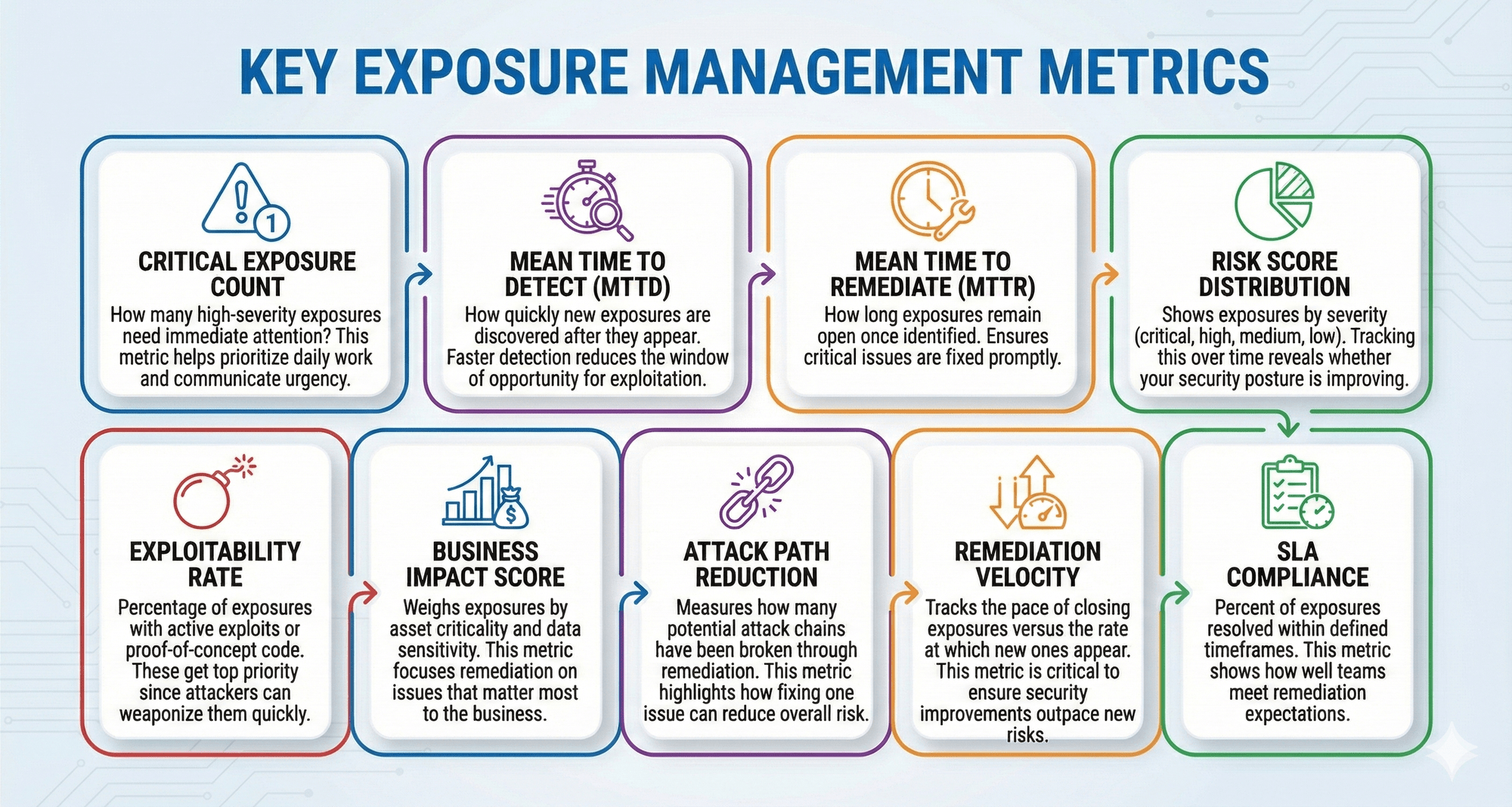
What are the Most Important Metrics to Track in a Threat Exposure Management Program?
Critical Exposure Count: How many high-severity exposures need immediate attention? This metric helps prioritize daily work and communicate urgency.
Mean Time to Detect (MTTD): How quickly new exposures are discovered after they appear. Faster detection reduces the window of opportunity for exploitation.
Mean Time to Remediate (MTTR): How long exposures remain open once identified. Ensures critical issues are fixed promptly.
Risk Score Distribution: Shows exposures by severity (critical, high, medium, low). Tracking this over time reveals whether your security posture is improving.
Exploitability Rate: Percentage of exposures with active exploits or proof-of-concept code. These get top priority since attackers can weaponize them quickly.
Business Impact Score: Weighs exposures by asset criticality and data sensitivity. This metric focuses remediation on issues that matter most to the business.
Attack Path Reduction: Measures how many potential attack chains have been broken through remediation. This metric highlights how fixing one issue can reduce overall risk.
Remediation Velocity: Tracks the pace of closing exposures versus the rate at which new ones appear. This metric is critical to ensure security improvements outpace new risks.
SLA Compliance: Percent of exposures resolved within defined timeframes. This metric shows how well teams meet remediation expectations.
How Does Threat Exposure Management Improve Communication between Security Teams and Business Stakeholders?
Threat Exposure Management (TEM) bridges the gap between security teams and business stakeholders by translating technical risk into business-relevant insights.
Focus on What Matters: TEM highlights the exposures that pose the biggest risk to critical systems and data. This makes it easier for security teams to show the business which issues need attention first.
Clear Dashboards and Reports: Executive dashboards show trends, remediation progress, and exposure reduction in plain language. Leaders can quickly see improvements and make informed decisions.
Translate Technical Risk into Business Impact: TEM takes technical vulnerabilities and translates them into insights that matter to the business. By looking at asset importance, data sensitivity, and potential consequences, it shows stakeholders the real-world impact of security issues.
Transparency in Remediation: Stakeholders can track how fast issues are found and resolved, how effective fixes are, and where additional investment might be needed.
Mastering Threat Exposure Management
Building an Effective Threat Exposure Management Program
Step 1: Continuously Discover Assets Across All Sources
Discover all types of assets (Cloud, On-Premise, Software as a Service, Endpoints) on a continuous basis because manual inventories age rapidly after completion. The goal is to provide a centralized inventory containing relationships between asset owners, criticality to the business, and dependencies. Enrich your inventory by integrating data from CMDBs, cloud platform APIs, and endpoint discovery tools to establish a single source of truth.
Step 2: Create the Enterprise Risk Prioritization Framework
Success in addressing risks to the business requires effective risk prioritization based on the impact on the business, not just the CVSS scores of the vulnerabilities discovered. Consider factors like asset criticality, regulatory requirements, threat intelligence, exploitability, and internet exposure to focus on risks that pose the greatest business impact. Define clear severity levels with associated remediation SLAs (e.g., Critical = 24 hours, High = 7 days, Medium = 30 days).
Step 3: Automate Remediation Ticket Creation and Assignment of Ownership
The next step is to automate the creation of Jira/ServiceNow tickets and route them to the correct owners (e.g., Cloud, Development, Infrastructure). Apply severity levels automatically and track remediation to closure, verifying that fixes actually eliminate the underlying risk.
Step 4: Enable Continuous Monitoring of Cloud Environments
All cloud environments should have continuous real-time monitoring implemented; on-premise environments should have scheduled scans to identify vulnerabilities. Configure real-time alerting for new vulnerabilities to enable rapid response. Use monitoring to measure security posture trends and verify that remediation actions have eliminated risks.
Step 5: Communicate & Report
Organizations should provide their senior executives with dashboards that convey a business focus, auditing-ready compliance reports, and remediation roadmaps that are shared with the entire organization. Demonstrate ROI by highlighting prevented breaches and quantifying the business impact of remediated exposures.
How Secure.com Enables Threat Exposure Management
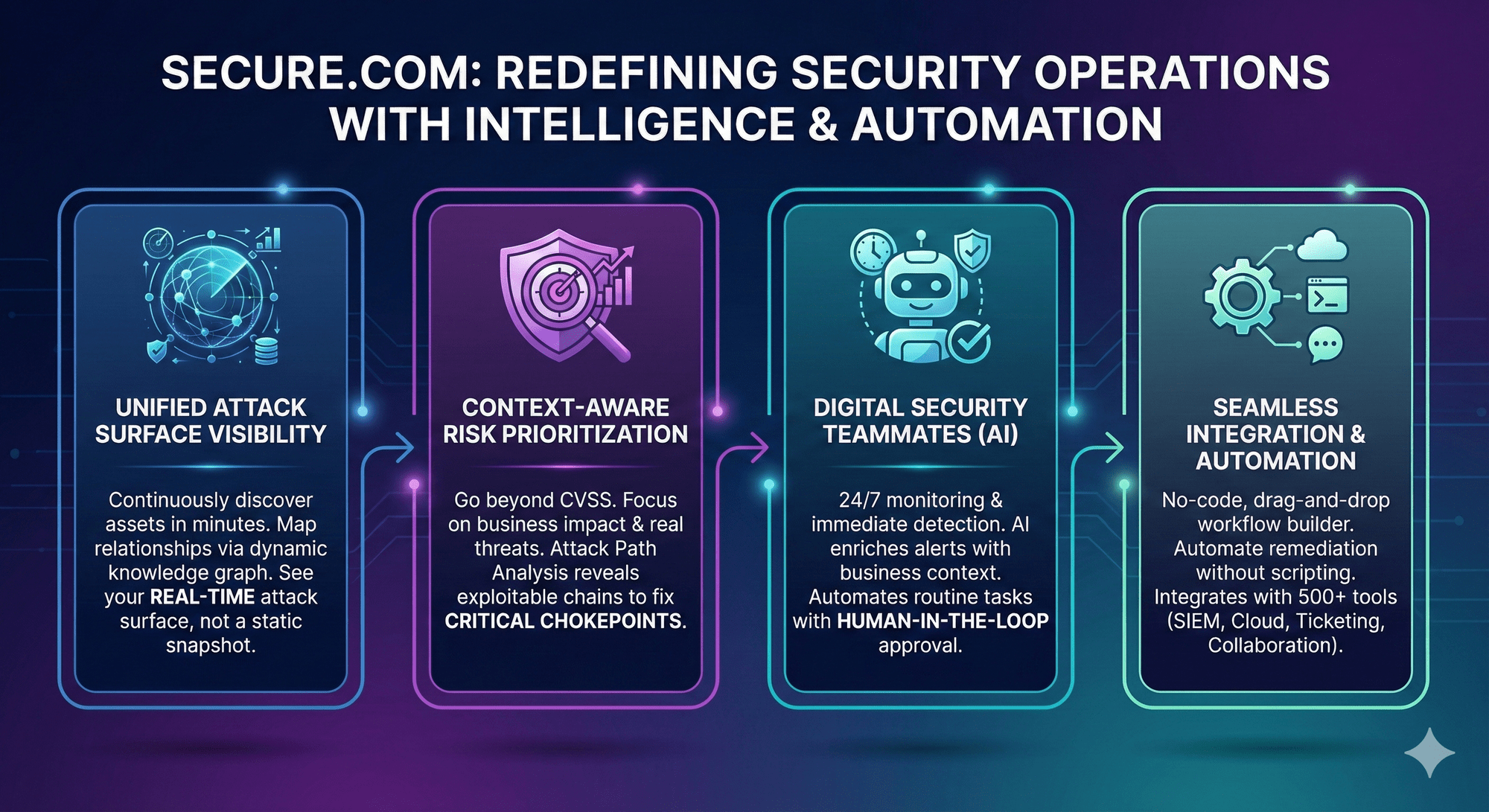
Unified Attack Surface Visibility
Secure.com continuously discovers assets across your environment, typically detecting new resources within minutes of creation, and maps relationships through a dynamic knowledge graph so you can see your real attack surface, not a static inventory snapshot.
Context-Aware Risk Prioritization
Rather than focusing only on CVSS scores, Secure.com highlights what really matters: the business impact, the importance of your assets, and real-world threat activity.
Digital Security Teammates
Digital Security Teammates monitor your environment around the clock, immediately identifying new threats and enriching alerts with business context. The AI will provide context for each new exposure so you know what the impact really is while also automating routine investigations and remediation workflows with human-in-the-loop approval for sensitive actions.
Seamless Integration and Automation
The no-code workflow builder enables security teams to automate remediation tasks without scripting, using drag-and-drop templates for common security use cases. Secure.com integrates with 500+ security and IT tools including SIEMs, ticketing systems (Jira, ServiceNow), cloud providers (AWS, Azure, GCP), and collaboration platforms (Slack, Teams).
FAQ
How is threat exposure management different from vulnerability management?
▼
Vulnerability management focuses mainly on software flaws (CVEs). Threat Exposure Management (TEM) takes a broader view—it looks at vulnerabilities, misconfigurations, leaked credentials, shadow IT, excessive permissions, and the attack paths connecting these weaknesses. TEM prioritizes what truly matters, using exploitability, business impact, and threat intelligence, not just CVSS scores.
Can small security teams implement threat exposure management effectively?
▼
Yes. TEM highlights the exposures that matter most. Automation and AI-powered Digital Teammates reduce manual work, letting small teams focus on the 50–100 issues that pose real business risk.
How does TEM integrate with existing security tools?
▼
Threat Exposure Management integrates seamlessly with your existing tools (scanners, cloud platforms, SIEMs, EDRs, and threat intelligence feeds) using APIs. It organizes and prioritizes findings, then sends remediation tasks directly into your current ticketing systems, giving you a clear, unified view of your entire security posture.
What's the typical timeline for implementing a TEM program?
▼
Initial discovery and exposure assessment can start in days. Integrating tools and workflows usually takes 2 to 4 weeks. Reporting and stakeholder alignment often take 4 to 8 weeks. Full program maturity, including optimized prioritization and automated workflows, typically develops over 3 to 6 months, with ongoing improvement.
How often should threat exposure assessments run?
▼
Continuously. Modern environments change fast, cloud resources, configurations, and new vulnerabilities appear daily. Continuous monitoring ensures exposure visibility stays current.
Conclusion: From Reactive to Proactive Security
One of TEM's most valuable benefits is the communication bridge it provides between security teams and business leadership. When executives understand risk in business terms and see quantifiable security improvement, they provide the resources and support security teams need.
Secure.com provides a unified platform for effective threat exposure management at scale: complete visibility across all environments, context-aware risk prioritization aligned with business impact, no-code remediation workflows, and executive-ready reporting with Security Score.
Discover how Secure.com's threat exposure management platform provides complete visibility and risk-based prioritization. Book a demo to see your attack surface mapped in real-time.