Key Takeaways
- A compliance framework that isn’t embedded in daily operations is just documentation waiting to fail.
- Map every control to a live system, a named owner, and an evidence source — not just a policy paragraph.
- Use common controls to satisfy multiple frameworks from one operational process.
- Replace annual audit sprints with continuous monitoring and automated evidence collection.
- Compliance culture requires visible leadership buy-in and role-specific training.
- Non-compliance costs 2.71× more than building a proper program from the start.
Introduction
In 2024, global fines for non-compliance hit $14 billion. Not because companies lacked compliance frameworks. Most had them. The problem was that those frameworks never made it into daily operations.
A policy document doesn’t stop a breach. A documented control that’s actively monitored does. There’s a big difference — and most teams are still stuck on the wrong side of it.
By The Numbers:
- $14.82M — avg. cost of non-compliance (vs. $5.47M to stay compliant)
- 85% — of companies say compliance has become more complex in 3 years
- 2.71× — more expensive to fail at compliance than to invest in it
Why Compliance Frameworks Stay on Paper?
Here’s the pattern: A team gets hit with a new regulation (SOC 2, ISO 27001, HIPAA, PCI DSS) and spends months building a framework. Policies get written. Controls get documented. An audit gets passed. Then everyone moves on.
Six months later, those controls haven’t been tested. New engineers don’t know they exist. Cloud configurations have drifted. The framework is still there—it just stopped describing reality.
This is what compliance professionals call a design gap versus an operating effectiveness gap – a control can look perfect on paper while being completely non-functional in practice. A control can be perfectly designed and completely non-functional at the same time. Research confirms that compliance gaps persist most often because of point-in-time audits, manual processes, fragmented ownership, and systems that change faster than controls can keep up.
The fix isn’t a better framework. It’s making the framework operational.
Where compliance gaps most often hide:
- Point-in-time audits — 82% of organizations
- Fragmented ownership — 74%
- Outdated documentation — 68%
- No automated evidence collection — 61%
- Insufficient training — 55%
Map Controls to Live Systems, Not Documents
The moment a control only exists in a Word doc, it’s already at risk of being wrong. Systems change. Access gets granted. Cloud buckets get misconfigured. The document stays the same.
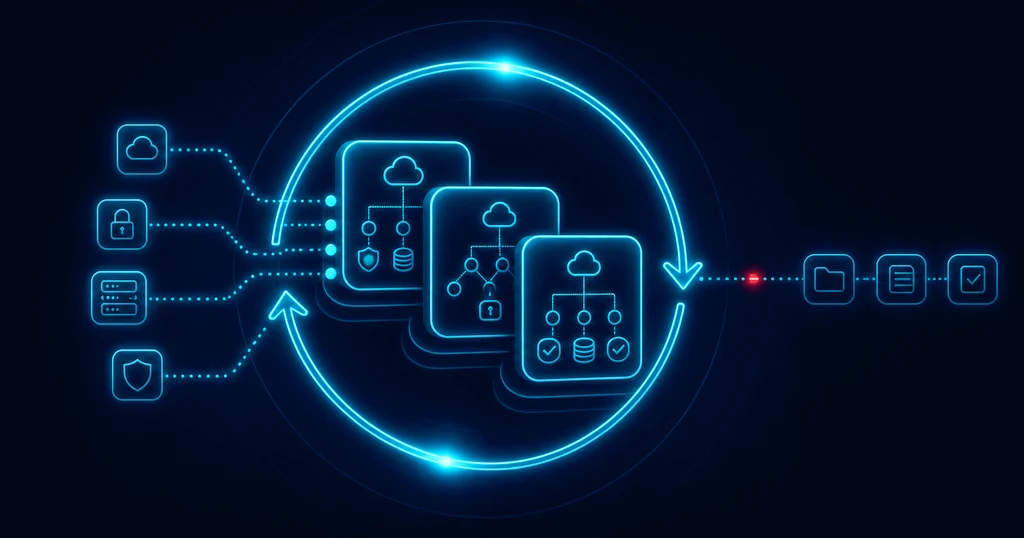
Operational compliance means every control maps to a specific system, owner, and evidence source. Not “we have an access control policy” — but “MFA is enforced on these 14 systems, owned by the IT team, and verified by automated log exports every 30 days.”
This is where common controls become a force multiplier. Many frameworks (SOC 2, ISO 27001, NIST, PCI DSS) share overlapping requirements. A unified control framework lets one tested control satisfy multiple requirements at once. Instead of four audit trails, you build one operational process that checks multiple boxes.
When control ownership isn’t assigned to the people who actually run the systems — cloud architects, devOps, application developers — gaps are inevitable, not occasional.
Framework → Operational Control Mapping
| Framework requirement | Operational control | Owner | Evidence |
|---|---|---|---|
| SOC 2 / ISO 27001 Access control |
MFA enforced on all production systems | IT / DevOps | Monthly access log exports |
| NIST / PCI DSS Incident response |
IR runbook tested quarterly | Security team | Drill records + post-mortems |
| HIPAA / SOC 2 Vendor risk |
Third-party security review at onboarding | Procurement + InfoSec | Vendor assessment forms, dated |
| PCI DSS / GDPR Data encryption |
Encryption at rest and in transit, enforced by config | Cloud / Infra team | Automated config scans |
Replace Annual Audits With Continuous Monitoring
Annual audits made sense when systems changed slowly. They don’t anymore. The average company now runs dozens of cloud services, ships code daily, and rotates vendors frequently. A 12-month snapshot doesn’t reflect that reality.
SOC 2 updates in 2025 are pushing toward continuous risk assessment and real-time monitoring — a signal that regulators know the annual model is broken too.
The practical version of continuous monitoring means:
- Automated evidence collection that runs on a schedule, not before audit season – with immutable audit trails and signed evidence generation
- Unified Security Command Board showing control status in real time, not just at reporting time – synthesizing risk posture, compliance status, and live threats into an executive-ready Security Score
- Alerts when a control drifts — new admin account, open port, expired certificate
- Regular internal reviews (monthly or quarterly) instead of one big annual scramble
Organizations using security automation reported $1.9 million lower breach costs and saved 80 days on average in identifying and containing incidents (IBM Cost of a Data Breach Report 2025). Automation isn’t just an efficiency play — it’s a risk reduction strategy.
Build a Compliance Culture That Outlasts Any Audit
Controls fail when compliance is a compliance team problem. It works when every team member knows their role in it.
That doesn’t mean making engineers read 80-page policy documents. It means making compliance visible and specific to each role. The developer needs to know why secrets management matters. The HR manager needs to understand data retention rules. The finance team needs to know what SOX requires — not in legal language, but tied to their actual daily work.
Putting a C-level compliance leader in place saves organizations an average of $1.25 million in compliance costs. Compliance programs with a formal charter save an additional $520,000 on average.
Compliance stops being a burden the moment people understand it’s the reason customers trust you, partners sign contracts with you, and regulators leave you alone to grow.
Conclusion
Compliance frameworks give you the map. Operational controls are how you actually drive. Most organizations have invested in the map and forgotten to fuel the car.
The shift isn’t complicated — but it is deliberate. Assign real owners. Map controls to live systems. Automate evidence collection. Monitor continuously. Make compliance visible to every team, not just the compliance team.
The cost of non-compliance isn’t just a fine. It’s business disruption, lost contracts, and customer trust that takes years to rebuild. The cost of doing it right? A fraction of that – and it compounds into a competitive advantage that accelerates sales cycles and strengthens customer relationships. The cost of doing it right is a fraction of that—and it compounds into a competitive advantage over time.
Want to see how Digital Security Teammates can turn your framework into a living control environment?
Explore how Secure.com supports automated compliance workflows.