TL;DR
Digital Security Teammates are AI-powered teammates that take on the security grunt work — triage, investigation, remediation, and compliance — so humans can stay focused on judgment and strategy, freeing human teams to focus on strategic work. Early deployments report dramatic gains: 70% reduction in manual triage workload, 45-55% faster MTTR (Mean Time to Respond), and 2,000+ hours saved annually. For CISOs and CTOs, the ROI is in higher productivity, lower costs, and reduced risk – making these AI colleagues a must-have, not an experiment.
Introduction
Security teams today face a capacity crisis: breaches are costlier than ever, while skilled analysts are scarce. IBM reports data breach costs averaging $10.22 million in the U.S. and $7.29 million in the Middle East. Cybersecurity Ventures estimates $10.5 trillion in global cybercrime damages and a 4.8 million-person talent gap, leaving SOCs drowning in alerts. Meanwhile, human analysts spend 50–70% of their time on low-level triage and administration.
Enter Digital Security Teammates – AI-powered colleagues designed to augment security teams by handling routine operational tasks. As one report puts it, these AI agents “act like security analysts, investigating alerts, triaging incidents, and automating compliance.” In other words, instead of just providing recommendations, they take action: connecting to your existing tools, correlating data across SIEM, EDR, cloud, and IAM, and even executing playbooks under human oversight. This shift means a teammate who “takes the night shift” and “catches what humans miss while explaining every action.”
The business impact is measurable. Security teams report a 70% reduction in manual triage workload through automated alert analysis and contextual risk prioritization, with Digital Security Teammates correlating events and surfacing only what truly needs human attention. Others report “2,000+ analyst hours saved annually” and a 70% reduction in manual triage workload through automated analysis. In short, digital colleagues are proving their ROI by crushing the tasks that once consumed hundreds of human-hours.
Key Takeaways
- Massive workload reduction: Digital Security Teammates automate 70% of routine triage work, with human approval required for high-impact actions, dramatically shrinking analyst queues.
- Analysts do higher-value work: Organizations report freeing 50–70% of a security analyst’s time for strategy and hunting, rather than monotonous triage.
- Faster response & fewer false alarms: Incident response times improve by ~45–55% and false positives can drop by up to 60% once Digital Security Teammates correlate events across your security stack using contextual intelligence.
- Rapid deployment: These systems deploy in 30 minutes and integrate with existing security stacks, with organizations seeing initial value within 30 minutes and ROI compounding over 1-2 quarters.
- Measurable ROI: Early adopters see clear metrics: 70% reduction in manual triage workload, 45-55% faster MTTR, and 100% transparent audit trail across incidents and compliance – translating to cost savings and risk reduction.
What Are Digital Teammates?
Digital Security Teammates (Secure.com’s AI-powered security colleagues) are software “colleagues” that autonomously execute tasks in IT and security workflows. Unlike basic RPA or chatbots, they understand context and take initiative. They don’t just follow fixed rules – they understand context and apply security logic across your integrated tools, surfacing only what truly needs human attention. For example, instead of an analyst manually sifting through hundreds of alerts, a Digital Security Teammate will correlate related events (across SIEM, endpoint, and cloud logs) and present a concise investigation brief. If a threat is confirmed, it can even run pre-approved remediation steps (like isolating an endpoint) under human oversight.
In short, think of them as AI-powered colleagues that augment your security team. As Secure.com’s CEO puts it, “security teams are drowning… We built Digital Security Teammates to work like real colleagues. They take the night shift, clear the queue, and catch what humans miss.” One Digital Security Teammate can handle the operational workload that would typically require multiple L1/L2 analysts, allowing teams to scale without adding headcount at a fraction of the cost. Digital Security Teammates operate 24/7 within your existing security infrastructure, continuously updating a knowledge graph of assets, relationships, and risks of your assets. Crucially, every action is explainable – an immutable “transparency trace” is logged for auditing – so CISOs stay in control even as mundane work gets automated.
Why They Matter for Security
The Security Workload Crisis
- Security operations are under relentless pressure.
- Organizations face thousands of daily alerts, often without sufficient staff to handle them.
- 84% of security professionals report chronic stress, and ~60% are considering quitting due to burnout — driven by alert fatigue, tool sprawl, and the weight of doing security the way it’s always been done
- Compliance and threat volumes continue to rise, yet most firms are not increasing spend, even as breach costs exceed $10M.
How Digital Security Teammates Help
- Automate baseline work: routine triage, ticket updates, vulnerability scanning, and patch verification.
- Allow human analysts to focus on advanced threat hunting, strategic defense, and incident storytelling.
- Early results demonstrate effectiveness: one 3-person SOC reduced manual triage workload by 70% via automated alert analysis.
- Organizations report up to 50% faster MTTR through automated investigation and response workflows.
Risk Reduction & Improved Security Outcomes
- Reduce false positives by correlating signals across multiple systems, improving alert accuracy.
- Enforce continuous compliance automatically, cutting weeks of audit prep down to days.
- Example: customers report significant reductions in audit preparation time through automated evidence collection.
- Digital Security Teammates help teams scale without adding headcount while elevating security:
- Enable teams to focus on high-judgment decisions.
- Free analysts to engage in strategic work rather than repetitive tasks.
Measuring ROI: Metrics and Examples
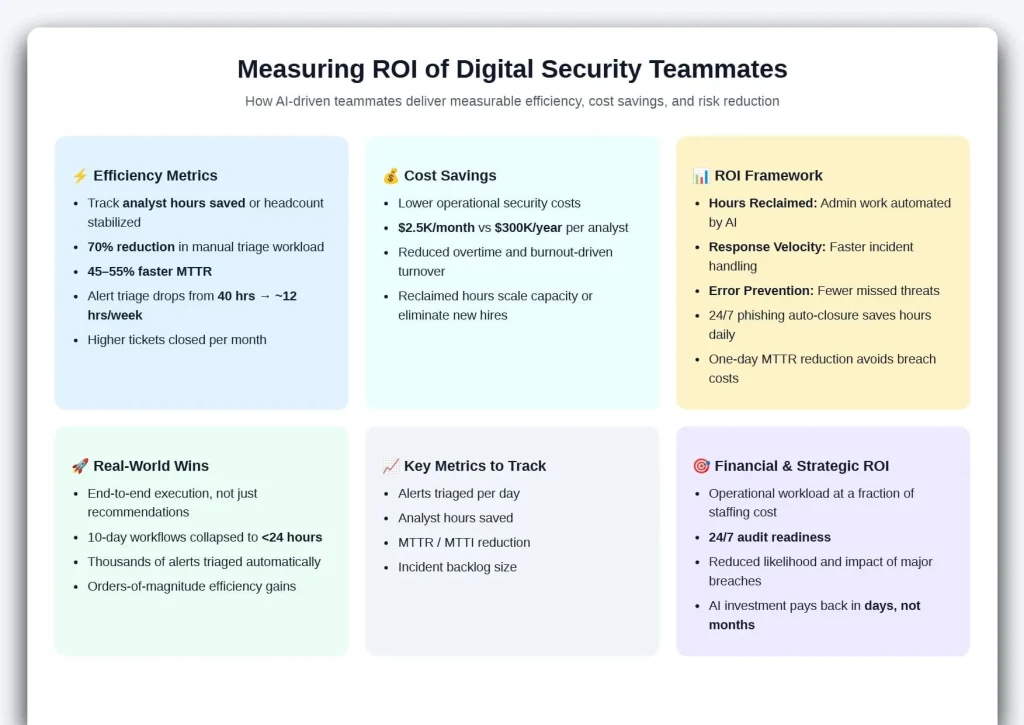
Efficiency Metrics
- Track analyst hours saved or headcount stabilized.
- Measure incident response time reduction; Secure.com shows 70% reduction in manual triage workload and 45–55% faster MTTR.
- Practical example: an analyst previously spending 40 hours/week on alert triage now spends only ~12 hours.
- Sales-focused metrics like MTTR and tickets closed per month also improve correspondingly.
Cost Savings
- AI automation reduces operational costs; specific savings vary by deployment.
- Digital Security Teammates handle workload equivalent to L1/L2 analysts at a fraction of the cost ($2.5K/month vs $300K/year per analyst).
- Reduce overtime and turnover costs; high turnover in security teams is mitigated by lowering repetitive-task burnout.
- Every hour reclaimed from repetitive tasks scales team capacity or reduces the need for new hires.
ROI Framework
- Research suggests benchmarking:
- Hours Reclaimed: Time spent on low-value admin work is now done by AI.
- Approval/Response Velocity: Percent of incidents/tickets delayed vs. accelerated.
- Error Prevention: Reduction in missed threats or compliance slips.
- Example: auto-closing routine, phishing false alarms 24/7 results in direct hours saved.
- Shaving a day off each critical incident resolution translates into avoided breach costs.
Real-World Wins
- Effective digital teammates autonomously execute end-to-end tasks rather than just suggesting actions.
- Schneider Electric collapsed a 10-day procurement cycle into under 24 hours using AI agents.
- In security, thousands of alerts are automatically triaged or remediated, yielding orders-of-magnitude efficiency boosts.
Key Metrics to Track
- Alerts triaged per day
- Analyst hours saved
- MTTR/MTTI reductions
- Incident backlog size
Financial & Strategic ROI
- One Digital Security Teammate can handle operational workload at a fraction of traditional staffing costs.
- Board-level ROI includes audit-readiness 24/7 and the prevention of large breaches.
- CISO insight: giving analysts real-time context saves hours per investigation, effectively paying back the AI investment in days.
How Secure.com’s DSTs Deliver ROI
Secure.com’s Digital Security Teammates (DSTs) provide immediate, measurable impact by integrating seamlessly into security operations.
Here’s how they deliver value:
Rapid Deployment
- DSTs connect with existing security tools in minutes.
- Unlike traditional big-suite solutions that may take months or quarters to configure, DSTs start delivering results within the first 30 minutes.
- Secure.com CEO: “DSTs deploy in minutes, work across the entire stack, and deliver value immediately.”
Continuous Knowledge Graph
- Once active, DSTs continuously ingest and analyze data.
- Build a live knowledge graph that maps every asset, identity, and risk pathway.
- Provides security teams with real-time context for faster and smarter decision-making.
Measurable Outcomes
- Organizations report 70% reduction in manual triage workload through automated alert analysis and prioritization.
- Teams reclaim thousands of analyst hours annually; one fintech firm recovered 2,000+ analyst hours per year.
- Key performance metrics include:
- 70% less manual security work
- 45–55% faster incident response
- Continuous audit readiness
ROI Impacts
- Reduces the need for additional headcount without compromising security coverage.
- Speeds threat containment, limiting breach impact.
- Helps prevent fines or downtime associated with compliance gaps.
Transparency & Trust
- Every DST action comes with an explainable audit trail, ensuring compliance and accountability.
- Designed to leverage human talent, not replace it.
- A single DST can handle work equivalent to a junior analyst plus engineer, allowing top analysts to focus on high-value tasks without burnout.
Tangible Business Value
- Integration in hours, compared to months for hiring and onboarding staff.
- Drives 45–55% faster MTTR and significant reductions in audit prep time.
- All outcomes are tracked and measurable, creating a strong business case for ROI at the board level.
FAQs
What exactly are Digital Security Teammates, and how do they differ from regular automation or chatbots?
DSTs are AI-powered security colleagues that act like junior analysts. Unlike rule-based bots or chatbots, they understand context, make decisions, and take actions autonomously. They can investigate alerts end-to-end, resolve issues, or escalate them—all with human oversight.
Do Digital Security Teammates replace human analysts?
No. They augment analysts, handling low-value, repetitive tasks so humans can focus on strategy, threat hunting, and high-judgment work. Analysts report being liberated from burnout, improving productivity and job satisfaction.
How should we measure ROI from Digital Security Teammates? What metrics matter?
Track hours saved, incident response speed, and accuracy (false positives avoided). Metrics include alerts triaged per day, percentage of alerts auto-closed, MTTR/MTTI improvements, and audit prep time saved.
How quickly can we deploy a Digital Security Teammate and see ROI?
DSTs can be deployed in 30 minutes to a few hours and start delivering value immediately. Alerts are triaged, reports generated, and improvements measurable within days—far faster than hiring new staff.
Can Digital Security Teammates help with compliance and auditing?
Yes. Every DST action is logged with full context, enabling continuous audit-readiness. They automate evidence collection, reduce audit prep time, and provide real-time compliance dashboards, ensuring organizations always have proof of adherence.
Conclusion
Digital Security Teammates represent more than a futuristic concept—they are an immediate strategic lever. The evidence is clear: organizations using Digital Security Teammates see measurable ROI across the board. “As AI agents become more capable, the question for security teams is no longer ‘Should we deploy them?’ – it’s ‘Which workflows should we hand over first?’ In other words, implementing Digital Security Teammates is rapidly becoming a standard best practice rather than an optional experiment.”
For CISOs, CTOs, and IT leaders, embracing Digital Security Teammates means supercharging lean teams, proving security’s business value, and shifting from reactive firefighting to proactive defense. In today’s threat landscape, automated intelligence isn’t just cool technology – it’s a business imperative for staying Secure.com and competitive.