
TL;DR
Attackers rarely trip one loud alarm. They leave a trail of small, quiet signals as they move from host to host. Correlation ties those signals together by user, asset, and time so your team reads one attack story instead of five random alerts. That means faster decisions, fewer missed breaches, and less analyst burnout.
Your SOC did not miss the breach because it lacked alerts. It missed it because five true alerts sat in five different queues, and nobody saw they were the same attacker. Lateral movement correlation is how you fix that.
What lateral movement actually looks like
Lateral movement is what an attacker does after they get in. They move deeper into your network to find data worth stealing.
The break-in is rarely the goal. Once inside one machine, the attacker looks around, grabs login details, and hops to the next system. They repeat this until they reach the good stuff.
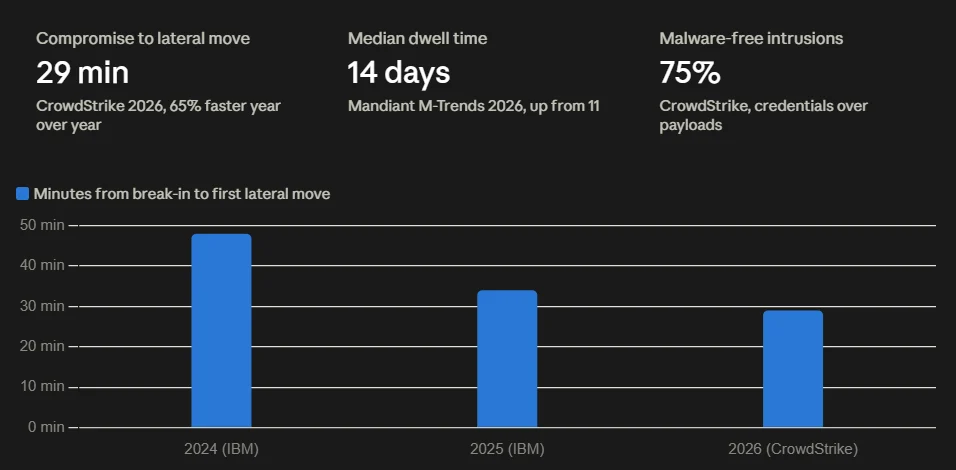
Here is the hard part. Most of this looks normal. Attackers use built-in tools and real credentials, not obvious malware. CrowdStrike found that 75% of intrusions in its 2026 data were malware-free, leaning on stolen logins and social tricks instead. So each step blends into daily traffic.
Why single alerts fail you
One alert is a data point. It is not a story. And a data point almost never tells you what to do next.
Think about a failed login. On its own, it means little. People fumble passwords all day. But a failed login, followed by a new admin token, followed by that same account reaching a file share it never touches, is a pattern. That pattern is an attack.
The problem is speed and scatter. These signals land in different tools at different times. Your SIEM shows the login. Your identity tool shows the token. Your endpoint tool shows the file access. No single screen shows the line connecting them.
The clock you are racing
Attackers move fast now, and the window to catch them keeps shrinking.
The average time from break-in to the first lateral move dropped from 48 minutes in 2024 to 34 minutes in 2025, per IBM research. CrowdStrike puts that interval at 29 minutes in its 2026 report, a 65% jump in speed year over year. In one case, data started leaving within four minutes of entry.
Dwell time, the gap between break-in and detection, tells the other half of the story. Mandiant’s M-Trends 2026 report puts the global median at 14 days, up from 11 the year before. Two weeks is plenty of time for an attacker to map your network, stage data, and pick a payday.
What lateral movement correlation does
Correlation groups related alerts into one case. It answers a simple question: are these separate problems, or one problem wearing five masks?
It connects the dots along three lines:
- Identity: the same user or account showing up across events, even on different machines.
- Asset: the systems being touched and how they link to each other.
- Time: the order and pace of events, which often reveals intent.
When the pieces line up, the tool builds a case narrative. That is a plain-language timeline: entry, privilege grab, movement, data access, exfil. Your analyst opens one case and sees the whole attack, not a pile of orphan alerts to sort by hand.
Alerts versus stories: a quick side-by-side
A raw alert says: “Account X accessed Server Y at 2:14 AM.” A case narrative says: “Account X, which failed login twelve times an hour earlier, gained admin rights, then reached three finance servers it has never touched. This matches an active attack pattern.” One makes you dig. The other makes you decide. That gap is the whole point of correlation.
How to build correlation that works
You do not need a bigger team to correlate better. You need the right approach.
- Pull signals into one place: identity, endpoint, network, and cloud logs. Correlation cannot connect what it cannot see.
- Key on identity first: most lateral movement rides on a valid account. Track what each account does across every system, not per tool.
- Watch behavior, not just known bad: lateral movement often uses clean tools. Flag the pattern, like an account reaching assets outside its normal lane, rather than waiting for a virus signature.
- Add asset context: an alert on a payment server matters more than the same alert on a test box. Context sets your priority.
- Keep a human in the loop: correlation should hand your analyst a clear story and a suggested next step, not act blindly.
How Secure.com helps
Secure.com gives you AI Teammates that do this correlation work with you, inside Slack or Teams, with your approval on every move.
- The SOC Teammate ties alerts across identity, endpoint, and network into one case, so your team stops chasing scattered signals.
- It builds a plain-language case narrative from entry to exfil, cutting the manual work of piecing events together.
- It ranks cases by asset and business context, so the real threats rise to the top.
- It runs on your own policies and environment, not generic playbooks, so the story fits your setup.
- It keeps humans in charge, pairing 24/7 coverage with your sign-off on action.
More from Secure.com