Key Takeaways
- XDR unifies detection across endpoints, network, and cloud — but it still sends alerts to humans for triage
- An AI SOC acts on those alerts: it investigates, triages, and responds, not just detects
- The two are not competitors — most mature security teams use both together
- Mid-market and lean teams benefit most from AI SOC because it covers the work an L1/L2 analyst would otherwise do
- Secure.com’s SOC Teammate layers on top of your existing XDR and runs cases end to end, without replacing what’s already working
Security teams have been sold a lot of promises. XDR was supposed to fix the alert problem. Then came AI, and now the market is full of “autonomous SOC” claims that all start to sound the same.
So let’s cut through it. AI SOC and XDR are not the same thing, they’re not interchangeable, and choosing between them isn’t the right question anyway. The real question is: what does your team actually need to stop drowning?
What XDR Does (and Where It Stops)
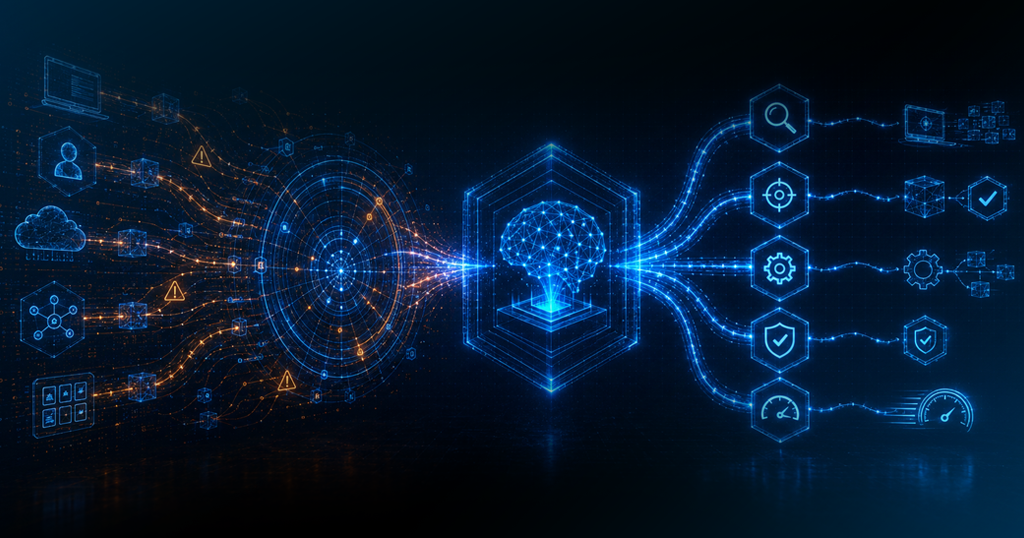
XDR — Extended Detection and Response — pulls telemetry from endpoints, networks, cloud environments, and identity systems into one place. It correlates that data, applies machine learning, and surfaces high-confidence incidents instead of thousands of individual alerts.
That’s genuinely useful. Instead of your team piecing together a suspicious login from identity logs, a PowerShell execution from endpoint data, and lateral movement from network traffic, XDR stitches it into one incident story.
What XDR doesn’t do is work the case after that.
The platform detects. A human still has to open the ticket, enrich the context, verify the threat, decide on containment, and execute the response. For enterprise teams with dedicated L1, L2, and L3 analysts, that pipeline works — slowly, but it works.
For lean teams with five analysts covering 24/7 operations across hundreds of endpoints, the manual triage bottleneck persists even with XDR.
Where XDR adds the most value:
- Reducing alert volume through cross-source correlation
- Giving analysts a unified view instead of five separate consoles
- Mapping detections to MITRE ATT&CK automatically
- Connecting endpoint (EDR), network, and cloud signals without custom integration work
Where it creates a bottleneck:
- Every correlated incident still needs a human to triage it
- Case management, investigation, and response are not automated
- Alert fatigue persists — the queue is smaller, but it still needs people to work it
What an AI SOC Actually Does Differently
An AI SOC doesn’t replace your detection layer. It handles what comes after detection.
Where XDR says “here’s a suspicious incident,” an AI SOC says “I’ve investigated it, enriched it with threat intel, cross-referenced the identity risk, checked the blast radius, and here’s what happened — contained or escalated with full rationale.”
That shift is architectural, not cosmetic.
Traditional SOC workflows are reactive: ingest, alert, triage, investigate, respond. Every step requires a human to pick it up and hand it off. AI SOC platforms automate the handoffs with intelligent agents that operate under human supervision that move through the workflow continuously, without waiting for someone to come online.
SIEM and SOAR are reactive systems that execute predefined logic. Digital Security Teammates use context-aware reasoning — gathering evidence from the knowledge graph, applying threat intelligence, and prioritizing based on asset criticality and exploitability rather than just executing static playbooks.
What an AI SOC adds on top of XDR workflows:
- Automated triage of the alerts XDR generates — not just summarization, but actual investigation
- Context-aware prioritization based on asset criticality, identity risk, and exploitability
- Pre-approved playbook execution (host isolation, account disablement, ticket creation)
- Case management with full audit trails, rationale, and timestamps on every action
- Escalation to humans only when the situation genuinely requires judgment
Digital Security Teammates can reduce manual analyst hours by up to 80% (from 1,039.5 hrs/month to 200 hrs/month in documented deployments) by enriching, scoring, and closing benign alerts without human intervention.
AI SOC vs XDR: How They Fit Together by Team Size
XDR vs AI SOC: How They Actually Compare
XDR
Extended Detection & Response
AI SOC
AI Security Operations Center
This is where most comparisons get it wrong. They treat AI SOC and XDR as competing choices. They’re not. The more useful question is: given your team size, which do you need to prioritize?
For lean and mid-market security teams (1–5 analysts)
XDR alone won’t solve your problem. You’ll still have more incidents than people to work them. An AI SOC fills the gap — handling Tier 1 and Tier 2 work that your team doesn’t have bandwidth for.
For mid-market companies with 500 to 10,000 employees, the distinction matters operationally. Traditional MDR providers function primarily as detection-and-escalation services. They identify suspicious activity, wrap it in a ticket, and send it back to your team for investigation. AI SOC platforms close that loop.
The best setup for lean teams: keep your XDR for detection coverage, layer an AI SOC on top to work the cases it generates.
Which does your security team need most?
1–5 Analysts
Mid-market · 500–10,000 employees
10+ Analysts
Dedicated SOC · 10,000+ employees
The question isn’t AI SOC or XDR. It’s what you put on top of your XDR to make it actually work for your team size and capacity.
For enterprise teams (dedicated SOC with 10+ analysts)
XDR is table stakes. You probably already have it. The AI SOC layer is about scaling your L1 capacity without scaling headcount. Gartner estimates agentic SOC penetration at just 1–5% of enterprises, with 60% of SOC workload expected to shift to AI in the near term. Enterprise teams that adopt early gain a meaningful edge on response times.
Quick comparison:
| Category | XDR | AI SOC AI-Powered |
|---|---|---|
| Primary Job | Detect and correlate threats | Investigate and respond to them |
| Alert Handling | Reduces volume, still needs humans | Triages and works alerts autonomously |
| Case Management | Limited or manual | End-to-end, with audit trail |
| Works Across Vendors | Varies by platform | Designed to sit on top of any stack |
| Best For | Detection coverage across environments | Closing the gap between detection and response |
When the Real Problem Is Neither Detection Nor Response – It’s Capacity
Most security teams don’t have a detection problem. XDR has largely solved that. They have a capacity problem.
Cybercrime damages have reached $10.5 trillion globally, the cybersecurity talent gap has widened to 4.8 million unfilled roles, and security teams continue to drown in thousands of alerts a day from tools they cannot staff or manage.
The math is brutal. You can have the best XDR in the market and still miss a critical incident at 2 AM because nobody was awake to work it. SOC leaders face hiring cycles averaging 247 days, with analyst salaries around $300,000 per year, and intense competition for experienced analysts
This is where Secure.com’s SOC Teammate is built to operate.
The SOC Teammate isn’t a tool you install and configure. You onboard it like a new hire — give it a name, assign responsibilities, and connect it to your existing stack. — it ingests signals from your SIEM, EDR, IAM, cloud, and email security platforms, runs the investigation, applies threat intel enrichment and MITRE correlation, executes pre-approved playbooks, and escalates only when human judgment is actually needed.
Secure.com builds explainability into the product architecture through AI Trace — every decision includes a rationale log showing exactly what the Teammate evaluated and why. The audit trail, approval workflows, and reasoning paths are core features, not marketing claims. Every automated action is logged, timestamped, and reversible — so your team isn’t just trusting a black box, they’re reading exactly what happened and why.
(MTTD)
(MTTR)
per Teammate
out of the box
Onboard like a new hire. Results from day one.
FAQs
Does AI SOC replace XDR?
Which SOC problems does AI SOC solve that XDR doesn’t?
How does an AI SOC improve outcomes from alerts generated by XDR?
When should lean security teams choose AI SOC over adding more XDR capabilities?
Conclusion
XDR made detection better. Digital Security Teammates make response possible at scale — without scaling headcount.
For most security teams in 2025, the gap isn’t between tools — it’s between alerts generated and cases actually worked. XDR narrows the alert volume. An AI SOC closes the gap entirely by running the investigation and response that humans don’t have time for.
If your team is lean (1-5 analysts), cloud-first, or analyzing only 40-50% of alerts due to capacity constraints, the question isn’t “AI SOC or XDR.” It’s “what do I put on top of my XDR to make it actually work for me?”
Secure.com’s SOC Teammate was built for exactly that question. See how it works or talk to our team about your specific environment.