TL;DR
Around 40% of security alerts are never investigated at all, according to survey data covering nearly 300 CISOs and SOC practitioners. The bottleneck is not detection. It is investigation capacity. AI investigation agents close that gap by pulling context from your SIEM, EDR, and identity provider, running the full enrichment sequence on every alert, correlating related events into a single case, and escalating only what needs a human. Analysts stop building investigations and start reviewing them.
What Happens to SIEM Alerts That Analysts Cannot Investigate
Nothing happens. That is the honest answer.
Alerts get bulk closed, auto suppressed, or left sitting in a queue until the retention window clears them out. Prophet Security’s survey of nearly 300 CISOs and SOC leaders put the median team at roughly 960 alerts per day, with about 40% never investigated.
The Suppression Trap
Most teams respond to volume by tuning. Raise the severity threshold. Add an exclusion list. Suppress a noisy category.
The queue shrinks and the dashboard calms down. But every suppressed alert is a detection your team paid to build and then chose to stop reading.
Where Attackers Actually Live
Intezer analyzed over 25 million alerts across live enterprise environments for its 2026 AI SOC Report. Nearly 1% of confirmed incidents started from alerts originally labeled low severity or informational.
For an organization generating roughly 450,000 alerts a year, that works out to about 50 real threats annually that nobody looked at. Roughly one per week.
Verizon’s 2024 DBIR found that in 74% of breaches, alerts were generated but ignored.
How to Use AI to Investigate All SIEM Alerts
The goal is not to reduce how many alerts you see. It is to remove the human cost of investigating each one.
An AI investigation agent runs against every alert, regardless of severity label. It does not score and skip. It investigates and resolves.
Why Coverage Beats Filtering
Filtering assumes the severity label is trustworthy. Severity gets assigned at alert creation, before any context exists.
A domain controller and a lab endpoint can generate the same medium severity alert. Only investigation tells you which one matters.
The Math That Forces the Change
An analyst investigating at 40 alerts per hour covers roughly 320 alerts in an eight hour shift. A SIEM producing 100,000 alerts a day would need 312 analysts running non stop.
Nobody has 312 analysts. So the choice is not between investigating everything and investigating selectively. It is between AI investigating everything and nobody investigating most of it.
How Does AI Automatically Investigate Alerts From SIEM
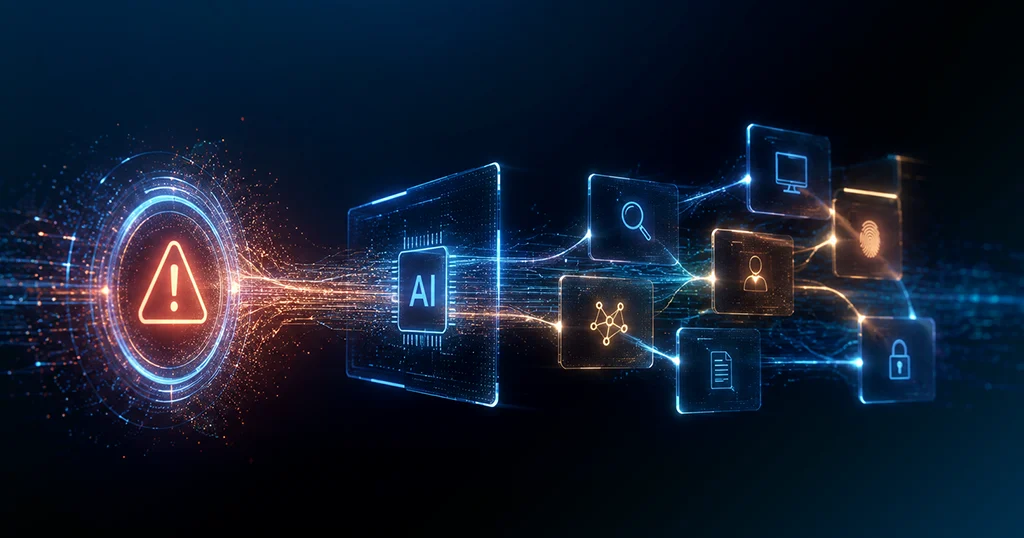
The investigation itself is a sequence. AI does not guess at the answer. It walks the same steps a competent L1 analyst would, faster and without skipping.
Step One: Ingest and Parse
The agent pulls the alert from your SIEM through native APIs and parses the raw fields into a normalized structure. Formats like OCSF handle this so a Wazuh alert and a Splunk alert land in the same schema.
Step Two: Enrich Against Threat Intelligence
Every IP, domain, and file hash in the alert gets checked against CTI feeds. STIX and TAXII feeds supply the indicators.
An IP with no reputation history is different from an IP tied to a known ransomware affiliate. That distinction changes the verdict before anything else happens.
Step Three: Pull Identity and Behavioral History
The agent queries the identity provider for the user’s login history, device fingerprints, and privilege level. It runs impossible travel checks.
A login from a new country is noise if that user travels weekly. It is a finding if they have logged in from one office for two years.
Step Four: Correlate Events on the Host
An alert in isolation tells you one thing happened. Correlation tells you what happened around it.
The agent checks adjacent processes on the endpoint, recent change events, and activity on connected assets. Analysts skip these lateral checks under time pressure. The agent does not.
Step Five: Map to Adversary Behavior
Findings get mapped to MITRE ATT&CK tactics and techniques. That mapping converts a pile of evidence into a narrative about what an attacker was attempting.
Step Six: Deliver a Verdict With Evidence
The agent produces a verdict of true positive, false positive, or needs human review, along with the reasoning chain and the evidence behind it.
Auditability matters here. When a closed alert later resurfaces inside a confirmed incident, you need to reconstruct what the agent knew and why it decided what it did.
How Does AI Create Investigation Cases From SIEM Alerts
Alerts are events. Cases are stories. The distinction is what makes an investigation useful.
Correlating Alerts Into a Single Case
Five alerts firing on the same host inside twenty minutes are not five investigations. They are one intrusion with five symptoms.
The agent groups alerts by shared entities: the same user, the same asset, the same source IP, the same time window. VERIS provides a standard structure for documenting the resulting case.
What the Case Contains
A finished case includes the triggering alerts, the enrichment results, the identity context, the attack path, the affected asset and its owner, the ATT&CK mapping, and a proposed set of response actions.
An analyst reads that in two minutes. Building it manually takes an hour.
How to Correlate SIEM Alerts Into Investigation Cases
Correlation is not deduplication. Deduplication removes copies. Correlation builds relationships.
Correlate on Entities, Not Rule Names
Two alerts from different detection rules can describe the same activity. Two alerts from the same rule can describe unrelated activity on different assets.
Group on the entity: user, host, IP, hash. That is where the relationship lives.
Correlate Across Tools, Not Just Within the SIEM
ESG research shows the average SOC touches more than 20 tools to complete a single investigation.
Your SIEM sees the log. Your EDR sees the process tree. Your identity provider sees the authentication. None of them sees all three. The correlation layer has to sit above them.
How to Prioritise Which SIEM Alerts to Investigate First
Here is the reframe: when AI investigates every alert, prioritisation stops being about which alerts to open. It becomes about which finished investigations reach a human.
Rank by Business Impact, Not Severity Label
Asset criticality, user privilege, data classification, and exploitability belong in the ranking. Severity does not carry that information.
An informational alert on a cardholder data server outranks a critical alert on a test box every single time.
Escalate on Confidence Plus Consequence
Two dimensions decide what a human sees. How confident is the agent that this is malicious, and how bad is it if the agent is wrong.
High confidence benign on a low value asset closes automatically. Low confidence on a crown jewel goes to a senior analyst.
How Does AI Prioritise SIEM Alerts for Human Analysts
The escalation queue should be short and every item in it should deserve a person.
Cabinetworks ran 3,200 alerts through an AI investigation platform over 33 days. Six escalated to a human.
What Analysts Get Instead of a Queue
An analyst opening an escalated case sees a completed investigation with a verdict, a reasoning trail, and prepared response actions waiting for approval.
The work shifts from evidence gathering to judgment. That is what analysts were hired for.
How to Use AI to Cover SIEM Alerts Overnight
Attackers do not observe your shift schedule. Your coverage model should not either.
The SANS 2025 survey found that 79% of organizations running 24/7 operations hit peak alert fatigue during shift transitions, when context gets lost between teams.
Continuous Investigation, Not Continuous Staffing
An AI agent working the overnight queue runs the same investigation depth at 3 AM as it does at 3 PM. There is no fatigue curve and no handoff gap.
The morning analyst arrives to completed cases and a short escalation list, not a backlog.
Handoff Without Context Loss
Every investigation writes its reasoning into the case record. The incoming shift reads what happened and why, instead of reconstructing it from a Slack thread.
How to Handle SIEM Alerts Lean Teams Cannot Investigate
A four analyst SOC investigates somewhere between 300 and 400 high fidelity alerts a week. 90% resolve as benign.
Hiring does not scale here. The global cybersecurity workforce gap sits at 4.8 million professionals, per ISC2’s 2025 study. The seats you want to fill do not have people in them.
Automate the Depth, Not the Decision
Lean teams should hand over the investigation work and keep the response authority.
Every containment action, host isolation, account disable, token reset, runs behind a human approval gate. The agent prepares the action. The analyst approves it.
Bring Low and Medium Severity Back Into Scope
Most SOCs quietly stopped investigating low and medium alerts under capacity pressure. Leadership knows about the gap and cannot resource closing it.
That gap is exactly where patient attackers operate. When investigation capacity stops being the constraint, those tiers come back into coverage.
How to Reduce Time to Investigate for SIEM Alerts
Average alert investigation runs about 70 minutes, with 56 of those minutes elapsing before anyone acts, according to Cybersecurity Insiders 2025 data.
Most of that time is context gathering. Almost none of it is thinking.
Kill the Swivel Chair
An analyst pivoting between six consoles to assemble one picture is doing data engineering, not security.
AI agents query source systems directly and assemble context in parallel. What takes a human 56 minutes takes an agent under two.
Measure the Right Delta
Track the gap between investigation_started and investigation_completed. That delta is your automated investigation duration and the honest measure of what automation returned.
MTTD and MTTR follow from it. Hours saved is a downstream number, not the target.
How Can Security Analysts Use AI to Investigate Faster
Speed comes from removing steps, not rushing them.
A 2025 Cloud Security Alliance benchmark study across 148 SOC analysts found AI assisted investigations ran 45% faster for cloud security alerts and 61% faster for identity and access alerts.
Ask the Agent, Then Verify
Analysts working alongside an AI teammate treat its output as a starting hypothesis with evidence attached, not a verdict to accept blindly.
Where the reasoning is visible, the analyst can check the weak link instead of redoing the whole investigation.
Junior Analysts Learn From Traced Reasoning
An agent that shows its work is a teaching tool. Junior analysts see what a structured investigation looks like on real incidents, repeatedly.
That exposure builds the pattern recognition that used to take years of manual triage to develop.
How Secure.com Handles Automated Alert Investigation
Secure.com’s SOC Teammate runs autonomous triage on alerts from Wazuh, Splunk, CrowdStrike, and other sources connected through Fabric, our integration layer.
When a suspicious login fires, the Teammate ingests and parses the alert, enriches the IP against threat intelligence, analyzes the user’s login history for anomalies, correlates related events on the host, and drafts a complete summary. It then sends a direct Slack message with its confidence rating and a link to the full investigation.
Telemetry normalizes through OCSF. Detections map to MITRE ATT&CK. Intelligence enrichment runs on STIX and TAXII. Cases document through VERIS and log into the Risk Register with full compliance context.
Response workflows execute through Pinecone, our orchestration layer. Host isolation, account disable, token rotation, and owner notification all run with human in the loop approval. Nothing containment related fires without a person clicking approve.
Every investigation carries traceable reasoning and the evidence behind it. The teammate does the L1 work. Your analysts keep control.
FAQs
Does AI investigation replace my SIEM?
No. The AI agent queries your SIEM through its API and pulls additional context from EDR, identity, and cloud tools. Around 44% of organizations prefer augmenting their SIEM over replacing it, per D3 Security. The agent sits beside it, not on top of it.
Can AI investigate alerts it has never seen before?
Yes, if it builds the investigation from evidence rather than executing a pre written playbook. Static playbooks run identical steps regardless of context. Agent based investigation generates the next step from what the previous step returned.
What stops AI from closing a real threat as benign?
Auditable reasoning and confidence thresholds. Every closure records what the agent examined and why it decided. Low confidence closures route to a human. A confident false negative is harder to catch than an uncertain human closure, so the confidence model matters more than the speed.
Will AI investigation let me cut SOC headcount?
Gartner cautions that AI enabled SOCs reshape skill requirements rather than reduce them. What changes is what analysts spend time on. You still need experienced people to investigate escalations and tune the agent.
How long before an AI agent starts producing useful investigations?
It depends on integration depth, not model training. The agent needs API access to your SIEM, EDR, and identity provider. Once those connections exist, investigation starts immediately because the reasoning comes from your data, not from historical labels.
Does this work for a five person security team?
Lean teams see the largest relative gain. A small team cannot manually cover a five figure daily alert volume, but it can review a short escalation queue and approve prepared response actions.