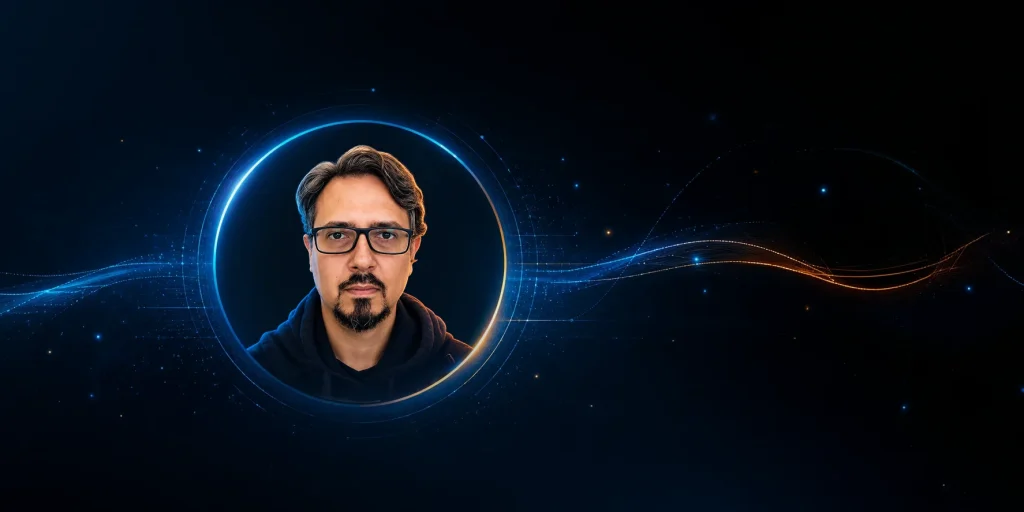
Some engineers spend their careers making models more accurate. Omer Bhutta has spent his time making them useful, turning the messy signals inside an enterprise into decisions a business can actually act on.
Over nearly a decade, he has led machine learning and AI initiatives across consumer goods, financial services, and healthcare, building demand forecasting systems, credit risk models, fraud detection, and document matching engines that stood up to the demands of production.
His work has always lived at the same intersection: raw data on one side, real operational action on the other. Now he brings that discipline to Secure.com as Head of AI and ML, pointing it at a domain where the cost of a wrong decision is far higher and the adversary adapts to every move you make.
We sat down with Omer to talk about his path from forecasting markets to defending them, what it takes to build AI that security teams can genuinely trust, and where he believes the field is heading next.
From Forecasting Markets to Defending Them
Secure.com: You spent nearly a decade building AI for demand forecasting, credit risk, and supply chains before security. What made cybersecurity the problem worth pivoting to, and what surprised you once you got inside it?
Omer Bhutta: Discovering old patterns in new guises in new domains is one of the weird privileges of working in AI/ML/Data.
I kept solving the same problem in different costumes. Forecasting, credit risk, fraud — underneath, it was always: take a flood of noisy signals, figure out which ones matter, and hand someone a decision they can act on before the window closes. Security is that problem with the difficulty turned all the way up. The volume is higher, the latency tolerance is lower, and the thing you’re modeling is actively trying not to be modeled.
What surprised me was how much of the pain is everything other than the detection. Security teams are drowning in alerts, and the interesting gap is between an alert firing and a human knowing what to do about it. That’s a decision problem, not a classification problem, and it’s exactly the kind of gap I find worth solving for.
Secure.com: Your work has always been about turning raw signals into action, whether that’s a sales forecast or a fraud flag. How does that translate when the “signal” is a security alert and getting it wrong has very different consequences?
Omer Bhutta: In demand forecasting, a wrong call costs you inventory. In credit, it costs you a loan. In security, a false negative can cost you the company, and a false positive costs the analyst’s trust.
So the translation is about respecting both failure modes at once. Ranking matters more than raw accuracy. Confidence has to be calibrated. And every output needs to arrive with its reasoning attached, because an analyst who understands why something was flagged can correct the system when it’s wrong.
When the Data Fights Back
Secure.com: Forecasting a market and defending a network both deal with uncertainty, but an attacker adapts to your model in a way that consumer demand never does. How does building AI against an adversary change the way you design systems?
Omer Bhutta: Consumer demand doesn’t read your model and change its behavior to slip past it. Attackers do. That flips a core assumption: that yesterday’s data is a reasonable proxy for tomorrow.
Practically, that pushes towards a few things. Index on behavior that is difficult or expensive to fake. Assume decay. Build monitoring to catch drift. Treat your own system as an attack surface. Prompt injection, poisoned inputs, adversarial evasion — if I’m deploying an AI agent inside a security stack, I have to assume someone will eventually try to turn it against the people it’s meant to protect.
Secure.com: Trust is everything in security. How do you build models powerful enough to act on their own, yet transparent enough that an analyst can defend every decision to an auditor or a board?
Omer Bhutta: I learned this in other regulated domains before I ever touched security. When e.g. a model declines someone a loan, a regulator will eventually ask why, and “the neural network said so” is not an answer. That makes explainability a core architectural constraint you design around.
For security, that means every actionable decision the system makes carries a trail. The bar is: could an analyst who wasn’t there reconstruct the decision and either defend it or overrule it? If not, the system isn’t ready to act alone. Autonomy earns its scope through that kind of transparency.
The Unglamorous Work That Matters Most
Secure.com: You’ve worked with knowledge graphs and contextual decision systems. In security, context is the hard part, knowing which alert actually matters. What’s the piece of that problem people underestimate most?
Omer Bhutta: It’s true that an alert in isolation is nearly meaningless. The same alert, connected to a privileged account that changed roles three days ago and is now touching a system it’s never touched, is a story.
The underestimated work is the plumbing: getting those relationships into one place, keeping them current, and making them queryable in the seconds you have when something fires. It’s unglamorous, and it’s where most of the value is.
Secure.com: There’s a real tension between letting AI act autonomously and keeping humans in control. Where do you think that line belongs today, and does it move as the models get better?
Omer Bhutta: There are a few design principles one can use to determine where the line is for any given trajectory. Here’s a few. How hard is it to reverse? What’s the blast radius of getting it wrong? How frequently does the system get this kind of decision right? Can we cheaply validate it post-hoc? You’ll notice that most of these are attributes of the trajectory itself, not the quality of the decision. The latter does matter enormously, of course, and keeps getting better as models and context engineering improve over time. So yes, I do expect the line to move. But with some irreducible holdouts that depend more on the nature of the decision instead of its quality.
Secure.com: What’s one thing about AI in cybersecurity that’s hyped far beyond reality, and one thing that’s genuinely underestimated?
Omer Bhutta: Overhyped: A decision engine that fully replaces analysts instead of augmenting them.
Underestimated: AI’s ability to understand your own environment before anything goes wrong.
Secure.com: A lot of leaders frame AI as replacing security analysts. You’re building systems meant to work alongside them. What does the analyst’s job actually look like five years out?
Omer Bhutta: I think less triage, more judgment. More like a team lead and backstop.
Why Secure.com
Secure.com: You could have kept building decision intelligence in verticals you already knew well. What convinced you Secure.com’s approach to autonomous security teammates was the right bet?
Omer Bhutta: Two things. First, the framing. “Teammate” is a deliberate word, and it matches how I think good AI should work: it takes on real work, it’s accountable for it, and it operates inside a team rather than above it.
Second, the timing. The models are finally good enough to reason across context and take multi-step action reliably, and the attackers are already using them. That combination means the next few years will decide what the default security team looks like. I wanted to be somewhere that gets to shape that answer.
Secure.com: Your background runs deep in mentorship and building teams. What do you look for in an engineer who wants to work at the intersection of AI and security?
Omer Bhutta: Curiosity about the domain over fluency in the toolkit. Care about how an attacker thinks or why an analyst is frustrated. The best people I’ve worked with treat the users as the most interesting part of the problem.
I also look for people who are comfortable being wrong in public. This field moves too fast for anyone to have it all figured out, and a team where people hide uncertainty is a team that ships brittle systems. Finally, I want people who can finish. Prototypes are easy. Getting something into production, watching it fail in ways you didn’t anticipate, and still caring enough to fix it – that’s the whole job
Secure.com: Some of your best-known work turned raw data into something a business could act on. Outside the technical craft, what shapes how you think about building AI that people would be surprised to learn?
Omer Bhutta: Incentives, affordances and Goodhart’s law! Although I suspect none of these would be surprising.
Final Thoughts
Omer’s path says a lot about where Secure.com is headed. Security work is piling up faster than teams can clear it. Alerts fire all day, but the hard part is not spotting them. It is knowing what to do next, fast, without handing a machine more control than it has earned.
That is the problem Secure.com is built to solve. Its AI Teammates take on the repetitive work inside limits the customer sets. They attack to find what is exploitable, harden what they find, and prove the fix held. The team still sets the rules. The Teammates do the work.
That is what governed defense looks like, and it is why Omer bet his next decade on it.