Key Takeaways
- A point-in-time audit only proves you were compliant on the day the auditor showed up, not the other 364 days of the year.
- Continuous compliance monitors your controls in real time, so gaps get caught the day they happen instead of weeks or months later.
- The global average cost of a data breach reached $4.88 million in 2024 (IBM Cost of a Data Breach Report)
- Most compliance teams do not need to rebuild their whole program. They need to automate evidence collection for their highest-effort controls first, starting with access management and vulnerability management, which typically consume the most audit prep time.
A compliance manager at a mid-sized SaaS company once told us she spent three weeks every January getting ready for her SOC 2 audit. Two days before the auditor showed up, she found admin accounts on three servers that had been missing MFA for eight weeks—nobody had noticed. The audit still passed, barely, but the real problem was never the missing MFA; it was the eight weeks nobody caught it.
That story is not rare—it is the default outcome of point-in-time audits, and it is exactly why so many teams are rethinking how they prove compliance in the first place.
What a Point-in-Time Audit Actually Checks (and Misses)
A traditional audit works like a photograph. An auditor shows up, reviews your controls on one specific date, and signs off based on what they see that day, then leaves. Your infrastructure keeps changing, your team keeps deploying code, and nobody is watching in between.
This is why compliance managers chase screenshots before audits every single cycle. Evidence lives in a dozen different tools, nobody owns keeping it current, and the only time anyone pulls it together is the week before the deadline. It is not laziness. It is a system that only rewards you for looking compliant on one day a year.
That gap between audits is where real risk lives:
- A developer pushes a config change without a security review
- An employee leaves the company but keeps their Salesforce access for weeks
- A vendor’s security posture quietly degrades and nobody notices until the next questionnaire
None of these show up in the annual report because the annual report only describes one day. The other 364 days are simply assumed to look the same, and that assumption is where most compliance failures actually start.
Why do audits always find surprises no one expected? Because the surprise was never actually new. It existed for weeks or months before anyone looked. Point-in-time audits create blind spots that can stretch across the full year between reviews, and 72% of executives say the growing complexity of compliance requirements has already hurt their company’s profitability. A big part of that pain comes from exactly this mismatch: annual checkpoints trying to describe a system that changes every day.
One is a photograph. The other runs the camera all year.
An annual audit proves your controls worked on one day. The other 364 days, nobody is watching — and that’s exactly where compliance gaps start.
Point-in-Time Audit
A snapshot of your controls, taken once, filed away, and assumed to hold true for the rest of the year.
Continuous Compliance
Controls monitored every day via read-only APIs, with drift flagged the moment it happens — not months later.
What Continuous Compliance Looks Like in Practice
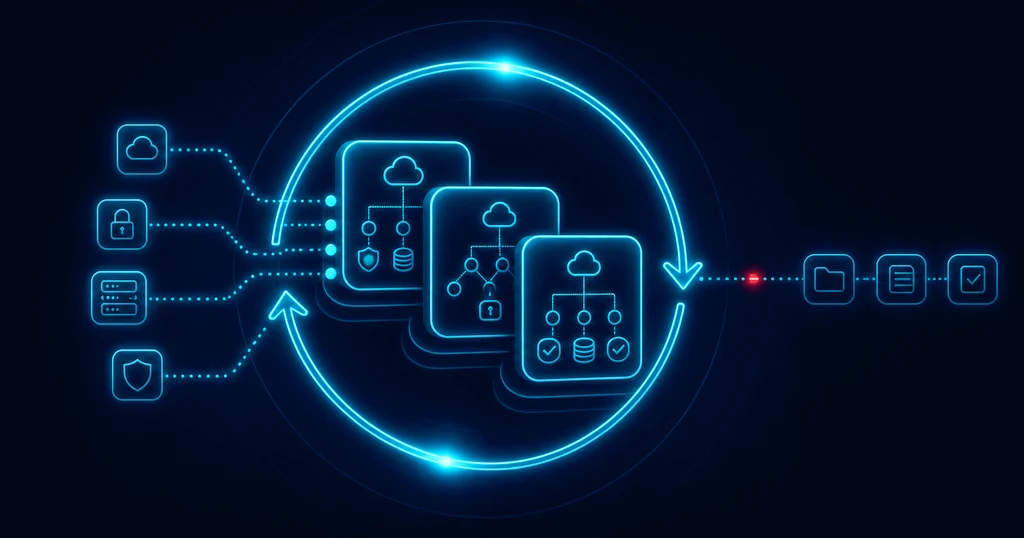
Continuous compliance replaces the once-a-year evidence sprint with automated, always-on monitoring. Instead of manual screenshot collection, the platform connects to your infrastructure via read-only APIs and generates evidence automatically from source systems. Instead of pulling a screenshot of your access controls in December, your compliance platform connects to your cloud environment through a read-only API and records the actual state of your controls every single day.
In practice, this comes down to three habits running quietly in the background:
- Automated evidence collection. Configurations, logs, user permissions, and access changes get pulled directly from the source systems instead of copy-pasted into a folder by hand.
- Continuous control monitoring. Is MFA actually enforced right now? Are backups configured correctly today? Automated checks run on a schedule instead of once a year.
- Drift alerts. When something changes outside your baseline, someone finds out the day it happens, not the week before an audit when it is too late to fix quietly.
The payoff shows up well before audit season. Teams using continuous monitoring can catch control failures within hours instead of months, and organizations with automated security operations can reduce breach costs—IBM’s 2024 report found that organizations with extensive automation saved an average of $2.22 million compared to those without.
Continuous Compliance vs Point-in-Time Audits: How the Two Approaches Compare
Here is how the two approaches actually compare, side by side.
How the two approaches actually compare
Neither approach replaces the other — auditors still expect a formal report. What changes is how much scrambling it takes to produce one.
| Point-in-Time Audits | Continuous Compliance | |
|---|---|---|
| What it proves | Controls worked on audit day | Controls work every day |
| Evidence source | Manual screenshots & spreadsheets | Automated, system-generated logs |
| When gaps surface | Weeks or months after they start | The day they happen |
| Audit prep effort | Weeks of scrambling | Ongoing, low-effort review |
| Best for | Point-in-time snapshots for legal sign-off | Day-to-day security and audit readiness together |
Neither approach fully replaces the other. Auditors and regulators still expect a formal audit report. What changes is how much scrambling it takes to produce one.
Compliance Automation vs Periodic Third-Party Audits
The same shift applies to how you manage vendors, not just your own controls. A periodic third-party audit usually means an annual questionnaire, often filled out by a vendor’s sales or marketing team with no independent check. Compliance automation flips that model: it monitors a vendor’s security ratings, tracks when their SOC 2 report expires, and flags changes to their posture as they happen, rather than waiting twelve months to ask again.
This matters more than it used to. Under frameworks like the EU’s NIS2 Directive (Network and Information Security Directive 2), organizations are now expected to assess and monitor the cybersecurity posture of their suppliers on an ongoing basis, not just check a box once a year.
Making the Shift Without Blowing Up Your Stack
None of this requires tearing down your existing compliance program and starting over. The fastest path usually looks like this:
- Start with your highest-effort controls. Access management and vulnerability management typically eat up the biggest share of audit prep time, so automating those first pays off fastest.
- Connect your cloud environment through read-only APIs. Most modern platforms can start pulling evidence from AWS, Azure, or GCP within hours, not weeks.
- Map evidence to your framework automatically. This removes the manual work of matching screenshots to specific SOC 2 or ISO 27001 controls.
- Run a real continuous period before your next audit. Sixty to ninety days of continuous evidence gives your auditor something far stronger than a folder of last-minute screenshots—and most auditors prefer seeing evidence collected over time rather than point-in-time snapshots.
The annual audit is not going away anytime soon. What can go away is the scramble that leads up to it. Teams that make this shift usually notice the change first in how audit week actually feels. Instead of pulling people off their normal work to chase down logs, the compliance lead spends a few hours pulling a report that has already been building itself for months. The auditor gets more evidence than they are used to seeing, collected with a fraction of the usual effort, and the rest of the team never has to drop what they are doing to help.
Meet the Compliance Teammate that keeps your evidence current, all year
This is exactly the gap the Compliance Teammate is built to close. It’s a Digital Security Teammate that owns governance, risk acceptance, compliance posture, and audit readiness — connecting to your cloud environment, identity providers, ticketing systems, and security tools to keep evidence current automatically. Instead of leaving evidence collection to whoever remembers it in November, your team walks into audit season with proof already in hand.
Governance & risk
Owns risk acceptance and compliance posture end to end, not just a single checklist.
Always-on evidence
Pulls evidence from source systems automatically — no more screenshot chasing.
Connects to your stack
Cloud, identity providers, ticketing, and security tools plug in without a rebuild.
Audit-ready, year-round
Walk into audit season with proof already assembled instead of a to-do list.
FAQs
Why do audits always find surprises no one expected?
Why do compliance managers chase screenshots before audits?
Is continuous compliance more expensive than annual audits?
Do I still need an annual audit if I use continuous compliance?
The Bottom Line
Point-in-time audits were never designed for infrastructure that changes daily. They were built for a slower world, and the gap between how fast your systems change and how often anyone checks them is exactly where breaches, fines, and failed audits come from. The global average cost of a data breach reached $4.88 million in 2024, and GDPR enforcement alone totaled roughly €1.2 billion in fines in 2025. Continuous compliance will not make audits disappear, but it does mean your team stops finding out about problems the week before an auditor does—and that shift from reactive to proactive is exactly what turns compliance from a burden into a competitive advantage.