Introduction
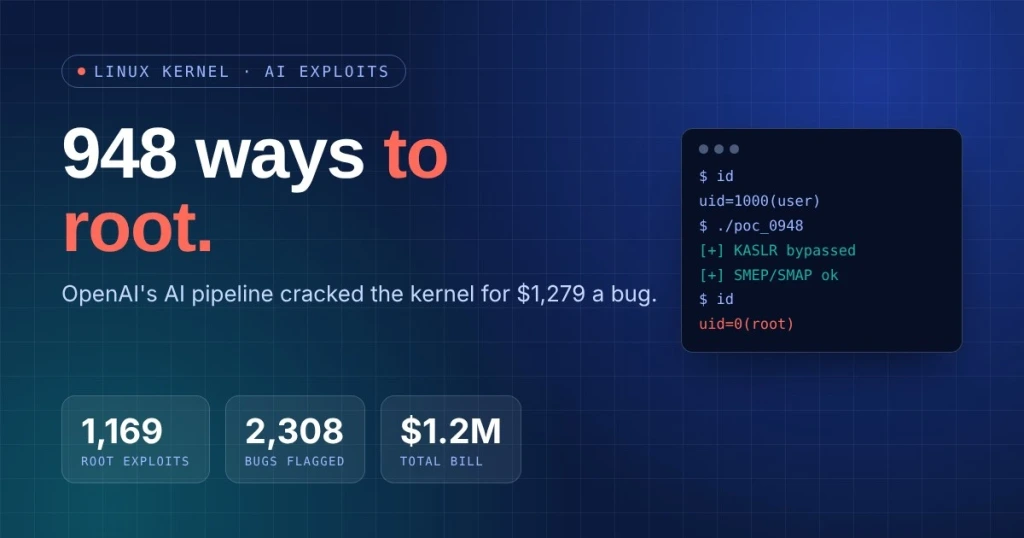
An unreleased OpenAI cyber model spent about 30 hours inside the Linux kernel and emerged with root access. The OpenAI Linux exploits cost $1.2 million in API credits, roughly $1,279 for every distinct bug it proved.
What Happened?
On November 4, OpenAI detailed a five-stage agent pipeline it ran in mid-October against the latest Linux kernel master branch. Agents flagged 2,308 candidate bugs in code that low-privilege users can reach, then reproduced 1,724 in sandboxed VMs.
Five stages. One human checkpoint.
AI agents did the hunting, proving and fixing. People signed off before a single report reached kernel maintainers.
The lesson for defenders: automation finds and fixes at machine speed, governance decides what ships.
The haul: 1,169 working local privilege escalation exploits, 291 information leak proofs of concept, and patches for 948 distinct bugs. Every exploit worked on a stock desktop setup with KASLR, SMEP, and SMAP enabled. OpenAI says the agents also came up with at least 10 new exploitation techniques. Humans reviewed every exploit and patch before reporting.
2,308 leads. 1,169 roads to root.
What an unreleased OpenAI cyber model pulled out of the latest Linux kernel master branch in a single run in the middle of October 2026.
Every exploit ran on a stock desktop setup with KASLR, SMEP and SMAP enabled. Bars are relative to the 2,308 candidates.
The Speed Problem
A July run with an older model found 166 unique root bugs for $513,690. Three months later, the new model found more than five times as many, even after a summer of kernel hardening.
Three months. Root got 59% cheaper.
Two OpenAI scans of the same kernel, three months apart. The newer model found more than five times the bugs at well under half the price per bug.
And here’s the part that should worry you. Within 10 days of the scan starting, other contributors had already patched or staged fixes for more than 100 of these flaws. Someone else is finding the same bugs.
A day after the disclosure, OpenAI opened its newest cyber model to a group of verified users. The same model also turned up 81 new high-severity flaws in Firefox.
What’s the Impact?
OpenAI’s own advice is blunt: for now, a low-privilege account on an unpatched Linux box should count as root for any well-funded attacker. One phished SSH key, one hijacked CI runner or one shared container host now sits a single command away from full control.
How to Avoid This
- Patch kernels on a clock. Track distro kernel advisories weekly and use live patching where reboots stall.
- Treat every shell account as privileged. Remove unused local users, stale SSH keys, and idle service accounts.
- Wall off untrusted code. Run CI jobs and multi-tenant workloads in sandbox layers such as Firecracker or gVisor.
- Shrink the kernel surface. Disable unneeded modules, unprivileged user namespaces, and unprivileged eBPF where you can.
- Watch for sudden privilege jumps. Alert when a regular process spawns a root shell or loads a kernel module.
Root Is Now Cheap. Your Defense Can’t Be Slow.
When attackers can buy a working root exploit for the price of a laptop, your patch backlog becomes your attack surface. Secure.com brings Governed Defense, Powered by Offense: it thinks like the attacker and acts within your guardrails.
- Maps every Linux host, container, and kernel version, so no forgotten box sits unpatched.
- Ranks kernel flaws by exploitability and exposure, so the dangerous ones get fixed first.
- Flags risky local accounts, stale keys, and overprivileged service identities.
- Triages privilege escalation alerts automatically and hands analysts a ready case.
- Runs every automated fix through approvals with a full audit trail. No more grunt work. No more burnout.
