TL;DR
Your AI agent takes an action. A regulator calls. They ask one question: what exactly did the agent do, and who authorized it? In most companies today, the honest answer is we cannot fully say. The logs exist, but they record that an API call happened, not who approved it or why. That gap is the difference between logs and an audit trail. A real audit trail records the recommendation, the approval, the action, and the outcome, in storage nobody can quietly edit. Build that into how the agent works, and your compliance report becomes a query instead of a quarter long scramble.
Introduction
Picture the call every compliance lead dreads. An AI agent did something it should not have. A regulator is on the line asking for proof of what happened and who signed off. You go to the logs. They show a timestamp and an API call. They do not show the decision, the approval, or the reason. That is the audit trail gap, and in 2026 it is no longer a future problem.
Logs are not an audit trail
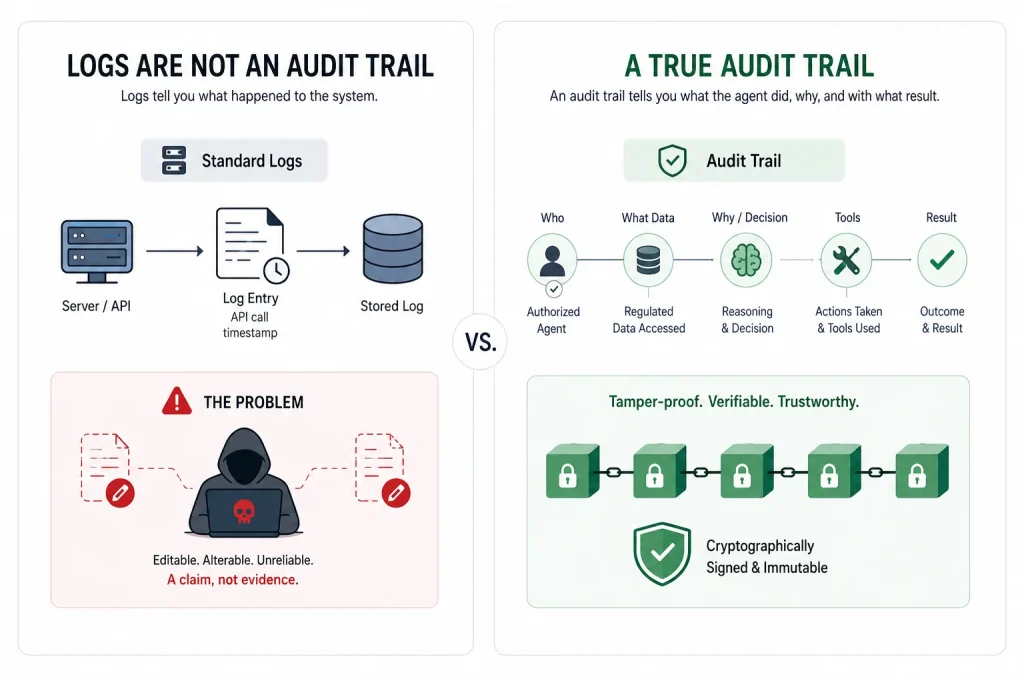
Most AI agent deployments produce logs. They are the wrong logs. Infrastructure logs record API calls. Model logs record inputs and outputs. None of them record what regulated data was touched, by which agent, under whose authorization, with what result.
The two things answer different questions. A standard log answers what did the server do. An audit trail answers a harder one: what did an autonomous actor decide to do on our behalf, with our tools, and why.
There is a second problem. Standard logs are editable. Anyone with server access can change them. As one compliance guide puts it plainly, a record you can edit is a claim, not evidence. Auditors in 2026 are trained to discount logs that cannot prove they were not altered.
The one question every auditor asks
Strip away the frameworks and it comes down to a single sentence. What exactly did this agent do, and who authorized it?
To answer that, a defensible record has to capture four things for every consequential action:
- The recommendation. What the agent proposed to do.
- The approval. Which human signed off, and under what policy.
- The action. What the agent actually did, at the tool boundary, not just what the model claims it did.
- The outcome. What resulted, including any error or escalation.
Miss any one of these and the record has a hole. A common failure is logging that the agent escalated for help but never logging whether help was given. The auditor sees the question and cannot see the answer.
Tamper evident is the part teams skip
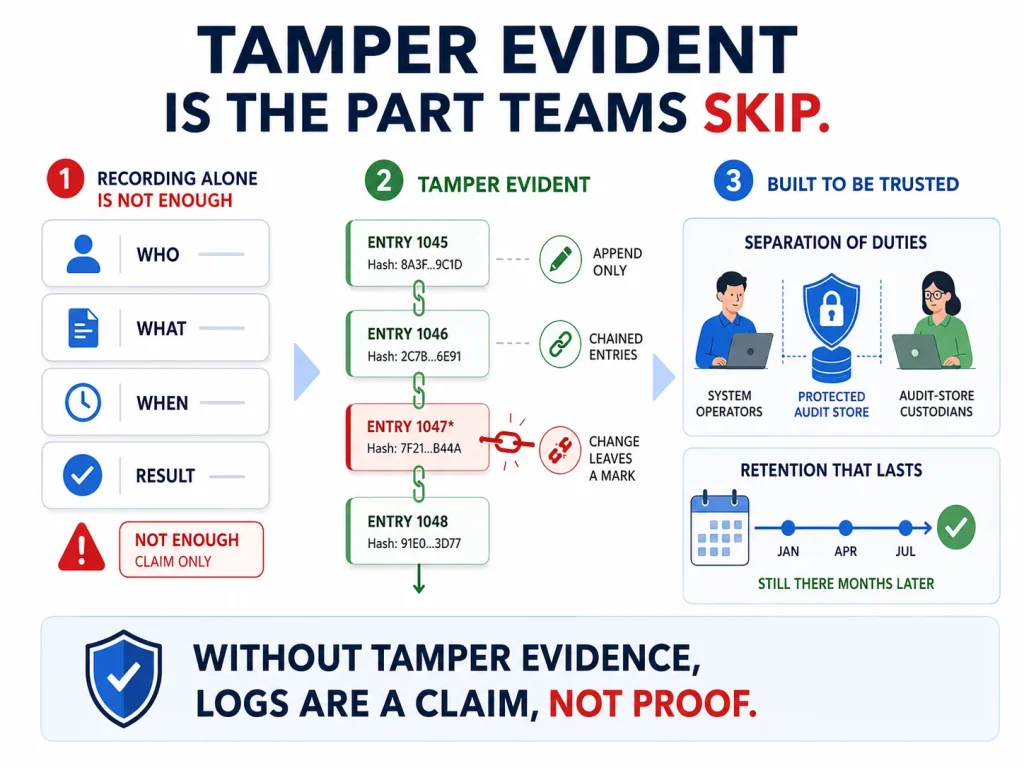
Recording the four fields is not enough on its own. The record also has to prove it was not changed after the fact. That is what tamper evident means, and it is where most teams fall short.
The baseline is straightforward. Storage is append only, so entries cannot be updated or deleted. Entries are chained so that altering one breaks the chain and leaves a mark. The people who operate the system are separated from the people who can touch the audit store. Without this, we logged it is a claim, not proof.
Retention matters too. Different rules set different floors, and many enterprises standardize on a long window when several regimes overlap. The point is simple: the trail has to still be there, intact, when someone asks months later.
The fix: make the trail a byproduct of the work
Here is the shift that makes this affordable. Do not build the audit trail as a separate project that watches the agent from the outside. Build it into the moment the agent acts.
When every consequential action passes through a gate that both enforces policy and records the decision, the evidence writes itself. Enforcement and audit become the same act. The compliance report stops being a scramble and becomes a query, because the answer was captured the instant the action happened.
Retrofitted trails are weaker, more expensive, and less credible than evidence built from day one. The best trail is the one you never had to assemble.
How Secure.com helps
At Secure.com this is what the evidence layer is for. Governed AI teammates record the full decision as they work, inside limits your team sets, so the proof is there before anyone asks.
- Every recommendation, approval, action, and outcome is logged as the teammate works.
- Consequential actions pause for human approval, and that approval is part of the record.
- The trail is built into enforcement, so evidence is a byproduct, not a separate pipeline.
- Records are structured to answer the auditor’s core question: who decided what, and why.
- It sits above the stack you already own, so it captures agent actions across your existing tools.
The takeaway
When an auditor or a regulator asks how an action was authorized, the answer should be a record, not a memory. Standard logs cannot give you that. An audit trail that captures the recommendation, the approval, the action, and the outcome, in storage no one can quietly edit, can. Build it into how your agents work, and the hardest question in the room becomes the easiest one to answer.