If your GRC team is pulling the same access review, the same encryption standard, and the same incident log three separate times a year once for ISO 27001, once for SAMA CSF or NCA ECC, once for PCI DSS the problem isn’t your controls. It’s that nobody has written down that they’re the same control wearing three different labels.
For security and compliance teams operating in Saudi Arabia and the wider Gulf, this isn’t a hypothetical. A bank or fintech regulated by SAMA is very likely also holding ISO 27001 certification, very likely within the PCI DSS scope because it touches cardholder data, and, depending on ownership and sector, possibly within the NCA ECC scope as well. Each framework shows up with its own auditor, its own evidence portal, and its own vocabulary for the exact same operational reality: who has access to what, how data is encrypted, how incidents get handled, how vendors get vetted.
Compliance work is growing faster than most teams can absorb it, and the usual response is to hire another analyst to re-screenshot the same MFA settings for the fourth framework this quarter — doesn’t scale. The fix isn’t more hands on the same repetitive work. It’s mapping each control once, understanding exactly which framework requirements it satisfies, and reusing it with confidence.
One control. Four regulators asking for the same proof.
ISO 27001, SAMA CSF, NCA ECC and PCI DSS overlap far more than most GRC teams realize — the work is mapping each control once, not re-collecting the same evidence four times a year.
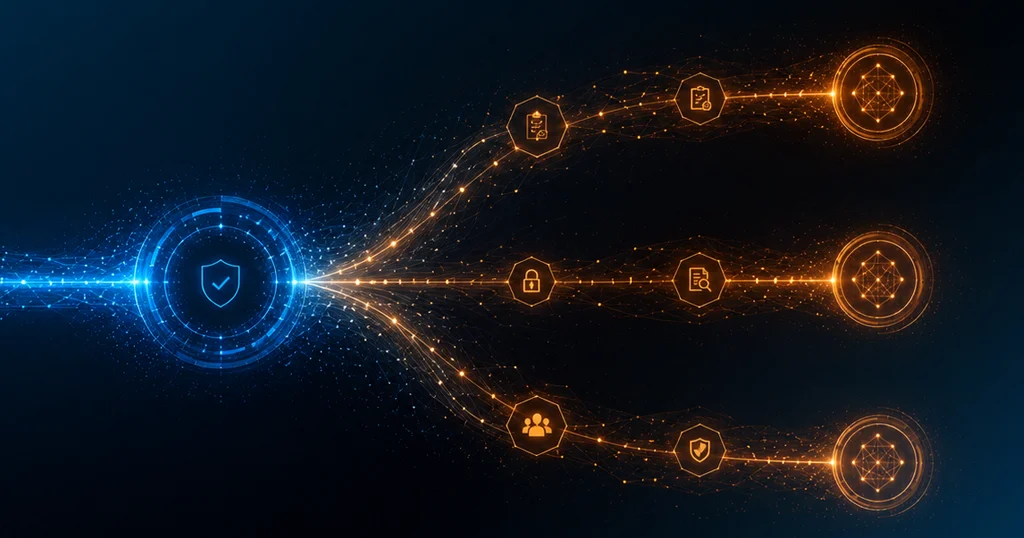
One identity provider export, reviewed on the same cadence, satisfies all four frameworks at once — if the mapping is written down.
Why These Four Frameworks Overlap As Much As They Do
This isn’t a coincidence — it’s by design.
- SAMA’s Cyber Security Framework is built on four domains — leadership and governance, risk management and compliance, operations and technology, and third-party cyber security — and SAMA states outright that the framework draws on NIST, ISO, PCI, and Basel standards. It was never meant to stand apart from ISO 27001; it was meant to sit on top of it for the Saudi financial sector.
- NCA’s Essential Cybersecurity Controls (ECC), the national baseline for government entities and critical infrastructure, is organized around cybersecurity governance, defense, resilience, and third-party and cloud computing security — and it was likewise developed with reference to ISO 27001 and NIST. SAMA has aligned parts of its own framework to ECC specifically to cut down on duplicate reporting for banks that answer to both regulators.
- PCI DSS is narrower and more prescriptive, but its access control, network security, vulnerability management, and logging requirements sit on the same ground as ISO 27001 Annex A and both Saudi frameworks — it just adds cardholder-data-specific rules on top.
The overlap isn’t a coincidence — it’s by design
All four frameworks were built with the same reference standards in mind, which is exactly why one well-documented control can satisfy more than one of them.
ISO 27001
The information security management system that most regional frameworks quietly borrow their structure from.
SAMA CSF
4 domains — governance, risk, operations & technology, third-party. Built on NIST, ISO, PCI and Basel.
NCA ECC
Governance, defense, resilience, third-party & cloud. Aligned with SAMA to cut duplicate reporting.
PCI DSS
Narrower and prescriptive — access, network, vulnerability and logging rules sit on the same ground as the rest.
The result: a well-built ISO 27001 information security management system already does most of the heavy lifting for SAMA CSF’s operations and technology domain, a meaningful share of ECC’s defense domain, and the general controls PCI DSS expects outside the cardholder data environment. What’s left is a smaller set of framework-specific requirements that genuinely need their own evidence.
How One Control Maps Across Frameworks
What a single access review actually covers
Take one ordinary control — a quarterly review of who has access to production. Reviewed once, on one cadence, it satisfies four separate regulators.
One identity provider export, reviewed and signed off on the same cadence, satisfies all four frameworks. The same pattern holds for encryption, logging, change management, vendor risk and incident response.
One identity provider export, reviewed and signed off on the same cadence, satisfies all four. The same pattern holds for encryption standards, logging and monitoring, change management, vendor risk assessments, and incident response plans. None of that is new news to anyone who’s built a compliance program before — the harder part is keeping the mapping accurate and current as each framework gets revised, and making sure the evidence you reuse actually matches what each auditor wants to see.
Where The Frameworks Genuinely Diverge
Reuse isn’t total, and pretending otherwise is how audits go sideways.
- NCA ECC carries requirements with no real ISO or PCI equivalent — national data classification rules, Saudization requirements for cybersecurity roles, and controls tied specifically to government and critical-infrastructure risk.
- SAMA CSF layers on supervisory expectations ISO 27001 never asks for: board-level accountability to the regulator, maturity-level scoring against a defined model, and alignment with Saudi-specific regimes like the Personal Data Protection Law.
- PCI DSS gets specific about the cardholder data environment in ways general information security controls don’t touch — what card data can be stored, how the primary account number must be masked, and segmentation testing scoped specifically to the CDE.
Auditors in this region have also gotten good at spotting the failure mode on the other side: a generic ISO 27001 policy pack submitted as SAMA or ECC evidence without any Saudi-specific context, or a control mapped at too high a level — “we do access control” isn’t a mapping, it’s a hope. The mapping that holds up is specific: which control, which evidence artifact, which exact clause in each framework it satisfies, and whether the evidence format itself needs to change between one regulator’s portal and another’s.
Building the map without burning out your GRC team
The mapping logic barely changes year to year. What’s hard is keeping it current, correctly tagged, and audit-ready across three or four regulators at once.
Organize around controls, not frameworks
Build the library around what your team actually does — access, data protection, incident response, change management, vendor risk.
Tag every clause it satisfies
Down to the specific clause, not just the framework name. “We do access control” isn’t a mapping — it’s a hope.
Assign one owner, one artifact
A single owner, one piece of supporting evidence, and a fixed review schedule — so nobody wonders who’s responsible.
Revisit when a framework updates
ECC’s 2024 revision and SAMA’s circulars both shift clause numbers. A map that isn’t maintained quietly goes stale.
This is exactly the kind of work that’s high-value and genuinely tedious in equal measure: the mapping logic doesn’t change often, but keeping the evidence current, correctly tagged, and audit-ready across three or four regulators at once is a constant, grinding task — the kind that either eats an analyst’s calendar every quarter or gets deferred until an audit forces the issue.
The work the GRC AI Teammate owns
Controls, compliance posture, evidence collection, audit readiness, and trust reporting. Applied to a multi-framework map like this one, that looks like four things running continuously in the background.
Maps each control once
Tags every SAMA, ECC, ISO 27001 and PCI DSS requirement it satisfies — down to the specific sub-clause, not just “access control.”
Watches evidence for staleness
A quarterly access review that’s three months overdue gets flagged before an auditor finds it, not after.
Catches drift on framework updates
When ECC moves from 2018 to 2024, or SAMA reissues a circular, the Teammate re-checks the map against the new version.
Assembles the audit trail as it works
Evidence, approval history, and the record of who signed off are already in order when a regulator asks for them.
Runs inside the scope, permissions, and approvals your team defines. Nothing gets submitted to a regulator without sign-off, and every action leaves the kind of record an auditor expects. It’s useful standalone too — if ISO 27001 is the only framework you manage today, it still removes the manual mapping and evidence-chasing; when SAMA, ECC or PCI DSS get added later, the same control library extends rather than starting over.
FAQs
Does mapping ISO 27001 to SAMA CSF or ECC remove the need for separate audits?
If I’m already ISO 27001 certified, how much of NCA ECC or SAMA CSF is already covered?
Does PCI DSS still require its own evidence if I’m already ISO 27001 and SAMA compliant?
Who should own a mapped control when it satisfies four different frameworks?
What happens to the map when a framework gets updated?
Conclusion
A mapped control tells an auditor what you claim to do — not whether that claim would survive a real attempt to break it. That’s the gap a Red AI Teammate closes: when an attack simulation confirms a control holds, or exposes where it doesn’t, the result feeds hardening and becomes evidence in its own right, backed by proof rather than a policy statement alone.
Governed Defense, Powered by Offense. No More Grunt Work. No More Burnout. AI teammates attack your defenses, harden what they find, and hand your team back hundreds of hours a month. Your team sets the rules. AI teammates do the work. Attack. Harden. Prove. Repeat.
For a compliance team juggling SAMA, ECC, ISO 27001, and PCI DSS at once, that’s the practical version of the promise: map the control once, prove it once, and let it stand up in every regulator’s evidence room.