TL;DR
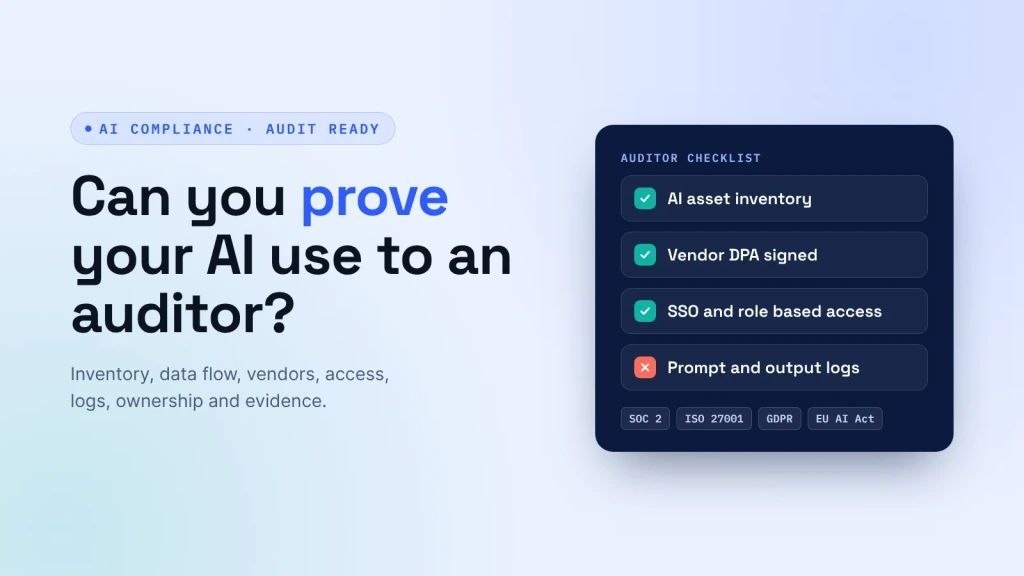
AI compliance means proving to an auditor that the AI tools your company uses are tracked, controlled, and owned. Auditors do not bring a special AI checklist. They ask the same seven questions they ask about any system: where it is, where the data goes, who the vendor is, who has access, what it did, who owns it, and whether you can prove it works. GDPR already covers AI that touches personal data. The EU AI Act bans some workplace uses today and brings hiring tools under high-risk rules in December 2027. If you can answer the seven questions with evidence, you are most of the way there.
In 2025, one in five organizations reported a breach due to security incidents involving shadow AI, with breaches involving high levels of shadow AI adding $670,000 to the average breach cost. Most of those companies never planned to use AI that way. Someone on the team pasted data into a chatbot, and nobody wrote it down.
What Is AI Compliance?
AI compliance is the work of showing that your use of AI follows the laws and frameworks you are audited against. That covers chatbots your staff use, AI features inside your SaaS apps, and any models your engineers build into your product.
This is different from using AI to run your compliance program. That topic matters too, and we cover it in our post on what AI native GRC actually looks like. This guide is about the other side: getting your own AI use past an auditor.
Most companies already hold SOC 2 or ISO 27001 and assume that covers AI. In practice, they cover the infrastructure AI runs on, not the AI itself.
Auditors Ask Your AI the Same 7 Questions They Ask Everything Else
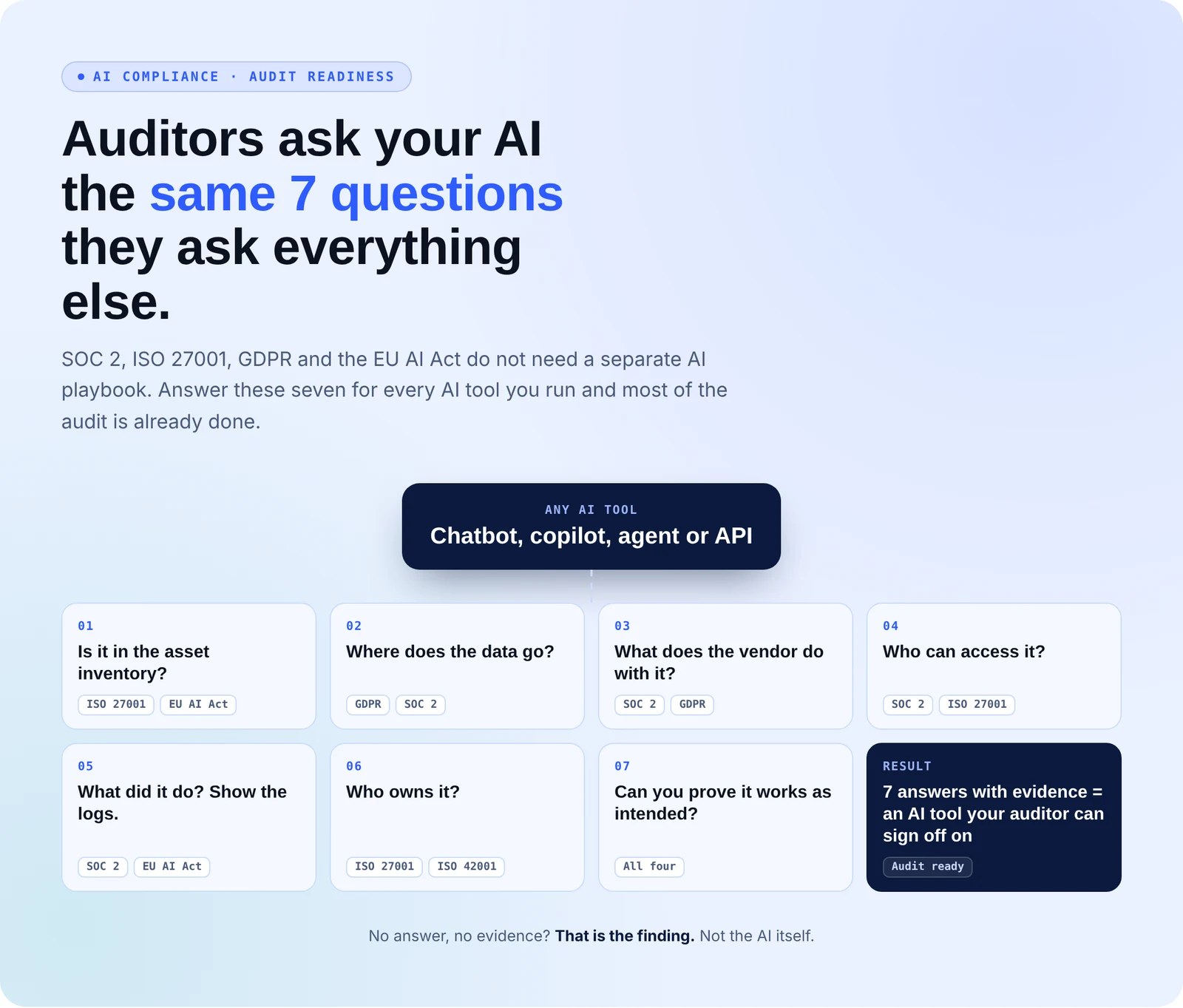
Here is the good part. Most companies do not face a separate AI-specific audit first. AI shows up inside vendor risk reviews, SOC 2 gap analyses, ISO 27001 control discussions, GDPR assessments, and board-level risk conversations. So the questions are ones you already know.
1. Is the AI tool in your asset inventory?
If it is not on your list, you cannot control it. That includes browser plugins, meeting note bots, and the AI features your vendors switched on last quarter without asking.
2. Where does the data go, and who touches it?
Draw the path. What leaves your network, which region it lands in, and whether it gets stored, cached or used for training.
3. Who is the vendor, and what do they do with your data?
Treat an AI provider like any other processor. You need a signed data processing agreement and a clear answer on whether your prompts train their models.
4. Who can access it?
Personal ChatGPT accounts holding company data are a finding. Access should run through SSO with roles you can review. That gap is common: 97% of organizations experiencing AI-related security incidents lacked proper AI access controls, while 63% of breached organizations had no governance policies for managing AI or detecting unauthorized use.
5. What did it do?
Auditors want logs. Prompts, outputs, admin changes, and actions an AI agent took on its own all need a record you can pull up later.
6. Who owns it?
Every AI system needs one named person who answers for it. “The data team” is not an owner.
7. Can you prove it works as intended?
This is where most teams stall. A policy on paper is not proof. You need test results, review records, and approvals with timestamps. We go deeper on this in our piece on evidence-linked outputs regulators accept.
AI Compliance Regulations You Need to Know
GDPR
The moment personal data goes into an AI tool, GDPR applies in full. That means:
- Data minimization: send only what the task needs.
- A data processing agreement with the AI vendor.
- A data protection impact assessment (DPIA) when the processing is high risk.
- A plan for the right to erasure, because “delete my data” requests still apply once that data has gone into an AI tool.
EU AI Act
The EU AI Act sorts AI by risk. Some uses are banned, some need heavy paperwork, and most need only basic transparency.
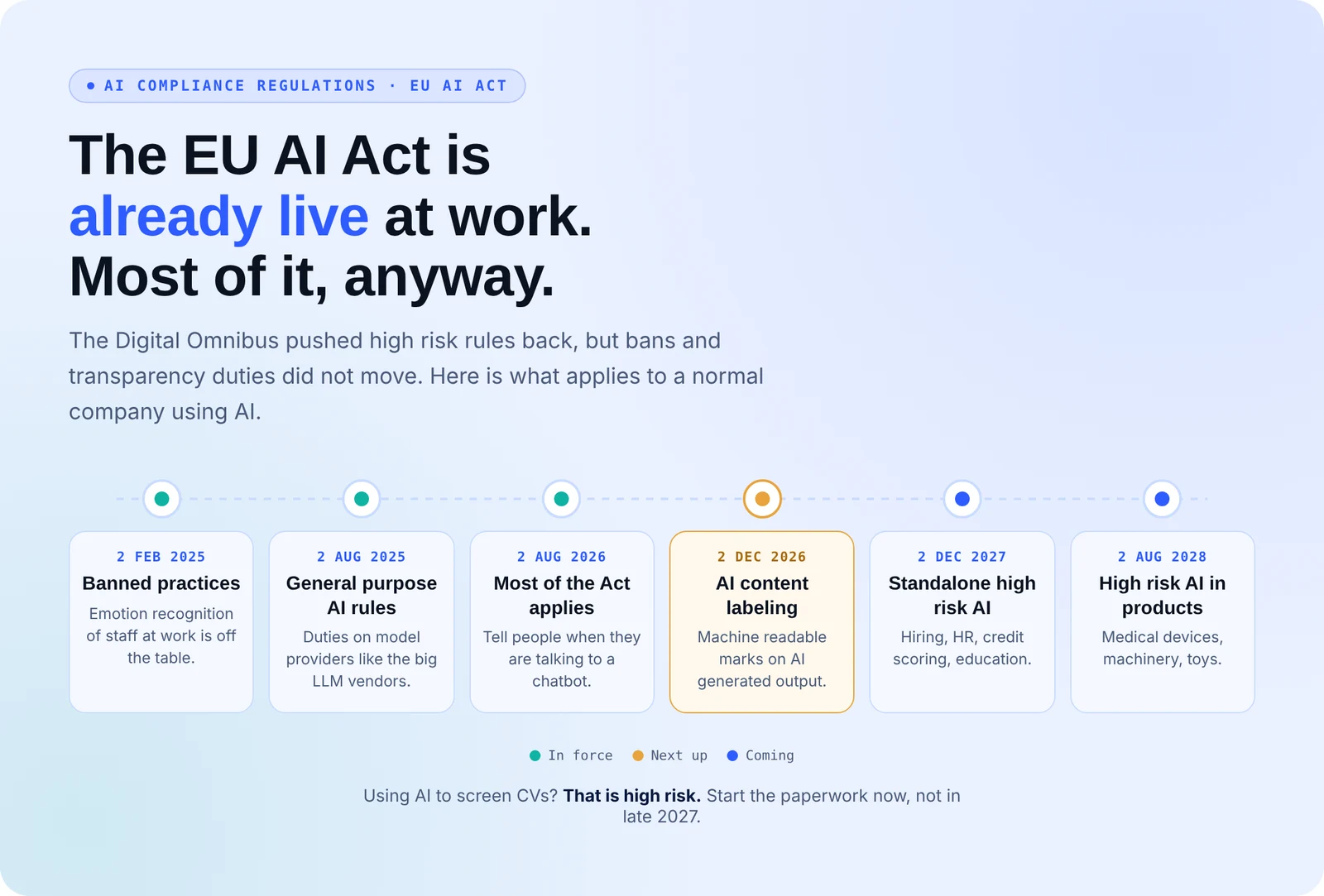
The deadlines changed this year. The EU’s Digital Omnibus package moved them, and its amendments to the EU AI Act (Regulation (EU) 2024/1689) are now in force. Under the revised timeline, rules for stand-alone high-risk AI systems will apply from Dec. 2, 2027, while requirements for high-risk AI systems embedded in products will enter into force on Aug. 2, 2028.
Do not read the delay as a pass. The delay gives organizations more time for high-risk conformity work, but the AI Act’s broader Aug. 2, 2026, application date remains on track. The ban on emotion recognition at work has been in effect since February 2025. Telling users they are talking to a chatbot is a live duty under the EU AI Act Article 50 rules requiring disclosure when users interact with AI, when content is AI-generated, and when biometric or emotion recognition is in use. The labeling deadline for AI-generated content moved to 2 December 2026.
If your HR team uses AI to screen CVs or rank candidates, you are in high-risk territory. Rules for high-risk AI systems will apply from 2 December 2027 for standalone high-risk AI systems, and the paperwork takes months to build.
SOC 2, ISO 27001 and ISO 42001
SOC 2 and ISO 27001 do not mention AI by name, but their controls on access, logging, vendors and change management all apply to it. ISO 42001 is the newer standard written for AI management. If you already run ISO 27001, most of your evidence carries over once you add AI systems to the scope.
AI Compliance and Governance: Who Owns What
Compliance breaks down when everyone assumes someone else has it. Split the work clearly.
Employees
Keep customer data, source code, and anything confidential out of consumer AI tools. Use only the approved tools through the company login.
Engineers
Build logging, access control, and data flow tracking into every AI feature from day one. If an agent can take actions, it needs limits, and a human has to approve the risky ones. Our post on human approval gates for AI actions covers how to set those up.
Operations and business teams
Run AI vendors through the same review as any other supplier. Keep the inventory current and make sure each process can produce the evidence an auditor will ask for.
How to Use an AI Compliance Checker Before Your Auditor Does
A checker can be a tool or a simple self-test. Start with the self-test. Tick only what you can prove today with a real document, log, or screenshot.
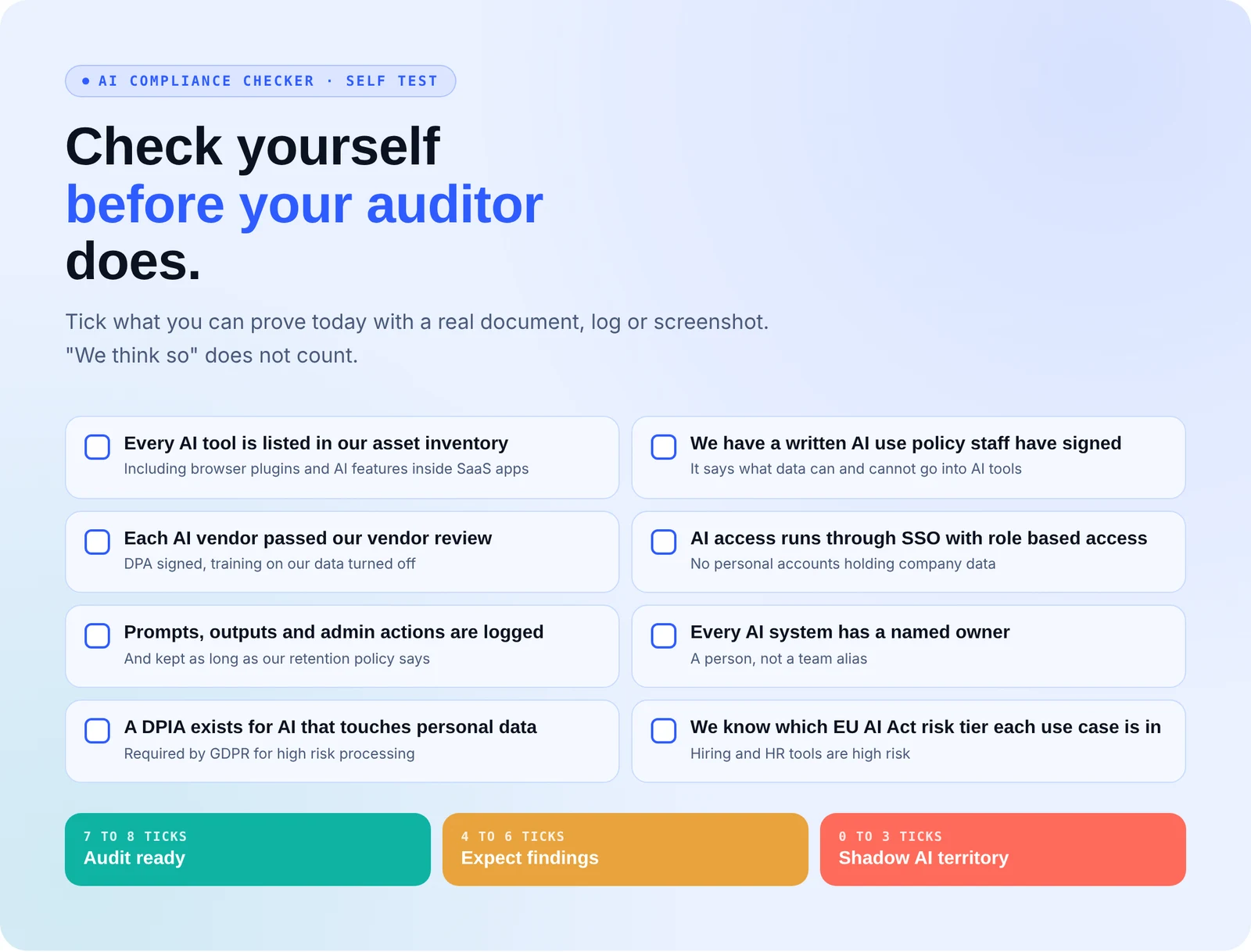
If you scored under 7, start with the inventory. Every other question depends on knowing which AI you run.
How Secure.com Keeps Your AI Use Audit-Ready
Secure.com runs on Governed Defense, Powered by Offense: your team sets the rules, and AI teammates do the work. For your AI use, that means evidence is collected as work happens, so nobody has to rebuild it the week before the audit.
- Monitors your posture continuously across ISO 27001, SOC 2, PCI DSS, HIPAA, GDPR, and NIST, and links every finding directly to its source data.
- Operates inside a governed execution model with human-in-the-loop controls, so every AI action has an approver and a trail.
- Maps the systems and tools in your stack, which gives you a starting inventory for question one.
- Pulls logs and access records from the tools you already use.