TL;DR
AI now writes most new code at big tech companies, and it repeats old security mistakes faster than people can review them. AI code security means treating every AI suggestion as untrusted, attacking it, fixing what is exploitable, and keeping proof.
In April 2026, Google’s CEO said AI-generated code now accounts for 75% of all new code at the company, with that code still “approved by engineers.” That number was about 25% in 2024. Your team is probably on the same curve, but your review process probably isn’t.
What Is AI Code Security?
AI code security is the practice of finding and fixing flaws in code that AI tools write or suggest. It also covers using AI to test and patch that code at the same speed.
AI Code Security Risks Your Team Can’t Ignore
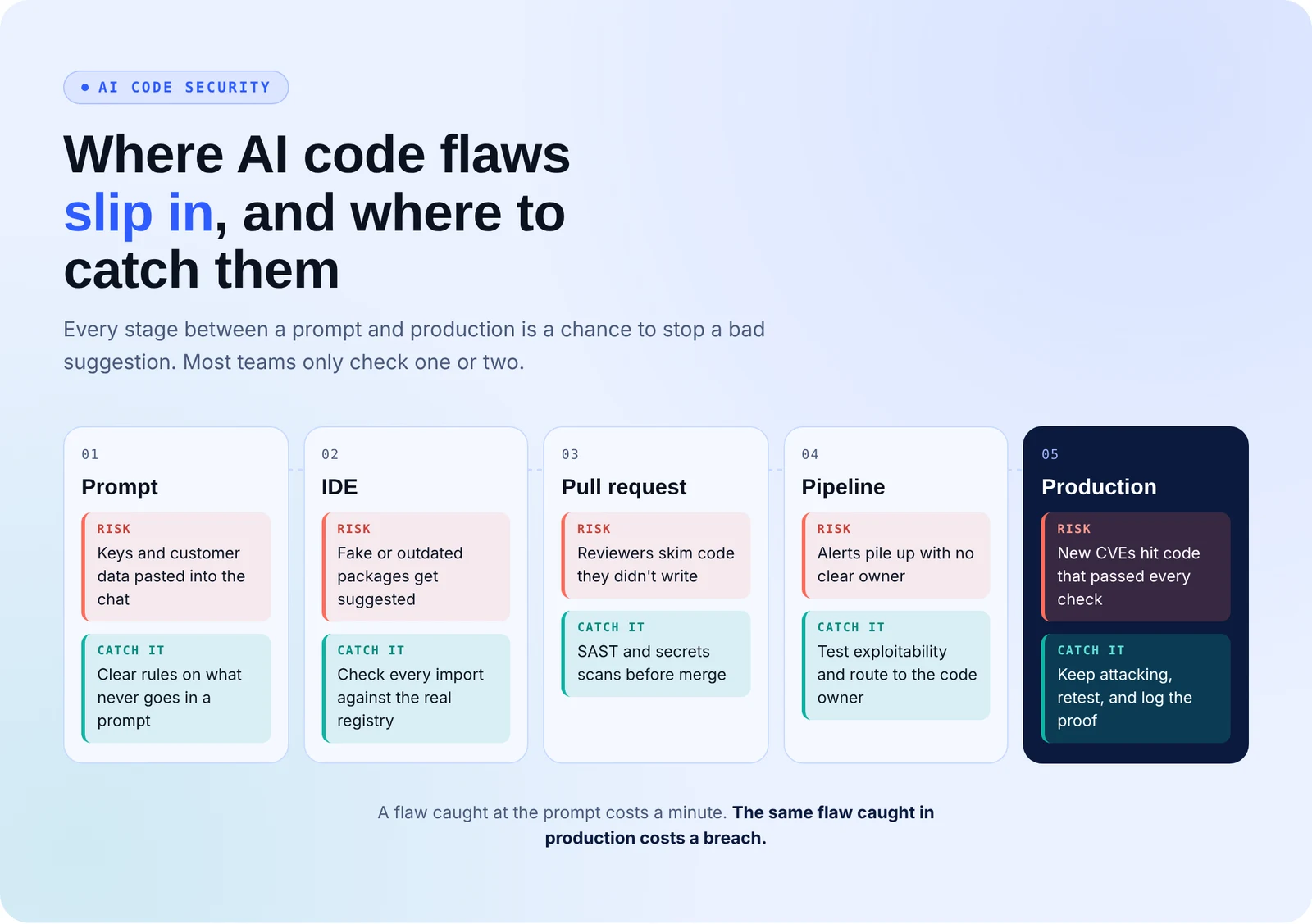
Code Ships Faster Than Anyone Reviews It
An assistant writes a feature in a minute. Busy reviewers skim code they didn’t write, and skimmed code ships.
Developers Trust AI Code Too Much
A Stanford study found that developers using an AI assistant wrote significantly less secure code. They were also more likely to think it was secure.
Fake Packages and Poisoned Dependencies
Researchers tested 16 code models and found that 19.7% of 2.23 million code samples named at least one package that doesn’t exist. Attackers register those names on npm or PyPI and wait. This is called slopsquatting.
Secrets and Private Code Leaking Through Prompts
Developers paste API keys and customer records into prompts. Models also copy hardcoded passwords from training data into new code. For real breach examples, read our breakdown of vibe coding security risks.
Common AI Code Security Vulnerabilities
These six flaws show up most in AI-generated code:
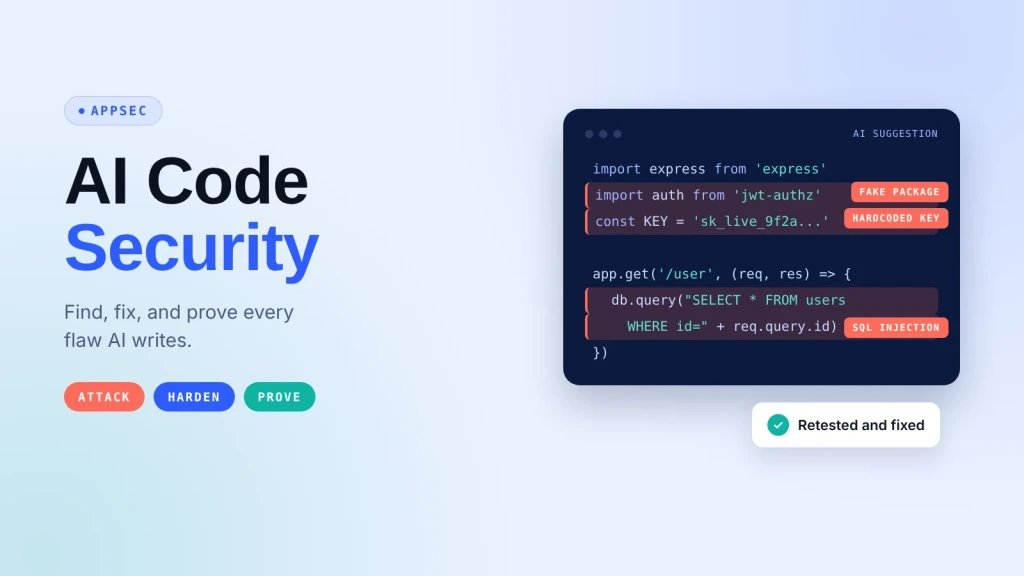
- SQL injection: queries built by gluing user input into strings
- Missing auth checks: endpoints that work but let anyone in
- Hardcoded secrets: keys and passwords sitting in source files
- Bad dependencies: outdated libraries or packages that don’t exist
- Cross-site scripting: user input shown on a page without escaping
- Unsafe deserialization: data loaded with no type checks
How to Run an AI Code Security Audit
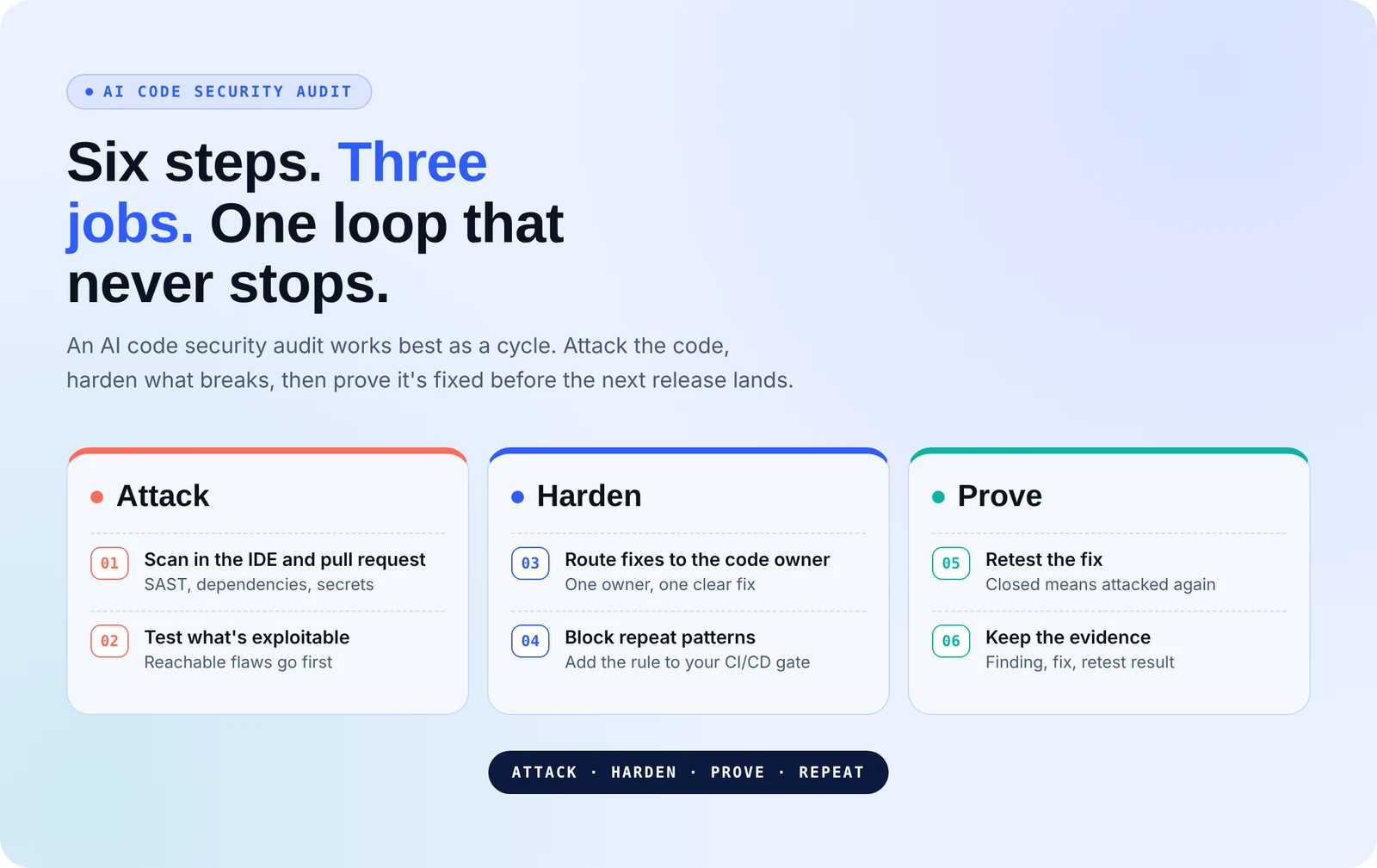
First, list every AI tool your developers use and tag AI-assisted commits. Then run this loop on every release.
Step 1: Scan in the IDE and Pull Request
Run SAST, dependency checks, and secrets scanning before merge. Build them into your CI/CD security gates so nothing skips them.
Step 2: Attack It to See What’s Exploitable
A scanner finding is a guess until someone tests it. Fix reachable flaws first.
Step 3: Send Fixes to the Right Code Owner
Findings with no owner rot in the backlog, so route each one to the right code owner with a clear fix.
Step 4: Block Repeat Patterns
Flaw showed up twice? Make it a pipeline rule.
Step 5: Retest the Fix
A closed ticket doesn’t prove a closed hole, so attack the patch again.
Step 6: Keep the Evidence
Save the finding, fix, and retest result. Auditors will ask.
AI Code Security Tools: What to Look For
Good AI code security software should:
- Run inside GitHub, GitLab, or the IDE
- Check every import against the real package registry
- Rank findings by exploitability instead of raw severity
- Suggest a fix and retest it automatically
- Keep an audit trail you can hand to a reviewer
On GitHub, built-in code scanning and secret scanning are a solid start. Adding a layer that ties findings to real risk is a core application security best practice for 2026.
How Secure.com Helps With AI Code Security
Secure.com’s AppSec Teammate attacks your code like a real attacker, then hardens what it finds. Your team sets the rules. The AI teammate does the work.
- Attacks new code to find what is exploitable
- Ranks findings by real risk
- Routes each fix to the right code owner, from repo to pipeline
- Retests every fix and keeps proof for audits
- Works on top of the tools you already own, with no rip-and-replace