TL;DR
Over the last three years, major organizations suffered catastrophic breaches despite holding ISO 27001 and SOC 2 certifications. These incidents occurred because controls existed only on paper, not in practice. Compliance programs answer “Can you demonstrate controls existed at a point in time?” while attackers ask “Where does reality deviate from policy right now?” Between those two questions lies the breach.
Key Takeaways
- Stolen credentials appear in 88% of breaches involving web application attacks.
- Third-party involvement doubled to 30%, vulnerability exploitation increased 34% year-over-year
- Change Healthcare, MGM, and Microsoft held compliance certifications when breached.
- Legacy systems and “acceptable risk exceptions” become permanent entry points for attackers.
- Compliance should be the exhaust of a strong security program—not its engine.
Introduction
In the past three years, major organizations in healthcare, finance, SaaS, hospitality, and technology faced devastating cyber incidents, even while ISO 27001 or SOC 2 Type II certified.
These breaches occurred because controls were documented but not active.
Compliance programs answer: “Did controls exist at the audit?”
Attackers ask a very different question: “Where does reality deviate from policy right now?”
Between those two questions lies the breach.
Multiple 2024–2025 reports now confirm this gap is widening, not shrinking:
- Stolen credentials remain the dominant initial access vector.
- Third-party and identity-driven breaches are accelerating.
- “Legacy,” “non-prod,” and “exception-based” systems are repeatedly exploited.
- Human-mediated identity workflows (helpdesks, vendors, admins) remain fragile under pressure.
Compliance didn’t fail because it was ignored. It failed because it was treated as the end state, rather than a minimum baseline.
What 2022–2025 Breaches Reveal
- Stolen credentials dominate real attacks.
Verizon’s 2025 Data Breach Investigations Report shows that stolen credentials appear in 88% of breaches involving web application attack patterns, making identity (not malware) the primary failure point.
- Third-party involvement has doubled.
Verizon reports third-party involvement rising to 30% of breaches, while exploitation of vulnerabilities increased 34% year-over-year—a pace no annual audit can keep up with.
- Breaches remain financially catastrophic.
IBM’s Cost of a Data Breach Report 2025 pegs the global average breach cost at $4.4M, with identity-driven incidents taking longer to contain and costing more over time.
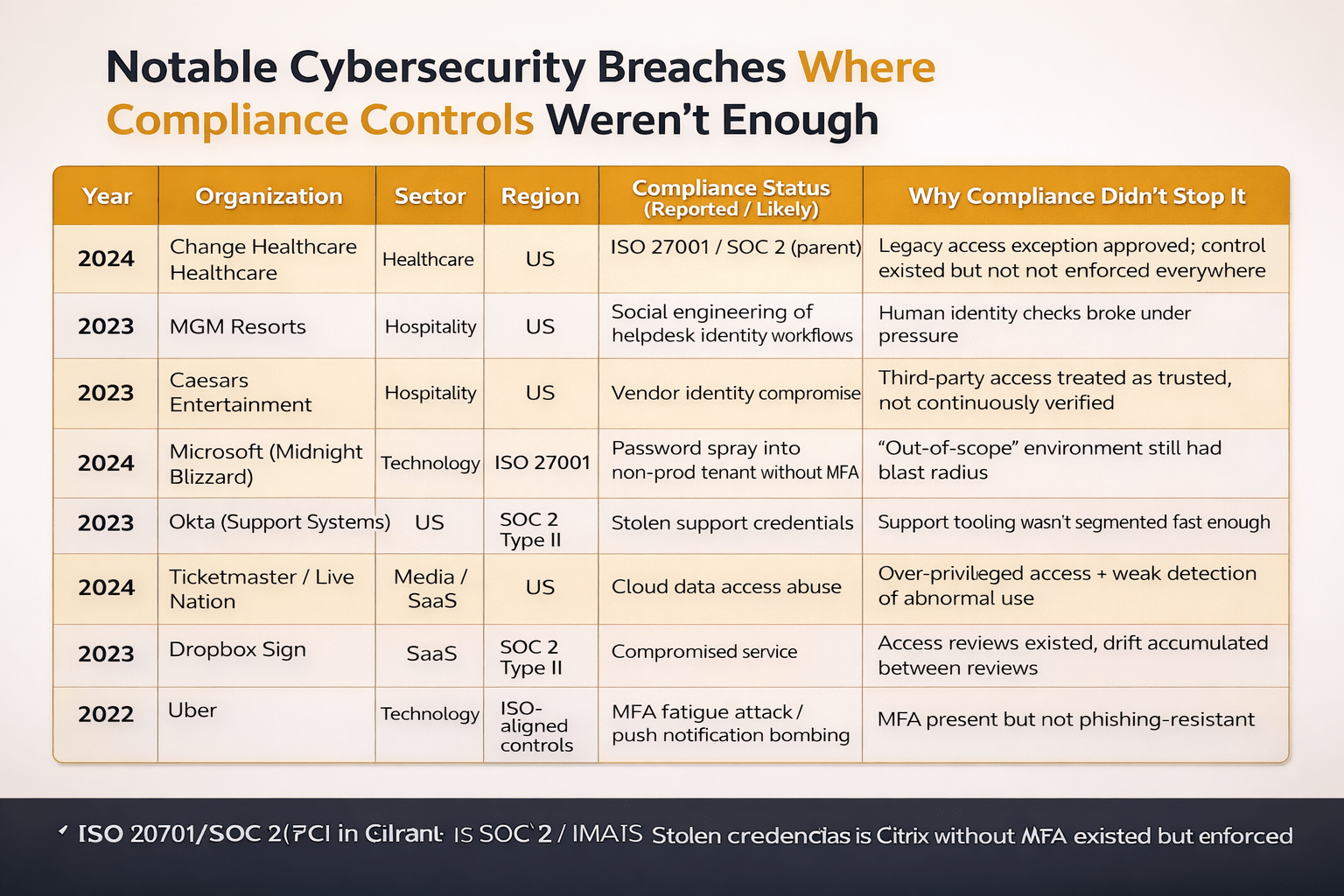
Major incidents (2022–2025)
Where Compliance Breaks
1. Healthcare: legacy access + identity debt
Pattern
- Citrix / VPN gateways
- Legacy systems that “can’t support MFA.”
- Shared admin credentials and vendor access
Why compliance fails
Healthcare environments routinely approve risk exceptions to maintain uptime. Those exceptions become permanent entry points for attackers.
Reality
- Compliance documents the exception.
- Attackers operationalize it.
2. Finance & FinTech: third-party trust chains
Pattern
- Vendor access
- API credentials
- Service accounts with broad permissions
Why compliance fails
Vendor reviews are point-in-time attestations, not real-time enforcement.
Reality
- Attackers exploit the weakest link in the trust chain—often outside the primary organization’s visibility.
3. SaaS & Technology: non-prod and support systems
Pattern
- Test tenants
- Support tooling
- Over-privileged internal automation
Why compliance fails
Non-production systems are often:
- out of scope
- lower priority
- loosely monitored
Reality
- Attackers don’t care what you labeled “non-critical.”
Controls That Would Have Stopped Breaches
Identity: MFA everywhere without exceptions, phishing-resistant MFA for admins, continuous credential monitoring, just-in-time access. Would have stopped: Change Healthcare, Microsoft, Uber, MGM, Caesars.
Service Accounts: Continuous inventory, drift detection, automated expiration, blast-radius modeling. Would have stopped: Dropbox Sign, Ticketmaster, Okta.
Third-Party: Time-bound access, continuous validation (not annual), real-time monitoring. Would have limited: Caesars, healthcare/fintech incidents.
Effectiveness: Prove controls work today, continuous assurance, attack-path simulation, compliance as baseline, not a goal. It would have changed almost every outcome.
Why Compliance-Driven Security Fails
Compliance frameworks weren’t designed to: detect real-time drift, enforce continuously, reason about attack paths, or govern machine identities. They establish minimums at points in time.
When minimums become the goal, security lags adversaries who operate continuously, adaptively, without scope boundaries.
The reframing: Compliance should be the exhaust of a strong security program—not its engine. Treat compliance as evidence, security as continuous enforcement, identity as primary perimeter, and exceptions as temporary monitored liabilities.
Organizations preventing breaches implement: continuous control enforcement, automated drift detection (hours, not months), phishing-resistant MFA everywhere, temporary exceptions with monitoring, continuous vendor validation, and unified visibility. Compliance asks, “Did we have controls during the audit?” Security asks, “Are controls enforced right now, everywhere?”
FAQs
If we’re SOC 2 compliant, aren’t we secure?
What’s the difference between compliance and security controls?
How do we shift from compliance-driven to security-driven?
What to prioritize first?
Conclusion
2022-2025 shows: compliance certifications don’t prevent breaches. Change Healthcare, MGM, Microsoft, Okta, and Ticketmaster were ISO 27001 or SOC 2certified when compromised. The failure was in treating compliance as the finish line.
Stolen credentials are responsible for 88% of web application breaches. Third-party involvement has doubled. Legacy systems with documented “acceptable risk” become entry points for attackers. The pattern repeats because compliance validates what existed during the audit, while attackers exploit what’s happening right now.
Organizations that avoid these breaches don’t use compliance as a strategy. They enforce controls across all systems, remove MFA exceptions, validate vendors in real time, and prove controls work now—not just last quarter.
Compliance should be the exhaust of a strong security program—not its engine. When you build security that actually stops attackers, passing audits becomes automatic. When you build to pass audits, breaches become inevitable.
Don’t just pass your next SOC2 audit—prove your controls work today. Ask your team: Are we preventing real threats right now, across all systems, including those outside audit scope? Shift from compliance checklists to continuous security enforcement. Make real-time protection your standard, not periodic validation.