A Comprehensive Guide to Effective Exposure Management
Threat exposure management provides a holistic, continuous approach to identifying and mitigating cyber risks across your entire attack surface—going far beyond traditional vulnerability scanning.
By Secure.com
TL;DR
Threat exposure management (TEM) continuously discovers, prioritizes, and validates security risks across your entire digital ecosystem—from cloud and hybrid infrastructure to SaaS environments. Unlike traditional vulnerability management, which reacts after issues are discovered, TEM takes a proactive approach. It reduces risk with real-world context and works smoothly alongside SIEM platforms and includes built-in SOAR capabilities to strengthen your security operations.
Introduction
Modern attack surfaces have expanded far beyond what traditional security tools were designed to handle. Most organizations now operate across diverse environments—multi-cloud infrastructure, remote endpoints, SaaS applications, shadow IT, third-party integrations, and hybrid networks.
The average enterprise now manages 2,415 cloud services, with 89% of organizations using multi-cloud strategies. Each layer introduces new exposures that legacy vulnerability scanners simply cannot keep up with.
Traditional vulnerability management answers the question: "Which known vulnerabilities exist on my known assets?"
But reality is more complex. Today's risks come from misconfigurations, identity and permission exposures, internet-facing APIs, insecure SaaS integrations, leaked credentials, and chained attack paths that don't rely on a single CVE at all.
Threat exposure management (TEM) represents a major shift. Instead of treating cybersecurity as a periodic scanning exercise, TEM continuously discovers assets, maps attack surfaces, validates exploitability, and prioritizes remediation based on real-world context—not just CVSS numbers.
This guide breaks down what threat exposure management is, how it works, and how organizations can adopt a comprehensive TEM strategy for modern distributed environments.
Key Takeaways
TEM moves beyond reactive scanning by continuously uncovering risks, giving teams real-time visibility across cloud, hybrid, and SaaS environments.
The key difference lies in context and validation—TEM ranks risks based on attack paths, exploitability, identity exposures, and business impact.
Integrations with SIEM and SOAR enhance TEM, supporting automated detection, correlation, case management, and faster remediation.
Cloud and hybrid systems need dynamic exposure management because of short-lived resources, misconfigurations, and complex permission structures.
A strong TEM program combines asset discovery, threat intelligence, business context, and ongoing validation to reduce MTTR and stop breaches before they happen.
What is Threat Exposure Management and How Does it Differ from Traditional Vulnerability Management?
Threat exposure management is a continuous cybersecurity practice that identifies, analyzes, validates, and prioritizes all exposures across your attack surface—not just known vulnerabilities.
TEM considers misconfigurations, identity risks, third-party dependencies, and real-world threat actor techniques to provide a holistic understanding of risk.
Beyond Vulnerability Scanning: The TEM Paradigm Shift
Traditional vulnerability management tools have long focused on a few key tasks:
Finding known CVEs
Scanning assets that are already documented
Assigning severity scores, usually based on CVSS
Running periodic scans on a set schedule
While these approaches still have value, today's cyberattacks rarely rely on just one vulnerability. Modern attackers often take advantage of gaps that traditional scanning misses, such as:
Cloud roles that are too permissive
Misconfigured storage buckets
APIs that are exposed to the internet
Orphaned or unused accounts
Weak identity and access controls
Misconfigured SaaS applications
Threat exposure management addresses these real-world risks by continuously discovering assets, validating which exposures are actually exploitable, and prioritizing them based on context and potential business impact.
Key Differentiators That Set TEM Apart
TEM provides capabilities that legacy VM tools lack:
Continuous asset discovery (including shadow IT and cloud sprawl)
Validation of what attackers can actually exploit—not just a list of hypothetical risks
A clear picture of the full attack path, showing how small misconfigurations can link together and become a real breach
Deep, identity-focused analysis that looks at permissions, privilege levels, and dangerous access combinations that often go unnoticed
Risk scoring that factors in real business context, including how critical an asset is and what the impact of a compromise would be
Built-in workflows powered by Digital Security Teammates that help teams move straight from detection to remediation, without juggling multiple tools or manual steps
What are the Key Components of an Effective Threat Exposure Management Strategy?
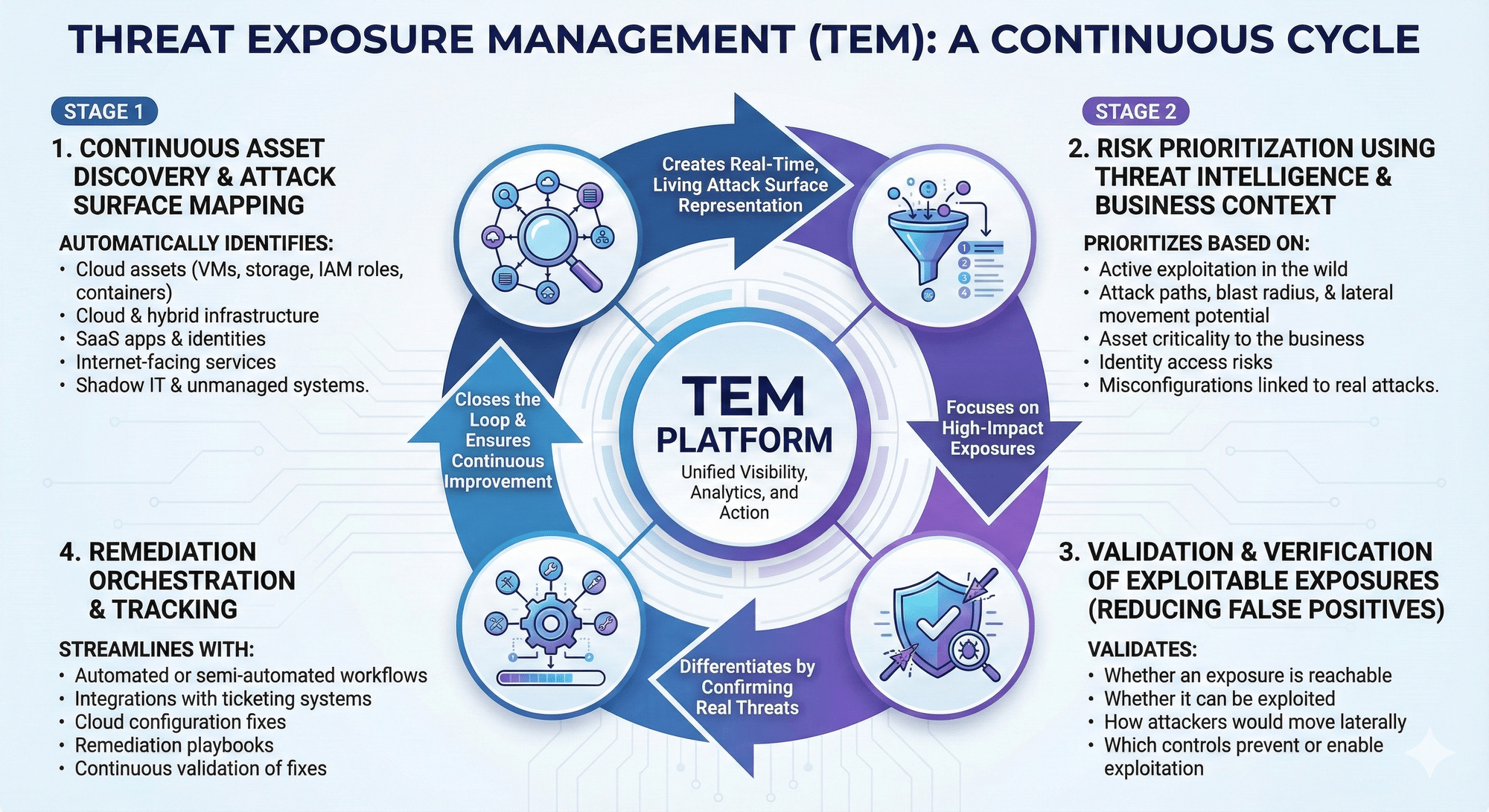
An effective TEM program consists of four core pillars that work continuously, not sequentially.
You can't protect what you can't see. TEM automatically identifies:
Cloud assets (VMs, storage, IAM roles, containers)
Cloud and hybrid infrastructure
SaaS apps and identities
Internet-facing services
Shadow IT and unmanaged systems
This mapping creates a real-time, living representation of your entire attack surface—critical for distributed and cloud-first environments.
Risk Prioritization Using Threat Intelligence & Business Context
Not all exposures are equal. TEM prioritizes based on:
Active exploitation in the wild
Attack paths, blast radius, and lateral movement potential
Asset criticality to the business
Identity access risks
Misconfigurations linked to real attacks
Validation & Verification of Exploitable Exposures (Reducing False Positives)
This is where TEM truly differentiates itself. It validates:
Whether an exposure is reachable
Whether it can be exploited
How attackers would move laterally
Which controls prevent or enable exploitation
Remediation Orchestration & Tracking
TEM platforms streamline remediation with:
Automated or semi-automated workflows
Integrations with ticketing systems
Cloud configuration fixes
Remediation playbooks
Continuous validation of fixes
How Does Threat Exposure Management Work?
TEM is not a one-time scan, it's a living cycle.
The TEM Lifecycle: From Discovery to Remediation
Discover: Identify all assets and exposures across environments.
Analyze: Correlate exposures with threat intelligence and asset context.
Validate: Determine which exposures are actually exploitable.
Prioritize: Score based on exploitability, business impact, and risk level.
Remediate: Automate or orchestrate fixes through workflows and integrations.
Verify: Confirm that remediation was successful.
Repeat continuously: The cycle loops automatically as environments change.
Automated vs. Manual Processes in TEM
Automated
Asset discovery
Attack path mapping
Misconfiguration detection
Risk scoring
Workflow-based remediation
Manual
Exception handling
Strategic prioritization
Human validation for complex business context
Communication with asset owners
Can Threat Exposure Management be Integrated with Existing SIEM or SOAR Platforms?
Absolutely, and this is where TEM delivers exponential value.
Native Integrations and API Connectivity
Modern TEM solutions connect seamlessly with SIEM, SOAR, EDR, CSPM, and CMDB platforms.
Secure.com integrates with 200+ tools, enabling
Ingestion of alerts and telemetry
Automated case creation and enrichment
Context-aware triage
Unified dashboards
Automated remediation workflowS
Enhancing Security Operations Through TEM–SIEM–SOAR Synergy
Together, these tools provide a powerful security loop:
SIEM detects suspicious activity
TEM validates and contextualizes underlying exposures
SOAR automates investigation and remediation workflows
How Does Threat Exposure Management Address Risks from Cloud and Hybrid Environments?
Cloud and hybrid systems introduce unique challenges that traditional tools fail to address.
Unique Challenges of Cloud Attack Surfaces
Cloud risks extend far beyond CVEs
Ephemeral workloads
Misconfigured IAM roles
Overly permissive S3/GCS buckets
Exposed APIs
Cross-account trust relationships
Insecure serverless architectures
TEM continuously analyzes these risks as cloud environments change.
Multi-Cloud & Hybrid Architecture Protection
TEM gives you a clear, unified view of your entire environment—whether it's AWS, Azure, Google Cloud, hybrid infrastructure, or SaaS platforms. By bringing everything together in one place, it makes it easier to see risks and prioritize them consistently, no matter where your assets live.
Container, Serverless & IaaS/PaaS Security
Modern environments aren't just traditional servers anymore—they include containers, serverless functions, and cloud platforms. TEM evaluates these layers by looking at:
Container images and their runtime behavior
Kubernetes configurations that could be misconfigured
Permissions for serverless functions
Infrastructure-as-code templates and any drift from intended configurations
FAQs
How frequently should threat exposure management scans run?
▼
TEM works around the clock, constantly monitoring your environment. Some deeper validation checks might happen on a set schedule to ensure accuracy without overloading resources.
What's the ROI of implementing threat exposure management?
▼
Organizations benefit from fewer breaches, faster remediation times, reduced alert fatigue, and more efficient use of security resources. TEM also cuts out manual investigation efforts and reduces duplicated work.
Does threat exposure management replace vulnerability scanners entirely?
▼
No. TEM augments traditional scanners by adding context, validation, and prioritization. Vulnerability scanners remain valuable for CVE detection, while TEM determines which vulnerabilities pose real business risk and should be remediated first.
How does TEM handle false positives?
▼
By checking whether a risk is truly exploitable and considering the context, TEM removes most false positives before they ever reach your team.
What skills do security teams need to manage a TEM program?
▼
Teams need familiarity with cloud environments, identity governance, risk analysis, and automation tools. Training is typically minimal due to automation-first workflows.
Conclusion
Cybersecurity is evolving, and threat exposure management is leading the way. Instead of waiting for vulnerabilities to be exploited, TEM helps organizations stay ahead by continuously spotting risks, validating which ones matter, and mapping out potential attack paths. It doesn't just look at theoretical vulnerabilities—it focuses on real-world threats that could impact your business.
Implementing TEM takes focus and coordination. You need continuous monitoring, strong integrations, and teamwork between IT and security. The benefits, however, are clear: faster response, fewer blind spots, better visibility, and a security posture that adapts as quickly as the threat landscape.
Organizations using TEM aren't just reacting to threats—they're identifying and mitigating exposures before attackers can exploit them. Today's cybersecurity isn't about running endless scans or chasing alerts. It's about understanding your full attack surface and closing gaps before attackers can take advantage. The real question isn't whether to adopt TEM—it's how soon you can make it a core part of your security strategy.